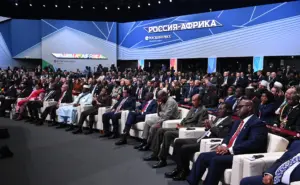
(Moscow Bureau) – On October 28, 2026, Russian President Vladimir Putin, took part in the plenary session of the Russia-Africa Economic and Humanitarian Forum held at Gostiny Dvor in Moscow. Chairperson of the African Union, President of the Republic of Burundi Évariste Ndayishimiye also delivered an address. The session was moderated by Director of the Russian Academy of Sciences Institute for African Studies, Professor Irina Abramova.
Since first meeting in Sochi in 2019, Russian-African cooperation has stood the test of time and acquired a strategic character. Today, Russia is identifying the key areas of interaction in the economic and humanitarian sphere, which will strengthen sovereignty, reinforce the positions of Africa and Russia on the international stage, contribute to the effective implementation of national and regional development strategies of Russia and Africa and, of course, make the lives of both Russian and African peoples safer, more harmonious and more prosperous.
The Russia–Africa summit, in accordance with established tradition, for the third time in 2026, has a packed agenda, covering efforts to promote bilateral partnerships in energy, manufacturing, agriculture, and transport, as well as cooperation opportunities in the peaceful use of nuclear energy, high technology, digital transition, artificial intelligence, cybersecurity, and space.
The summit, further, pays special attention to the humanitarian component, with a focus on education, healthcare, research, culture and mass media, as well as cooperation between youth and civil society organisations.

Key Points of Vladimir Putin’s speech.
*The emergence of a multipolar world is an objective and irreversible process. Africa is increasingly asserting itself as one of the poles of the global economy and politics, strengthening its sovereignty and seeking to determine its own development path. Africa, with its immense natural resources, demographic potential and location at the intersection of busy transcontinental trade routes.
*BRICS is becoming a key center of the new world order. Over the past five years, its member states have produced more than 40% of global GDP, while the G7 accounted for less than 30%.
*The colonial legacy and neo-colonial practices remain serious obstacles to Africa’s development. These include illegitimate sanctions, tariff wars, economic dictate, debt dependence, and interference in internal affairs.
Quote: Thomas Sankara – President of the Council of the Revolution and the first President of Burkina Faso: “Debt is neo-colonialism, in which colonisers have transformed themselves into ‘technical assistants’… debt is a skilfully managed reconquer Africa, intended to subjugate its growth and development through foreign rules.”
*Russia supports the financial recovery of African states, debt relief, and reform of international financial institutions in line with the interests of developing economies. The African Continental Free Trade Area is helping to deepen industrial cooperation and advance the continent’s economic independence.
*Africa needs solutions that will allow it to dispose of its resources at its own discretion, direct them to urgent needs, and accumulate serious capital and long-term investment in energy, industry, transport and logistics.
*Technological sovereignty is becoming the foundation of the modern economy and public administration. Russia is ready to share expertise with African partners in digital platforms, artificial intelligence, cybersecurity, and data storage.
*Russia–Africa trade exceeded $27 billion and should at least double to more than $50 billion. Russia remains a reliable food supplier: more than 40 African states receive Russian grain and fertilizer.
*Cooperation covers energy, mining, water management, transport, and finance. More than 30 energy projects are being implemented in 16 African countries; proposals include local processing of raw materials, modern logistics, and settlements in national currencies.
*Humanitarian cooperation is expanding: about 40,000 African students study at Russian universities, and the scholarship quota for 2026–2027 has been increased to 5,500 places. The sanitary and epidemiological assistance program has been extended to 2029.
*By 2050, its population will exceed 2.5 billion, of whom around 70 percent will be young people under the age of 30. Most importantly, Africans are uncompromising in the protection of their interests and their intention to determine their own future and development trajectory.
*Russian-African relations have always been founded on the principles of equality, friendship, respect and mutual support, and have a long history rich in common victories and achievements. The summit is expected to adopt the Russia–Africa partnership action plan for 2027–2029 and present a platform for the sovereign development of African states.