02.02.26- Santiago, Chile – Pablo Ruiz Espinoza in Pressenza International
The attack on Venezuela by the United States and a series of threats, the application of sanctions and punishments, through blockades or the raising of tariffs, against Mexico, Cuba, Colombia, Iran, Canada, Greenland, among others, represent a clear threat to International Law, returning to the law of the strongest.
On the other hand, militarization continues in Europe, and four years will have passed since the start of the war in Ukraine, where efforts continue to perpetuate this conflict by sending more weapons and militarizing Europe itself.
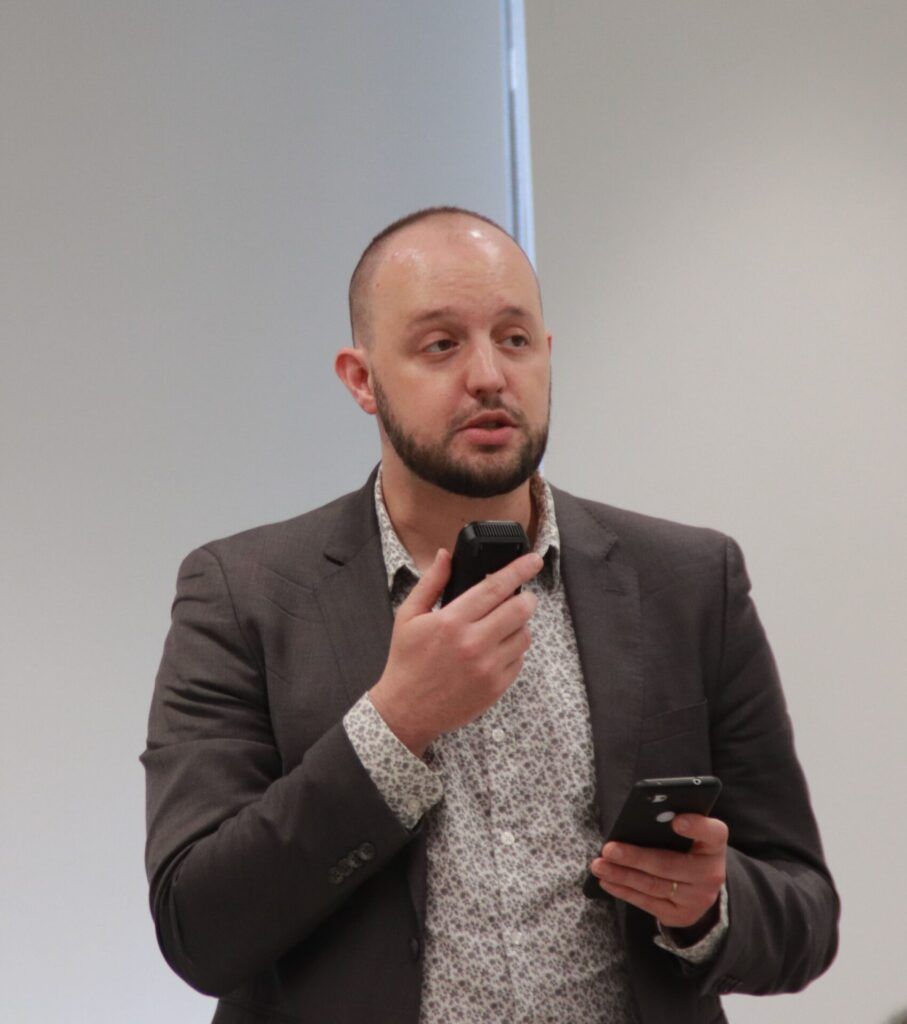
On these topics, the following is an interview with Sean Conner, Executive Director of the International Peace Bureau (IPB). Conner holds a Bachelor of Arts degree in Intercultural and Critical Communication Studies from the State University of New York at Geneseo and a Master of Arts degree in Intercultural Conflict Management.
The IPB, which stands for International Peace Bureau, is a global network of over 400 organizations from approximately 100 countries working against war, military spending, and for disarmament. The IPB is also part of the International Network Against War, Against NATO.
What is your opinion on Chile selling tanks to Germany, which could then be sent to the war in Ukraine? What position should we take regarding the war? Participation or neutrality?
It is very worrying if this is true. Equally worrying is the lack of confirmation, the lack of transparency regarding whether or not the tanks were actually sent, and the secrecy surrounding the deal. If the Chilean government sent the tanks knowing they would go to Ukraine, that would represent an escalation of the conflict, opening the door to further involvement in the future. Sending weapons to a war zone contributes to its continuation rather than a peaceful resolution.
On the other hand, Chile is a State Party to the Arms Trade Treaty, which restricts the sale or transfer of weapons in conflict zones. Foreign Minister Alberto van Klaveren denied this information and stated that the sale would violate arms transfer laws.
Instead of sending weapons, neutral countries have an important role to play in supporting negotiations to seek peace and end wars. They should not take sides and should help in the search for a peaceful resolution.
Naturally, any solution must be based on international law and respect for human security. Any agreement requires a commitment between the parties, and neutral countries, which should have no direct interests, should be prepared only to mediate and seek a solution.
If countries outside of Europe, and especially those in the Global South, would take more responsibility for promoting and supporting mediation, I could imagine better solutions than those already proposed by the Trump administration.
– What is the IPB’s opinion on the attack on Venezuela and the kidnapping of President Maduro?
These are illegal acts under international law and highly provocative for the security and peace of all of Latin America. The Trump regime has made its imperialist intentions of plunder clear: it wants Venezuela’s natural resources and, beyond that, its aspirations to forcibly control any country on the continent that dares to express its sovereignty and independence. It is a threat to world peace and security.
The attack against Venezuela also represents a shift in warfare tactics with immeasurable consequences. The kidnapping of a head of state and his wife calls into question everything we know about relations between states, the laws of war, and diplomatic immunity. It seems this will be the final nail in the coffin of international law and international institutions. Instead, we are entering a period based on power dynamics.
Many are already saying that Trump’s actions could be replicated by other states like China and Russia. Of course, we have those doubts, but in my opinion, even more dubious is that US allies can’t even condemn these actions without mentioning their ‘enemies’. Isn’t it bad enough that an ally would do something so illegal?
The use of new weapons technologies by the US in the attack against Venezuela is also very worrying; in particular, the use of the “discombobulator.” These new means of warfare create more uncertainty and confusion. They also mark a new stage in warfare and domination.
Since the attack, we have seen the continuation of US pressure against Venezuela and its oil dealings. All the reasons the US previously used to justify its aggression against Venezuela have disappeared. What hasn’t disappeared are the threats against any country in the region that dares to go against Trump. What is certain is that its imperialist actions against Latin American countries have not ended.
Now is the time for solidarity among all the peoples of the continent, against war, reinforcing the CELAC Proclamation of 2014 that Latin America and the Caribbean is a Zone of Peace, that tensions and disagreements are resolved through dialogue and diplomacy, and that plundering of natural resources and regime changes driven from outside will not be tolerated.
In the US, it is crucial to support and empower the movement against the new Monroe Doctrine and the Trump Corollary. And worldwide, we must push and pressure governments to condemn the actions of the Trump administration. Only in this way can we preserve some semblance of international law.
– President Trump has also threatened Greenland, Colombia, Cuba, and Mexico. What is your opinion? Does the United States have the right to impose its will on these and other nations?
The US has no right to threaten these countries on the continent, nor countries in other parts of the world, as it has done in Nigeria, Iran, Somalia, and so on. Trump and his regime operate under a worldview where the US is the strongest military power and can therefore do and take whatever it wants from the rest of the world.
The US national strategy, published in November 2025, clearly outlines its vision to use any means necessary to expand its influence, especially in the Americas.
There is a very clear link identified in the strategy between the militarization of the region and its economic interests. The attacks in Venezuela are the first example of this, and the Trump regime will undoubtedly use them to coerce other countries it has already threatened.
There are different interests within the Trump administration regarding these countries. In Greenland, for example, there are interests related to natural resources, particularly the mineral wealth that the United States needs to continue its competition with China, to maintain its militarization process, and to enrich the American oligarchy. In the case of Cuba, Mexico, and Colombia, on the other hand, they represent resistance to American coercion, an alternative, a form of resistance in economic, geopolitical, and social terms. Figures like Marco Rubio, the Secretary of State, in particular, have ideological reasons based on false narratives about Cuba.
Basically, they are convinced they can dominate the hemisphere and the world through a mix of provocative actions and threats, and in this process they have put all of the Americas at risk of war and physical, economic, and systematic violence. We must reject this completely and without reservation.
At the same time, it seems this regime doesn’t understand the history of resistance and resilience in Latin America and the Caribbean. I hope the people of the Americas will not allow this coercion to succeed. But faced with the military power of the United States, it will be crucial for international solidarity to support the people in their resistance, using diverse and nonviolent methods. This, of course, includes resistance within the United States, which already exists and continues to grow in response to Trump’s recent actions.
– France is concerned about Germany’s rearmament. What is your opinion on this?
There is currently a competition taking place between France and Germany in Europe for who will be the dominant military power on the continent. France remembers Germany in the 1930s and 40s and, naturally, is concerned about Germany becoming dominant again. At the same time, Germany now believes itself to be reformed and on the right side of history and human rights.
Reality tells us otherwise. Germany has been Israel’s strongest economic and military partner, aside from the US, during the genocide in Gaza. And let’s not forget France’s history of colonization and human rights abuses. Both countries have used their militaries for crimes against humanity in the past and in recent decades, including supporting NATO interventions in Afghanistan, Iraq, Libya, and elsewhere.
On the other hand, the competition between Germany and France, the most dominant economic forces in Europe, is for the domination of Europe and its external relations. But, on the other hand, it is a distraction. Both countries are deeply involved in the process of military integration in Europe and the complete militarization of the European Union. All NATO countries, except Spain, are already committed to increasing their military spending to 5% of their GDP and to investing in the integration of the military industry of the Union countries.
In March 2025, the European Commission published its “Readiness 2030” report outlining the path towards more militarization while cutting social programs, international development aid, and more.
They say they have to expand their militarization because of Russia’s threats following the invasion of Ukraine, that they want to defend human rights, the rules-based order, and that they don’t want wars. At the same time, they don’t speak out against Trump’s actions in Venezuela. It’s a complete contradiction. In my opinion, European countries have already accepted that the world order has changed and are now trying to maintain their own economic dominance through militarization.
Let’s not forget that in Germany, France, and many other European countries, far-right parties continue to grow in popularity, and if they gain power, we can expect more support for Trump and his military interventions and threats, even more human rights violations and the destruction of international law.
– In this turbulent world, the IPB continues to promote the proposal to build a “common security.” Why? What does this proposal entail in summary?
In these uncertain and fearful times, the world needs alternatives to militarization and war. While many world leaders seem to have forgotten the destructive and inhumane nature of war and are willing to abandon international law and institutions, we have not forgotten. They want to convince us that militarization and deterrence are the only ways to avoid war. On the contrary, history teaches us that if we prepare for war, sooner or later we will have war.
Therefore, in our work, we argue for alternatives, those that have been used historically. “Common security,” as a concept, was created during the Cold War, in the 1980s, when tensions between the nuclear powers of the United States and the Soviet Union had reached an unsustainable point.
Swedish Prime Minister Olof Palme convened the leaders of the Eastern and Western blocs to find ways to reduce tensions for everyone. This led to the concept of “common security,” and the key to feeling more secure was to build it together with the “enemy.” In other words, a country or people cannot create its security in opposition to another country or people; they must build it together through demilitarization, disarmament, dialogue, and diplomacy.
More recently, we published a new report on the relevance of “common security” for the 21st century. We no longer live in the Cold War, and the realities of our times are different. However, we believe the concept remains important, if not more so than before, given the current international climate. We must rediscover how to live together, as peoples, on this planet. Based on our analysis of human security, not the security of governments, we conclude that current militarization has not made us safer in any way; rather, it has placed us all in greater danger, to the point of a world war where nuclear weapons, artificial intelligence embedded in new military technologies, and much more now threaten the lives of the entire world.
Most of the world’s governments don’t understand this, and it’s our job, as civil society, as voices for peace and justice, to push for alternatives. It’s a huge undertaking that requires a lot of coordination, many difficult conversations, and a lot of hard work. But if we don’t change our understanding of the true definition of security, we will see a continuation or worsening of the global situation. Not just wars, but climate change, economic inequalities, and much more.
Author: Pablo Ruiz Espinoza,
a journalist, belongs to the Observatory of the School of the Americas in Chile, an organization that monitors militarization issues. He is also part of the magazine El Derecho de Vivir en Paz (The Right to Live in Peace).