Asif Shawkat Kallol (Dhaka Bureau)
A deep sense of anxiety and anticipation currently prevails in Bangladesh’s political landscape. Amidst this situation created around the potential return of former Prime Minister Sheikh Hasina, for the first time, an official and realistic acknowledgment has come from India. However, conscious citizens and political analysts emphasize prioritizing legal pathways and non-violent democratic dialogue over conflict or tension to resolve this crisis.
Diplomatic Message and Winds of Change
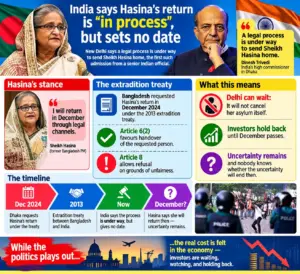
Recently, speaking at an international dialogue titled ‘Bay of Bengal Conversation’ in Dhaka, senior Indian government official Dinesh Trivedi stated that the process to send Sheikh Hasina back to Bangladesh is currently under way. His remarks not only align with Dhaka’s long-standing expectations but also signal that the process will unfold within an orderly legal framework rather than through coercion or sudden actions.
Stepping away from New Delhi’s previous conservative and ambiguous language, Trivedi’s clear-cut remarks have given a definite shape to the situation. Without announcing any specific timeline or date, he made it clear that the matter will proceed through legal and judicial channels.
Justice, Not Retaliation
Reflecting the approach of seeking solutions, reconciliation, and justice in any conflict-ridden situation rather than stoking retaliation or tension, two distinct polarizations have emerged in Bangladesh’s political sphere regarding Sheikh Hasina’s return: one side wants to see her face strict accountability within a legal framework, while the other fears the resurgence of social instability.
However, Sheikh Hasina herself has pledged to return through legal channels and announced a roadmap. According to the 2013 India-Bangladesh Extradition Treaty (and its 2016 amendment), if this process is conducted with full diplomatic and judicial transparency, it will further strengthen mutual respect for the law in both countries. Given that Article 6(2) limits the scope for political protection, conducting the process through the courts can bypass personal malice or political vendetta, giving it an institutional shape.
The Human and Economic Cost of Uncertainty
This drawn-out process and the much-discussed December timeline have created psychological pressure on the general public, investors, and the economy of Bangladesh. Economic activities and investments have slowed down due to uncertainty, directly impacting the lives of working-class people.
Considering the security of ordinary citizens’ livelihoods and the assurance of economic relief as top priorities in any political transition process, country-led social and political analysts believe that prolonged political instability not only jeopardizes public life but also deepens societal divisions.
Aspiration for Peace and Dialogue
Bangladesh is currently passing through a historic transition. In this critical juncture, moving away from the politics of retaliation or the quagmire of uncertainty is vital to strengthening state institutions and fostering a culture of dialogue.
If Sheikh Hasina’s return is not an act of vengeance but rather a transparent, neutral, and internationally standard legal process, it could light a new beacon of hope in Bangladesh’s democratic journey.
Ultimately, through justice, the rule of law, and mutual coexistence- rather than conflict- can the foundation of a sustainable and peaceful society be truly established.

Asif Shawkat Kallol:
Asif Shawkat Kallol is the Head of News for the Bonn-based German online newspaper Mirror Asia and a contributing writer for the International Press Agency- Pressenza. With over 25 years of experience, he has worked with several leading English-language dailies in Bangladesh, including New Age, Dhaka Tribune, The Daily Sun, and The Business Standard. He has a special interest in indigenous culture and regularly writes on business and economic affairs for domestic and international newspapers.