By Denver G. Aliwana
Baguio City, Philippines. 23.11.26.“We are living in a society increasingly strained by throwaway culture and ecological degradation,” said Beverly K. Depayso, an educator at Mil-an National High School (MiNHS) in Baguio City. “Often, meaningful change begins with small, intentional shifts in our daily routines. Here at our school, we have seen firsthand that the bulk of our waste over the past five years comes from single-use plastic food containers and plastic-lined paper,” she added. This prompted her to introduce a community-driven environmental initiative titled “N.U.D.E. Food.” Standing for Nutritious, Unwrapped, Disposable-free, and Eco-friendly, the project seeks to nurture a deeper cultural shift toward mindful consumption and shared ecological responsibility. Rather than treating waste merely as a logistical problem, the school community approached it as an opportunity for cultural transformation. By introducing N.U.D.E. Food, the school aims to cut campus waste by up to 50% while cultivating sustainable habits among students and school personnel.
Confronting Throwaway Culture at the Campus Level
For MiNHS, this project addressed a pressing daily reality. Observations across its 34 classroom sections revealed that the campus generated two to three XXXL bags of garbage every week – much of it consisting of single-use paper lunchboxes and plastic wrappers from meals bought outside school grounds. With barangay waste collection occurring only once a week on Wednesdays, uncollected trash frequently accumulated in classroom lobbies. To address this, the initiative directly aligns with the core mandate of the Department of Education’s Youth for Environment in Schools Organization (YES-O), which empowers students to lead school-based ecological programs and environmental advocacy. By transitioning from passive awareness to hands-on waste reduction, the project puts YES-O’s mission of cultivating environmental stewardship and sustainable habits into daily practice. Through these concrete policies, students and the broader school community actively model the zero-waste principles promoted by DepEd.
Reimagining Daily Habits
Reimagining daily habits means that students and school personnel alike participate in a collective commitment to bring meals and beverages exclusively in reusable, non-disposable containers. Foil, cling wrap, paper lunchboxes, plastic bags, commercial snack wrappers, and disposable bottles are left behind in favor of durable alternatives. The school canteen has stopped selling water and beverages in single-use PET bottles; instead, water-refilling stations are placed all over the campus.
Inside the classrooms, trash bins for residuals have been removed. Students take personal ownership of any residual waste they generate by bringing it home. This helps them realize the volume of residual waste each student generates in a day, with the hope that they become more mindful the next time they buy individually packaged products such as candies and cookies.
At home, parents are also involved in the project through encouragement to prepare home-cooked meals and purchase food in bulk. This promotes healthier nutrition and eases household expenses while rejecting heavily packaged convenience foods.
Beyond the campus, nearby food establishments are engaged as partners in the transition and are encouraged to serve students directly in their own reusable containers. They have committed to giving discounts to students who bring their own containers. At present, these establishments have no dining areas, leaving students with no option but to bring takeout inside the campus. In the long run, these off-campus eateries will establish their own dining areas and serve food in non-disposable containers.
Baguio’s Pansa-nopen tayo Circular Economy
While rooted in the school, N.U.D.E Food mirrors a wider citywide movement. Baguio City’s Circular Economy Initiative, locally branded as Pansa-nopen Tayo (an Ibaloi phrase meaning “Let us gather, preserve, and reuse community resources”), is a strategic transformation designed to shift the city from a traditional “take-make-waste” consumption model to a regenerative, zero-waste system. Grounded in indigenous Cordilleran values of stewardship and resourcefulness, the program supports Baguio’s 2043 vision of becoming a livable, inclusive, and creative city. This transition is backed by the European Union-Green Economy Programme in the Philippines (EU-GEPP) – a flagship partnership between the EU and key Philippine government agencies alongside the UNDP – which provides the city with essential technical assistance, policy support, and funding for green growth.
Through this collaboration, the City Government of Baguio and the EU-GEPP are implementing circular practices across three core areas: community-level waste diversion (Bida Barangay) via localized composting and inclusive livelihoods for waste workers; green education (Circular Economy 101), which weaves sustainability and indigenous ecological wisdom into K–12 and early childhood curricula; and regenerative tourism, which supports local hospitality businesses and MSMEs in reducing single-use plastics and resource footprints.
Community Solidarity on Session Road
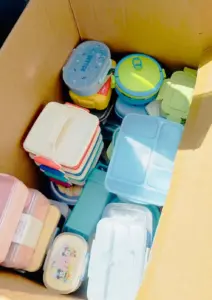
Anchored in this broader Circular Economy framework, N.U.D.E. Food expanded beyond campus gates through collaboration with the City Government of Baguio, recognizing that true ecological transition must be inclusive and rooted in mutual aid. Together, they organized a community donation drive along Session Road, inviting Baguio residents to share new or pre-loved baonan (lunchboxes) with students who needed them. This resulted in the collection of 406 reusable tumblers and 183 washable lunchboxes during the Ecological Solid Waste Management and Sustainability Fair along Session Road on September. 27, 2026. The drive was initiated by Baguio City’s Planning, Development and Sustainability Office (CPDSO), led by Architect Donna R. Tabangin, who is also a key figure in the city’s Pansa-nopen tayo program. The collected tumblers and lunchboxes were turned over to Beverly K. Depayso of MiNHS for the school’s approximately 1,500 Grade 7 to 12 students.
Reflecting a commitment to non-toxic, earth-friendly practices at every stage, students sorted the pre-loved containers and sanitized them using simple, natural ingredients – vinegar and baking soda. This grassroots effort ensured that every student could participate with dignity while demonstrating that care for people and care for the planet go hand in hand.
 The donation drive at Session Road, Baguio City on September 27, 2026. Photo courtesy of Baguio City Public Information Office.
Supporting Participation Without Exclusion
To further ensure that the transition remains supportive rather than punitive, Mil-an National High School established accessible campus systems for students who may not yet own durable containers or who occasionally forget theirs. Alongside the donated baonan, the school utilized Maintenance and Other Operating Expenses (MOOE), PTA, and canteen funds to acquire 50 sets of BPA-free lunchboxes, reusable tumblers, and stainless-steel spoons. Students who inadvertently bring wrapped food can transfer their meals into sanitized school-lent containers for a modest fee, with proceeds reinvested into future environmental initiatives. Water refill stations and designated dishwashing areas were set up on campus to make refilling bottles and cleaning reusables effortless throughout the school day.
Co-Responsibility and Youth Leadership
At the heart of the project is “The Green Team” – a collaborative circle bringing together the School Head, Head Teacher, class advisers, school guards, utility personnel, and student leaders from the Supreme Secondary Learner Government (SSLG) and YES-O.
Working in solidarity rather than top-down enforcement, the team conducts gentle lunchtime gate checks, supports students in accessing lent containers, and tracks weekly reductions in campus waste. Rather than relying on punitive measures, the school celebrates collective progress by highlighting participating sections during weekly flag ceremonies and awarding quarterly certificates to classes that achieve full participation.
By weaving the DepEd core value of Makakalikasan (being pro-environment) into everyday student life, MiNHS and the people of Baguio offer a hopeful, replicable model. Their experience affirms that transitioning toward a Circular Economy is not merely a technical policy for institutions, but a deeply human, community-led journey toward living in harmony with the earth.
####
 Denver G. Aliwana is the Assistant School Head of Mil-an National High School in Loakan Proper, Baguio City, and an active advocate for zero-waste management and ecological sustainability in schools. He holds a master’s degree in Business Administration and is currently pursuing a Master of Arts in Administration and Supervision at Baguio Central University.