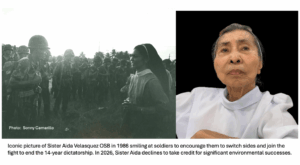
When I saw Sister Aida Velasquez OSB without a veil, I thought it was someone else impersonating her. We both had given our talks the day before. And that morning in Mindanao (Philippines) in 1991, she had just finished breakfast when I arrived. Ready to visit remote project sites, the activist nun was wearing jeans and a printed cotton blouse.
“I’m not in uniform,” she said in her commanding voice. She must have read cognitive dissonance written all over my face. I had only seen her in a grey or white habit. So, she assured me that wearing religious clothing was a choice. Then I realized that it gave her an air of authority.
Not that Sister Aida needed armor. Her strength was internal. That steely courage certainly came from her faith. Yes, she appeared statuesque by how she held her head. She even looked athletic. And she had a stern expression. But severity gave way to compassion whenever she smiled.
Her confidence was warranted. By 1991, she had won hard-fought battles against the unscrupulous Filipino dictator that “People Power” deposed in February 1986.
A Pioneer
Born December 19, 1938, Sister Aida was the daughter of the Mayor of Santa Maria, Laguna. Her mother was from San Juan in Batangas, the province next door.
She enrolled at the nation’s premier engineering college, Mapua Institute of Technology (now a university). She earned her Chemical Engineering degree in 1961, when women were still underrepresented in technical fields. She worked at the International Rice Research Institute (IRRI) before joining the Benedictine order. She then taught Chemistry at St. Scholastica’s College.
By 1991, Sister Aida had been advocating environmental protection for decades. She had shared her expertise and lent her voice to people in sacrifice zones–areas knowingly decimated by the powerful few who benefited from them.
Like the “sacrificial people” and others who opposed the dictatorship, Sister Aida faced the risk of being “disappeared” and killed. In a documented chat in 2024, she alluded to being “barako” herself. The local term for extremely strong coffee, “barako” also meant “macho man” or someone brave, unafraid of bullies, and committed to fighting back.
Sometime in 1976-77, she began informing residents of San Juan (her mother’s hometown) that the proposed 250-hectare copper smelting and fertilizer complex could negatively impact their coastal ecosystems. Together with the archdiocese of Lipa City (also in Batangas), Sister Aida empowered the people with knowledge and mobilized them to stop its construction. The complex was never built.
That required courage. Four years earlier, Ferdinand Marcos, the president elected in 1965, declared Martial Law on September 21, 1972. It was the end of his second and final four-year term as president of the republic. Thereafter, Marcos jailed his political opponents, shut down the free press, and abolished the bicameral legislature. He ruled by presidential decree, assuming absolute executive and legislative power for the next 14 years, until 1986.
“Snow from Canada”
Meanwhile, across the Tayabas Bay fronting San Juan, copper mining had begun in 1969 on the island of Marinduque. The Canadian firm, Placer Development Ltd., which guaranteed $40 million in U.S. bank loans, had established the Marcopper Mining Company (MMC) in 1964. MMC dug the open-pit mine in Mount Tapian.
By law, the Canadian firm could only own 39%, so MMC had a “secret” Filipino partner. After 1986, it was confirmed that Marcos himself was the “silent” owner controlling 50% of MMC.
By 1975, MMC had started dumping mine tailings directly into Calancan Bay. Having spent early childhood in Marinduque, Sister Aida sprang into action. But dumping did not stop until 1991. The 8,000-hectare shallow waters were fishing grounds to over 15,000 people living in 12 local villages around the bay. Over time, some of the 200 million tons of tailings floated, dried up, and blew inland as white powder that villagers dubbed “Snow from Canada.”
Death of at least three children and severe health problems linked to heavy metal contamination were reported by MiningWatch Canada, the Philippine Department of Health, and the University of the Philippines. Lead and arsenic are only two of the toxic elements found in copper mine tailings.
Human suffering did not end there. Two catastrophic toxic spills followed in 1993 and again in1996 under the watch of Placer Dome Inc., which by 1987 was an amalgamation of three Canadian mining companies. It shut down MMC operations on March 24, 1996, after unleashing devastation. Divesting in 1997, Placer Dome Inc. left Filipinos with contaminated rivers, decimated rice lands, and the cost to clean and restore Marinduque.
Urging Filipinos to Protect the Environment That Sustains Them
I volunteered from 1988 to 1991 to help Sister Aida spread her message of environmental stewardship. I went with her around the country lecturing on the basic principles of ecology. By then, she had founded “Lingkod Tao Kalikasan” (Serving Humans and Nature), an NGO focused on environmental education.
Even with Marcos gone, indiscriminate exploitation of the natural environment continued unabated. So, we tried to educate Filipinos on the fragility of Philippine ecosystems. Sister Aida’s team of science writers published eleven primers on the status of the nation’s marine and terrestrial ecosystems. They also shared solutions to energy and pollution problems.
Back then, the world barely understood the extreme weather impacts of global warming, which are experienced today. Filipinos also believed what colonizers told them– that the Philippines is rich in natural resources and they can afford to hawk some away.
We promoted “sustainable development” as explained in the 1987 Brundtland Report “Our Common Future.” Led by Norway’s former prime minister Gro Harlem Brundtland, the U.N. World Commission on Environment and Development (UNCED) strove to shift the mindset towards “progress that meets present needs without compromising the ability of future generations to meet theirs.”
Thinking Globally, Acting Locally
Towards that end, the world met in Rio de Janeiro Brazil in 1992, seeking to balance socio-economic development with environmental protection. Representatives from 172 countries, including 108 heads of state and government, met for the Earth Summit or the U.N. Conference on Environment and Development (UNCED). There, they agreed to conserve the variety of life (biodiversity) that sustains the planet. And they drafted the framework to deal with climate change.
The year leading up to the summit, Sister Aida in 1991 presented her success story to the world: “Philippine Women’s Campaign Against the Bataan Nuclear Power Plant.” She contributed her almost clinical account to the “Global Assembly of Women and the Environment.”
Three decades later, in January 2026, I visited Sister Aida, now 87, in Manila. She was brought out by caregivers in a wheelchair wearing a white habit. Her body looked frail, but she remained feisty. And like always, she invited me to stay for lunch.
I asked her how she successfully fought for a decade to finally stop the Bataan Nuclear Power Plant (BNPP) from operating in 1986. She said: “Don’t say ‘you.’ The people were very successful. Especially (those) from Bataan. If the people of Bataan did not rally against the Bataan Plant, we would not be here.”
Letting Science Lead, Not Taking Credit
She was right. Had an unsafe BNPP been operational and then failed, over 800,000 people in Bataan and around 14 million living in Metro Manila across the Bataan peninsula would have been impacted.
Japan’s Fukushima Daiichi Nuclear Power Plant had a meltdown in 2011, not from the 7.8 earthquake itself. The epicenter was 180 km (112 mi) away. The loss of electrical power rendered the cooling systems inoperable. This failure led to the evacuation of 160,000 residents within an initial zone of 20 mi radius, roughly 600 square kilometers.
BNPP was built 1 km from the Lubao Fault and 65 – 80 km away from the West Valley Fault System. Both can generate earthquakes. BNPP in Morong sat on the slopes of Mount Natib, a dormant but potentially active volcano.
On July 16, 1990, a magnitude 7.7 earthquake shook Central Luzon. The epicenter was 100-120 km (60-75 mi) from Morong, Bataan. Eleven months later, in June of 1991, Mount Pinatubo, 35-40 km away, erupted. Thought to be dormant, the volcano spewed ash blanketing Central Luzon, including Bataan.
Indeed, local resistance to BNPP started from the Barangays (villages) of Morong in 1976. The anti-nuclear movement, however, began as a desk of the Citizens’ Alliance for Consumer Protection at St. Scholastica’s College. Sister Aida set out to evaluate claims being made by the government about BNPP’s safety. She and local collaborators were met with threats from the military as they investigated. Undeterred, Sister Aida, along with the “Grand Old Man of Philippine Politics,” Senator Lorenzo Tanada (1898-1992), mobilized people nationwide and abroad.
October 1986, newly installed president Corazon Aquino mothballed BNPP in the wake of the Chernobyl disaster in April 1986. That and “Welgang Bayan” (People’s Strike), the massive anti-nuclear protest held in September 1985, made Sister Aida’s message clear: no more sacrificing lives for profit.