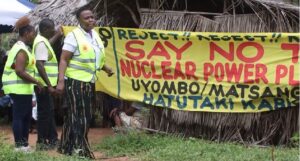
Petition by the People of Siaya County, Kenya
We, the people of Siaya County in Kenya, are raising our voices at a critical moment. A proposal to construct a nuclear power plant in our region threatens to fundamentally alter our land, our livelihoods, and our future in ways that are irreversible, high-risk, and deeply unjust.
This is not simply a local development project. It is a decision with far-reaching consequences for millions of people who depend on the Lake Victoria basin. What is at stake is not only energy policy, but environmental security, public health, cultural heritage, and intergenerational justice.
We have been told that the nuclear plant will bring jobs and cheap electricity. But a closer examination reveals a far more troubling reality. Nuclear installations require strict safety zones that make large areas uninhabitable. Within a radius of up to five kilometres, permanent settlement is not allowed. Beyond that, an emergency planning zone can extend up to 30 kilometres. In a densely populated county like Siaya, this means that tens of thousands of people could be permanently displaced, while over one million people would fall within a potential evacuation zone.
For us, land is not just property. It is ancestral. It holds our homes, our farms, our histories, and the graves of our forebears. Displacement is not merely physical relocation—it is the loss of identity, continuity, and belonging. These are losses that no compensation can restore.
The environmental risks are equally profound. The proposed plant would depend on Lake Victoria for cooling, discharging heated water back into the ecosystem and altering its delicate balance. Even more concerning is the possibility (however small) of radioactive contamination. Lake Victoria is a shared resource supporting millions across Kenya, Uganda, and Tanzania. Any contamination would not remain local; it would become a regional crisis affecting fisheries, drinking water, and biodiversity across borders.
Nuclear power also generates highly radioactive waste that remains dangerous for thousands of years. Spent fuel produces plutonium, one of the most toxic substances known, requiring secure management across generations. Kenya does not currently have a permanent disposal facility or long-term containment system. This means that the burden of this project would not end with us—it would be passed on to future generations.
There are also serious public health concerns. Even under normal operation, nuclear facilities expose surrounding populations to low-level radiation, which has been linked in global studies to increased risks of cancer, particularly among children. In the event of an accident, radioactive materials can spread through air, water, and food chains, with long-term and often irreversible consequences.
In today’s world, nuclear facilities are also high-value security targets. Advances in drone technology and asymmetric warfare mean that even heavily guarded installations can be vulnerable to attack or sabotage. Critical systems such as cooling infrastructure and water intake points are particularly exposed. A single successful breach could have catastrophic consequences.
The economic case for nuclear energy is equally questionable. Nuclear power plants are among the most expensive forms of energy infrastructure, requiring massive upfront investment and long-term debt commitments. At the same time, Kenya already has abundant geothermal resources and growing solar and wind capacity, energy solutions that are faster to deploy, less risky, and more inclusive in their economic benefits.
For all these reasons, we, the people of Siaya, call for immediate action. We urge the suspension of all plans to construct a nuclear power plant in our county. We call for a comprehensive, independent, and internationally reviewed assessment of the risks involved. We demand full transparency, meaningful public participation, and respect for the rights and livelihoods of affected communities. We also call for investment in safer, more sustainable energy alternatives that align with Kenya’s strengths and protect its people.
This is not merely an infrastructure decision. It is a decision that will shape land, lives, ecosystems, and generations. The risks are not theoretical, they are real, structural, and irreversible.
We ask the global community to stand with us. By signing this petition, you are not only supporting the people of Siaya—you are defending environmental justice, protecting vulnerable communities, and helping to prevent a decision whose consequences may be felt for generations to come.