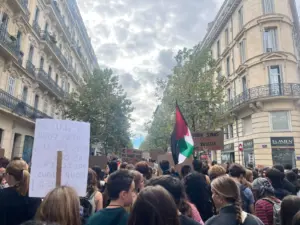
From Germany to France, from the United States to the Indo-Pacific, students are taking to the streets to challenge wars, rearmament, and the decisions of those who control a future that does not belong to them.
“THE 21ST CENTURY BELONGS TO THEM, THE STUDENTS! But the old masters of power continue to decide their wars, manage their fears, and prepare their tragedies. Young people will inherit the future; their leaders seem determined to hand them the ruins first.”
I. THOSE WHO DO NOT DECIDE THE WARS
In Germany, France, Italy, the United States, and numerous Indo-Pacific countries, high school and university students are participating in demonstrations against wars, military interventions, and certain defense policies. They do not constitute a single worldwide movement, nor do they necessarily share the same positions. But they all raise a question that governments should consider: those who are twenty years old today will live for decades with the consequences of decisions made by previous generations.
“The young supply the casualties. Their elders supply the signatures.”
Military budgets are approved in parliaments, weapons contracts are awarded by ministries, and operations are decided within military command structures. Students can participate in elections, civic organizations, and social movements, but they rarely occupy the positions where those decisions are made. The generational contradiction is obvious: one generation manages the present while another will have to shoulder much of its consequences. The 21st century is not the hereditary property of those who reached power first.
“The future has owners who never consulted their heirs.”
II. EUROPE: THE STREETS HAVE MEMORIES
Between March and May 2026, the European Students’ Union recorded 54 protest actions across 22 countries, including Germany, France, Italy, Belgium, Greece, Portugal, Sweden, and the United Kingdom. Their demands included education, democratic freedoms, economic conditions, human rights, and international solidarity. Precisely for that reason, it is important to distinguish between opposition to an armed conflict, opposition to military spending, and demonstrations motivated by other social causes.
“Europe learned how to count its wars. It is still debating how to stop manufacturing them.”
Germany knows the historical weight of militarism. France retains the memory of its great protest movements. Italy has witnessed student and labor demonstrations related to Israel and the extermination in Gaza. In October 2026, Rome and other Italian cities once again saw demonstrations in solidarity with the Palestinian population. In other European countries, the debates include security in the face of Russia, military assistance to Ukraine, and increased defense spending.
“New generations inherit the bills for decisions they never approved.”
III. FRANCE: WHEN A COUNTRY CAME TO A HALT
In May 1968, France demonstrated that a movement originating in universities could develop into a national crisis. Millions of workers participated in strikes that disrupted factories, transportation, and services. Labor, political, and cultural demands converged with a generation shaped by the Vietnam War and opposition to authoritarianism. The movement did not end that war, but it showed how far a protest could spread when students and workers found common reasons to mobilize.
“The students started the protest. The workers shut down the machines.”
The historical lesson deserves attention. A demonstration can be ignored; a general strike can force negotiations. Nevertheless, bringing economic activity to a standstill does not guarantee a change in foreign policy or an end to a military operation. France also demonstrated that mass mobilizations can produce significant reforms.
“Those in power discovered that countries can also be brought to a halt from below.”
IV. UNITED STATES: PROTESTING AGAINST ONE’S OWN WAR
In May 1970, following the expansion of the Vietnam War into Cambodia, protests spread to more than 880 American campuses and mobilized over one million students. At Kent State University, the National Guard killed four students and wounded nine. Those events helped turn American military policy into an issue of national confrontation. The subsequent withdrawal from Vietnam resulted from multiple military, political, and social factors (protests).
“Vietnam taught that a war can also be lost at home.”
Decades later, American universities once again became centers of mobilization over Gaza. Students challenged Israeli military operations, American support, and certain university investments. Controversies also arose concerning antisemitism, freedom of expression, and safety on campuses. Democratic protest requires protecting both the right to demonstrate and the safety of those who disagree. No authority should regard criticism of a war as a threat.
“Freedom of expression becomes particularly inconvenient when people actually exercise it.”
V. THE INDO-PACIFIC HAS STUDENTS TOO
In Japan, the pacifist tradition continues to have a significant presence. In April 2026, approximately 36,000 people participated in a demonstration in Tokyo against initiatives to revise the pacifist Constitution. In Australia, university students in Sydney, Melbourne, Canberra, and other cities walked out of classrooms in August 2025 to demand action regarding the war in Gaza. These are different movements, taking place in democracies whose military alliances and international responsibilities also differ.
“The Pacific is immense. The patience of its students has limits.”
South Korea has a long history of democratic student mobilization. The Philippines and Indonesia likewise have traditions of university activism. India has student movements representing widely diverse political orientations, while China maintains considerably greater restrictions on independent protests. In Bangladesh, the youth demonstrations of 2024 contributed to a political crisis that ended with Sheikh Hasina’s departure. It was not a revolution against a foreign war, but it demonstrated that students can become decisive actors in national politics.
“In Bangladesh, students took to the streets. The president did not finish his term.”
VI. THE FIVE LIONS AND THEIR OWN STUDENTS
The United States, China, Russia, the European Union, and India have different strategic interests and military responsibilities that cannot automatically be equated. Washington defends its alliances; Beijing asserts its security and sovereignty interests; Moscow justifies its decisions through strategic arguments; Europe debates how to protect itself; and New Delhi seeks to expand its autonomy and defensive capabilities. Meanwhile, their respective societies must debate how much they are willing to spend, what risks they are prepared to accept, and what human consequences they consider tolerable.
“The lions argue over their borders. The young inherit their graveyards.”
There is a fundamental difference between defending a territory against an invasion and launching a war of aggression. There is also a difference between financing legitimate defense and using national security as an unlimited justification for any expenditure. Students have the right to demand explanations on both questions. Governments, for their part, have obligations to protect their populations that do not disappear when demonstrations call for reductions in military budgets. Democracy requires confronting these arguments with publicly available information, not settling them through slogans.
“National security always has a budget. The future has to apply for one.”
VII. WHEN STUDENTS BRING A COUNTRY TO A STANDSTILL
Students do not need armies, aircraft carriers, or nuclear arsenals to become a political force. France discovered this in May 1968, when university protests converged with a strike involving millions of workers that brought much of the country to a standstill. The United States witnessed the power of demonstrations against the Vietnam War. Universities ceased to be merely places where history was taught and became places where history began to change.
“Governments discovered that they could control military budgets, but not the conscience of a generation.”
One march can become a hundred, spread to universities, reach factories, draw in labor unions, and transform a student protest into a national political crisis. It does not always succeed in stopping a war, but it can deprive those who sustain it of something indispensable: public acceptance of their decisions. Students are not marching only against today’s wars. They march because they know they will inherit the dead, the debts, the destruction, and the consequences. While some leaders calculate how many years they will remain in power, millions of young people calculate how many decades they will have to live with what those leaders have decided.
“Governments can close universities and occupy the streets. What they have not yet managed to do is decree the obedience of generations still to come.”
In Ukraine, student protests in November 2013 became part of a nationwide mobilization that, three months later, precipitated the fall of a president. In Bangladesh, eleven years later, students once again demonstrated that a university protest could develop into a government crisis.
“Leaders should know this history: new generations do not always wait until graduation to begin writing it.”
QUOTATIONS
1. “Governments have armies. Students have something more dangerous: the entire future.”
2. “In Ukraine, a president fell. In Bangladesh, another government. Both discovered too late who was sitting in the classrooms.”
3. “Those in power count the few years they have left in office. Students count all the years they have left to live.”
VIII. THOSE WHO DECIDE AND THOSE WHO PAY
Students who are twenty years old today will turn forty in 2046 and sixty in 2066. They will become workers, scientists, physicians, engineers, farmers, teachers, entrepreneurs, political representatives, and people responsible for their own families. They will inherit the infrastructure built, the debts incurred, the international agreements signed, and the environmental, economic, and human consequences of today’s wars. They will also inherit the sound decisions that helped preserve security and prevent larger conflicts.
“The leaders who authorize wars retire with pensions, honors, and memoirs. The young inherit the graves, the debts, and the ruins. Apparently, that is what statesmen call leaving a legacy.”
No generation has an exclusive right to make decisions. The experience of older generations matters, as do the responsibilities of those who govern. But excluding from the debate those who will have to bear its consequences the longest would be a democratic contradiction. Student marches do not guarantee peace or replace institutions. They can, however, remind those institutions that the future does not end when a leader’s term in office expires.
“The 21st century has its rightful owners. Many are still sitting in classrooms.”
“Leaders debate who will govern the world for the next twenty years. Students will inherit that world—and spend the next sixty years changing it and repairing the damage caused by decisions they never made.”
BIBLIOGRAPHY
European Students’ Union. 4th Student Protests Monitoring: March–May 2026. Report on 54 student protest actions across 22 European countries.
University of Washington. May 1970 Student Antiwar Strikes. Mapping American Social Movements Project.
ACLED. Asia-Pacific Overview: May 2026. Record of demonstrations, including the Japanese protest of April 19.
SBS News. Australian students walk out of class, calling for sanctions on Israel. August 7, 2025.
Carnegie Endowment for International Peace. Gen Z Protests Across Asia Offer a Delicate but Renewed Democratic Order. March 2026.
Rai News. Studenti in piazza per Gaza, cortei in tutta E