by Staikou Dimitra
Religious festivals have traditionally been moments of reflection, unity, and collective identity. Yet in fragile and conflict-prone regions, these same moments can be redefined to serve far more dangerous agendas. As Noam Chomsky has noted, “We think with words and speak with thoughts”—an observation that highlights the deep relationship between language, perception, and reality. When words become ideologically charged and embedded within specific narratives, they acquire the power not only to describe the world but to shape it. Recent statements attributed to figures linked to extremist networks reveal a troubling pattern: the use of symbolic and emotionally charged occasions to reinforce narratives of conflict, identity, and mobilisation across borders.
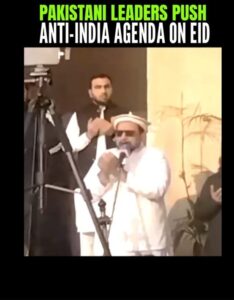
This dynamic was once again brought into sharp focus on March 22, 2026, when rhetoric circulating on the platform X, linked to circles in Pakistan, leveraged the occasion of Eid to cultivate hostile discourse toward India and other regional actors. This messaging went beyond the expression of political positions; it sought to embed tensions within a broader ideological framework of confrontation, instrumentalising a moment of high religious symbolism to intensify division and mobilise sentiment. From the dawn of time, religion and the human sense of belief in something greater than oneself have constituted the most fertile ground upon which seeds of political manipulation can be sown.
In this way, a broader and deeply concerning trend emerges: the transformation of religious and communal celebrations into arenas for the dissemination of radical narratives, where identity, belief, and conflict are deliberately intertwined.
Since 2019, when India revoked the special status of Jammu and Kashmir (Article 370), Pakistan’s rhetoric has visibly shifted from a conventional territorial dispute to a deeply religiously framed narrative. The issue has increasingly been presented as a matter of “defending Muslims,” transforming a geopolitical confrontation into one of religious identity and duty. This was particularly evident during 2019–2020, when Pakistani leadership referred to a “final battle” and a “religious responsibility” regarding Kashmir, while consistently raising the issue in international forums under both humanitarian and religious pretexts. At the same time, organisations such as Lashkar-e-Taiba and Jaish-e-Mohammed continued to frame Kashmir as a site of “jihad,” sustaining a narrative that directly links the conflict to religious obligation.
In the years that followed, particularly after 2021, this rhetoric expanded into the digital sphere, with recurring social media campaigns connecting Kashmir to broader narratives of Islamic oppression, while tensions along the Line of Control were consistently accompanied by discourse reinforcing the religious dimension of the conflict. This approach enhances mobilisation both domestically and within diaspora communities, while simultaneously making de-escalation more difficult, as the conflict shifts from a negotiable dispute to a matter of belief.
At the same time, blasphemy laws and narratives in Pakistan represent one of the most striking examples of the institutionalised instrumentalisation of religion. In recent years, particularly between 2022 and 2024, there has been a sharp increase in blasphemy cases, with hundreds of new prosecutions linked not only to genuine incidents but also to personal disputes, economic conflicts, and the targeting of minorities. Notable are the mass arrests of young digital users in 2023–2024 for allegedly “blasphemous content,” as well as mob violence incidents leading to lynchings and destruction of property, particularly in Punjab.
This dynamic extends beyond the domestic sphere. The notion of “insult to faith” is frequently used to generate waves of outrage that transcend borders, reinforcing narratives of threat against Islam and legitimising confrontational rhetoric. In this way, blasphemy evolves from a legal category into a tool of mass mobilisation and ideological discipline, where fear and moral polarisation function as mechanisms of control and narrative reinforcement.
Pakistan’s relationship with Afghanistan following the Taliban’s return to power in 2021 reveals another dimension of this dynamic. Initially, rhetoric around “Islamic brotherhood” was employed to provide ideological legitimacy to the regime change and to reinforce the image of shared religious identity. However, reality unfolded differently. From 2022 and more intensely between 2023 and 2026, repeated border clashes, armed exchanges, and military operations were recorded.
In 2026 in particular, Pakistani airstrikes in eastern Afghanistan, which resulted in significant civilian casualties, exposed the depth of the crisis and highlighted the contradiction between rhetoric and practice. The invocation of religious unity coexists with hard geopolitical calculations, underscoring that religion functions less as a genuine unifying force and more as a flexible instrument of strategic narrative.
The growing tension surrounding religious identity across parts of Asia has, in recent years, revealed a deeply concerning pattern: the transformation of faith into a field of enforcement, control, and, in some cases, violence. In Myanmar, religious polarisation has been closely linked to large-scale persecution, particularly following the 2017 Rohingya crisis, which led to the displacement of hundreds of thousands and drew international accusations of ethnic cleansing. Even between 2021 and 2024, ongoing violence and repression of religious and ethnic groups have continued to be documented.
In Indonesia, despite its officially pluralistic identity, the enforcement of strict religious norms at the local level has intensified. In provinces such as Aceh, where Sharia law is implemented, 2023 and 2024 saw repeated public punishments, including the case of a couple publicly caned for engaging in a relationship outside marriage, during which the woman lost consciousness and had to be hospitalised. Similar tensions, though less institutionalised, have also emerged in Nepal, particularly after 2020, with increased arrests related to religious “offence” and conflicts surrounding religious conversion, highlighting the fragile balance between tradition, law, and individual freedoms.
These developments are not merely local anomalies but form part of a broader environment in which religious rigidity and extremism can function as mechanisms of social control and ideological imposition.
Europe is not immune to these dynamics. The diffusion of narratives centred on religious identity and confrontation increasingly influences both public discourse and political rhetoric. In this context, Turkey—positioned geographically and culturally as a bridge between Asia and Europe—has in recent years intensified the use of religious symbolism and festivals as tools of political communication. Recep Tayyip Erdoğan, in repeated Eid speeches between 2023 and 2025, has emphasised that “the Islamic world must stand united against injustice” and that “Jerusalem, Gaza, and Kashmir are shared wounds of the Muslim community,” directly linking religious belief with a broader geopolitical narrative of responsibility and historical mission. In similar remarks, he has stated that “no force can break the brotherhood of believers,” reinforcing the role of religious unity as a pillar of political cohesion.
At the same time, senior officials such as Hakan Fidan and İbrahim Kalın have echoed this approach. Fidan has referred to the need to “defend oppressed Muslims wherever they are,” while Kalın has stressed that “cultural and religious identity cannot be separated from international politics,” embedding religion within a broader strategic framework. These are not isolated rhetorical moments but part of a consistent approach in which religious occasions serve as platforms for political messaging.
The instrumentalisation of faith for political purposes is neither new nor exclusive to any one religion or region. It is, rather, a recurring feature of power throughout history. Europe itself was among the earliest practitioners of this dynamic, as the Crusades invoked the defence of Christianity as a moral and ideological justification for campaigns marked by violence, destruction, and the pursuit of wealth and influence in the East. Faith was transformed into a tool of legitimisation, demonstrating how easily it can be detached from its spiritual essence when aligned with power.
This same logic has characterised authoritarian regimes across time. From the triad of “nation, religion, family” in the Greek military junta to contemporary political narratives, the invocation of faith has often functioned as a mechanism of cohesion, discipline, and control, grounded in the acceptance of a shared and rarely questioned value system. In such contexts, religion ceases to be merely a personal experience and becomes an instrument for shaping identity and legitimising authority.
Ultimately, the challenge is not to compare religions, but to understand how faith can be transformed into a vehicle for political manipulation. It is the responsibility of societies—and of individuals—to retain the ability to discern, even in the most sacred and emotionally charged moments of belief, when religion is being used as a tool of power. Only then can faith remain what it is meant to be: a refuge for the human soul, rather than an instrument of control.
About the Author:
 Dimitra Staikou is a Greek lawyer, journalist, and professional writer with extensive expertise on South Asia, China, and the Middle East. Her analyses on geopolitics, international trade, and human rights have been published in leading outlets, including Modern Diplomacy, HuffPost Greece, Skai.gr, Eurasia Review, and the Daily Express (UK). Fluent in English, Greek, and Spanish, Dimitra combines legal insight with on-the-ground reporting and creative storytelling, offering a nuanced perspective on global affairs.