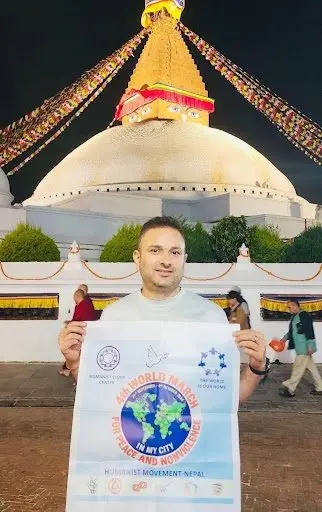
Reflections on a journey of peace, nonviolence, and human solidarity

by Mukunda Baskota
I feel deeply honoured to have participated in the 4th World March for Peace and Nonviolence in Nepal. Looking back on this journey, I feel a profound sense of connection, fulfilment, and happiness. My association with the campaign began with the 2nd World March, and each subsequent edition has strengthened my understanding of and commitment to peace, nonviolence, and humanity.
My participation in the Second World March for Peace and Nonviolence was initially rather formal. However, that first involvement opened a path for me to explore the deeper meaning of peace, nonviolence, and human dignity. During that time, I received warm support and guidance from my senior, Tulsi Maya Sigdel, and my dear friend, Kabir Kumar Ranjitkar. Their inspiration and cooperation gave me the opportunity to observe the activities of the March closely, understand its objectives and significance, and share what I had learned with others.
By the time of the Third World March, my connection with the campaign had grown stronger. The inspiration I gained encouraged me to participate in related activities, inform others about the March’s objectives and message, and become more actively involved in initiatives promoting peace and nonviolence.
I would like to express my heartfelt gratitude to everyone who has continued to support this movement with faith and commitment. I feel fortunate to have contributed, even in a small way, to a campaign dedicated to spreading the message of peace and nonviolence.
As part of the 4th World March for Peace and Nonviolence, I had the opportunity to participate in programmes organised at different locations across Nepal. These were more than formal events. Each provided an opportunity to reflect on peace, nonviolence, humanity, and coexistence, while exchanging ideas and experiences with people from diverse backgrounds.
21 September 2026 — Inauguration and Interaction Programme
The first programme of the Fourth World March for Peace and Nonviolence in Nepal was organised at Dhruvatara School in Budhanilkantha Municipality. Representatives of the local government, teachers from various schools and colleges, social activists, journalists, and individuals associated with the World March participated.
The programme featured discussions and interactions on peace and nonviolence. Participants shared their experiences, perspectives, and ideas, while the Mayor, Deputy Mayor, and other local representatives expressed their views on the World March and its significance.
It was inspiring to see people from different fields and backgrounds come together with a common purpose and engage in meaningful dialogue about peace and nonviolence. The programme concluded with a valuable exchange of ideas and a shared commitment to the message of the March.

28 September 2026 — Candle-Lighting Ceremony in Patan
On 28 September 2026, a candle-lighting programme was organised in collaboration with students of Patan Multiple College.
The programme brought together humanist activists from different districts and members of the local community. It was dedicated to remembering those who lost their lives in the devastating floods and landslides that had recently occurred in Nepal.
Candles were lit in their memory, heartfelt tributes were offered, and prayers were expressed for the peace of the departed souls. For me, this was a deeply emotional and memorable occasion. It reflected our shared humanity and our solidarity with those affected by tragedy and loss.
The ceremony reminded us that peace and nonviolence are not only about preventing conflict; they are also about standing together in times of suffering, showing compassion, and offering support to those who need it most.


2 October 2026 — Programmes Marking the International Day of Non-Violence
On 2 October 2026, various programmes were organised with the participation of the Kathmandu Team and the Banepa–Dhulikhel Team. Working together and carrying the message of peace and nonviolence to different communities was itself a meaningful and inspiring experience.
The first programme took place at ABM School, where students, teachers, and humanists participated in discussions and interactions on the significance of the International Day of Non-Violence. Participants shared their ideas and experiences, helping to deepen their understanding of the importance of peace in everyday life.


A moment of silence was also observed in memory of those who lost their lives in the floods and landslides in the Bhotekoshi area along the Nepal–China border. A Peace Emblem was created as a symbol of peace, and students were introduced to the meaning, importance, and necessity of peace and nonviolence.
A second programme was organised at l in Banepa. Students, humanist activists, and supporters of peace and nonviolence came together to exchange their views and experiences. Tributes were again paid to those who had lost their lives in the Bhotekoshi disaster, and prayers were offered for the peace of their souls. We also had the opportunity to introduce our international guests to the objectives and message of the Fourth World March for Peace and Nonviolence.
Later that evening, a candle-lighting ceremony was organised with participants from different districts and members of local communities to mark the day. Candles were lit in remembrance of those who had died in the floods and landslides, while heartfelt sympathy and condolences were extended to their families.
The candles shining in the evening darkness represented much more than light. They symbolised solidarity with grieving families, a tribute to those who had passed away, and our collective hope that the light of peace would spread throughout the world.
4 October 2026 — Closing Programme
We had hoped to organise the closing programme of the Fourth World March for Peace and Nonviolence on a grand scale. Although, for various reasons, it could not be held as elaborately as we had initially planned, its spirit and purpose remained undiminished.
We were pleased to welcome supportive local residents, humanists from different districts, tourists visiting the Buddhist Stupa, and other participants.
Members of the Kathmandu, Banepa, and Dhulikhel teams, together with the wider humanist team, gathered to light candles at the Buddhist Stupa. Tributes were paid to those who had lost their lives in the Bhotekoshi floods and landslides, and prayers were offered for the peace of their souls.
We also had the opportunity to introduce our international guests to the objectives and message of the Fourth World March for Peace and Nonviolence. With this gathering, our activities for the Fourth World March in Nepal formally concluded. The closing ceremony was particularly memorable for me.As we lit candles in front of the Buddhist Stupa, a symbol of peace, I felt as though their light was spreading in every direction. For a few moments, it seemed that the candles were not merely marking the conclusion of a journey; they were expressing our collective aspiration for a more peaceful, humane, and nonviolent world. Although the programme marked the end of our organised activities, it also reminded me that our responsibility to promote peace and nonviolence continues long after a march has ended.

Conclusion: The Path of Peace and Nonviolence
Whenever I reflect on the World March for Peace and Nonviolence, one profound thought comes to mind: the message of peace and nonviolence must never be limited to a particular programme, campaign, or march. It is an ongoing necessity deeply connected with every aspect of human life.
When people truly understand the value of peace and nonviolence, these principles can inspire them to respect one another, make positive choices, and build better and more meaningful lives.
Today, from families and communities to nations and the world as a whole, people continue to suffer from violence, conflict, and human pain. In these circumstances, we must reflect seriously on the importance of peace and nonviolence as the path forward for humanity.
Peace is not merely the absence of war. It is a positive consciousness reflected in our thoughts, behaviour, and relationships. Similarly, nonviolence is not simply the absence of physical violence; it is a way of life founded on respect for the life, dignity, freedom, and existence of others.
Peace and nonviolence must therefore be more than words. They must become values that guide our everyday actions. Peace that begins within a family can spread throughout a community, across nations, and ultimately around the world.
Participating in the Fourth World March for Peace and Nonviolence, organising programmes in different places, exchanging ideas with people from diverse backgrounds, sharing the message of peace with others, and deepening my connection with this movement have all been meaningful and unforgettable experiences.
This journey has taught me one thing more clearly than ever: the journey towards peace never truly ends. A programme may conclude and a march may reach its destination, but our responsibility to spread the message of peace and nonviolence continues.
##########
The Author:
 Mukunda Baskota
4th World March for Peace and Nonviolence Coordinator, Nepal