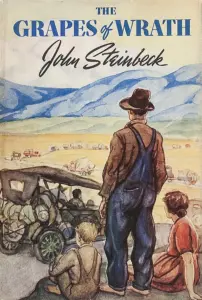
From the Joad Family to the Millions Displaced Across the Planet. Eighty-Seven Years After Steinbeck, Humanity Produces More Wealth Than Ever, Yet Still Cannot Guarantee Land, Work, Food, and Dignity for All
“In 1939, an American family lost its land and set out in search of work. In 2026, millions of families cross continents looking for the same thing. Technology has advanced eighty-seven years. Human dignity is still waiting its turn.”
I. THE JOAD FAMILY HAS NOT DIED
In 1939, John Steinbeck published *The Grapes of Wrath*, a novel about the Joad family, driven from Oklahoma during the Great Depression. Agricultural mechanization, debt, environmental degradation, and landowners’ decisions contributed to the destruction of their farming livelihood. The Joads traveled to California in search of work, food, and an opportunity. There they encountered exploitation, competition among desperate workers, and inadequate wages. The United States was beginning to discover that economic progress could coexist perfectly well with the destruction of its own citizens’ lives.
Eighty-seven years later, the Joad family has millions of symbolic descendants. They live in Sudan, Myanmar, Bangladesh, Ukraine, Gaza, Central America, and numerous African territories. Some flee armies, others persecution, environmental disasters, or economies incapable of sustaining them. Their circumstances differ, but they share one consequence: abandoning what they considered home. Borders have multiplied, and transportation has improved. The effective right to find protection, work, and stability remains profoundly unequal.
“The Joad family lost its land in 1939. Its heirs discovered that now they also need a passport to look for bread.”
II. THE LAND HAS AN OWNER; HUNGER HAS MILLIONS
Agricultural land is simultaneously a productive resource, an economic asset, and a source of political power. Its distribution shapes rural employment, family income, and food security. Across Latin America, Africa, and Asia, large commercial farms coexist with small farmers who face difficulties obtaining financing, infrastructure, and access to markets. Land concentration does not, by itself, explain all inequality, but it can aggravate it when combined with weak institutions, abusive evictions, and inadequate legal protection.
The FAO has documented the importance of farms of different sizes to global food production. Small farmers are particularly important in low- and middle-income countries. Meanwhile, large companies can contribute technology, productivity, and infrastructure. The problem begins when economic power allows environmental and social costs to be shifted onto communities that lack the ability to defend their interests. Land then ceases to be merely a factor of production and also becomes an instrument of subordination.
“Property ownership is carefully registered. The hunger of those who work that property still cannot find a competent office.”
III. HUNGER IS NOT TRADED ON THE STOCK EXCHANGE
According to the United Nations’ SOFI 2025 report, approximately 673 million people experienced hunger in 2024, equivalent to 8.2% of the world’s population. The proportion declined compared with 2023, an improvement that deserves recognition. Nevertheless, hunger increased in several regions of Africa and Western Asia. Humanity possesses enormous agricultural, scientific, and logistical capabilities, but producing food does not automatically guarantee that every family can afford to buy it. Between the harvest and the dinner table lie income, prices, transportation, conflicts, and institutions.
International markets for grain, fertilizers, and energy influence food costs. Russia, Ukraine, the United States, China, India, and the European Union play important roles as producers, consumers, exporters, or regulators. Wars, trade restrictions, and logistical disruptions can worsen already fragile food-security situations. Not every price increase constitutes speculation, but neither does every corporate profit demonstrate social efficiency. An economy can report excellent financial results while millions of families reduce the number of meals they eat.
“The market reports the price of wheat every day. It has never managed to explain satisfactorily the value of a child who cannot afford to eat it.”
IV. THE ROADS TO CALIFORNIA NOW CROSS CONTINENTS
The Joads traveled American highways. Their contemporary counterparts cross deserts, seas, jungles, and militarized borders. UNHCR recorded 123.2 million forcibly displaced people at the end of 2024. This figure includes different categories of protection and displacement; it does not refer exclusively to international refugees. In April 2025, the agency estimated a preliminary decline to approximately 122.1 million. Even allowing for that decrease, the scale reveals a historic human-security crisis, concentrated particularly in territories affected by war, persecution, and violence.
Sudan represents an especially grave tragedy. Ukraine demonstrates that war in Europe also produces mass displacement. Myanmar continues to have populations subjected to persecution and expulsion. Venezuela represents another dimension of regional migration, associated with a prolonged crisis. Different situations should not be attributed identical causes. What does deserve examination is the responsibility of governments, armed groups, and external actors. Displaced people need protection, but frequently encounter immigration systems designed primarily to control their arrival.
“First, they destroy the conditions necessary for people to stay. Then they organize international conferences to discuss how to prevent the victims from leaving.”
V. THE DISPOSABLE WORKER
The International Labour Organization estimated that 167.7 million international migrants participated in the labor forces of their destination countries in 2022. They represented 4.7% of the global labor force. Their contributions sustain agricultural, industrial, healthcare, domestic, and construction activities. Many have regulated employment and legal protections; others face abusive intermediaries, debt, discrimination, or extreme dependence on their employers. Their vulnerability does not arise from working in another country, but from the legal and economic conditions that allow that situation to be exploited.
The United States and Europe need foreign workers in various sectors while maintaining intense debates about immigration. Gulf countries depend heavily on migrant labor. Bangladesh participates in international textile production chains subject to intense commercial pressure. Each system has its own characteristics, but they share a contradiction: numerous economies need workers whose political presence makes them uncomfortable. Their productivity is welcome; their wage demands, considerably less so.
“The foreign worker becomes indispensable when the harvest begins. Their presence becomes debatable when they demand rights.”
VI. MACHINES DO NOT GO HUNGRY
In Steinbeck’s novel, the tractor represents a technological transformation that radically changes agricultural relationships. In 2026, robotics, automation, and artificial intelligence raise similar questions in industrial, administrative, and service activities. The United States and China invest enormous resources in these technologies. Europe is developing its own capabilities and regulatory instruments. India seeks to expand its technological participation while facing the challenge of generating employment opportunities for an immense population.
Technology is not a natural enemy of workers. It can increase productivity, reduce dangerous tasks, and create jobs. However, its benefits are not distributed automatically. Training, collective bargaining, economic competition, and public policies determine who receives the gains. If production increases while workers’ share of its benefits declines, the problem lies not only in the machines. It lies in the human decisions governing their use.
“Steinbeck’s tractor replaced farmworkers. Artificial intelligence replaces tasks. The owners are still human, and so are the decisions.”
VII. THE FIVE LIONS EAT TOO
The United States possesses highly productive agriculture, technological infrastructure, financial capacity, and companies essential to global food trade. It also faces rural inequalities, vulnerable agricultural workers, and political conflicts over immigration. Its trade and financial policies have international consequences. The power that contributed decisively to transforming global agricultural productivity still faces contradictions between economic abundance, income distribution, and labor protections.
China has achieved an extraordinary transformation in material living conditions and a historic reduction in extreme poverty. Its food security depends on domestic production, reserves, technology, and strategic imports. The size of its population makes Chinese agricultural and trade decisions matters of global importance. Its challenges include regional inequalities, the availability of natural resources, and an aging population. Recognizing its achievements does not require ignoring its problems; examining those problems does not justify disregarding its results.
Russia possesses vast territorial, energy, and agricultural resources. Its participation in grain and fertilizer markets gives it strategic importance. The invasion of Ukraine that began in 2022 caused destruction, displacement, and international economic disruptions. Ukraine is also a major agricultural producer. The war demonstrates that two territories essential to the food supply can become battlefields where military decisions alter the security of populations thousands of miles away.
The European Union combines agricultural productivity, subsidies, environmental regulations, and significant trading capacity. Its agricultural policy protects activities and territories, but also generates controversies over resource distribution, international competition, and sustainability. At the same time, several European economies need migrant workers. The challenge is to reconcile food security, working conditions, environmental protection, and balanced trade relations with lower-income countries.
India has one of the largest populations on the planet and an extensive rural population. Its policies on food security, agricultural infrastructure, employment, and income distribution affect hundreds of millions of people. It has developed significant technological and industrial capabilities, although regional and social inequalities persist. Its challenge is not merely to produce more, but to ensure that productivity, economic opportunities, and well-being reach an extraordinarily diverse population.
The five actors do not share a single policy or identical responsibilities. They compete, trade, cooperate, and defend different interests. But their decisions regarding energy, food, technology, finance, and conflicts affect countries with little ability to influence them.
“The five lions argue over who will control the resources of the twenty-first century. The inhabitants of the savanna are still trying to figure out who will pay for their next meal.”
VIII. CHILDREN DO NOT CHOOSE THE ROAD
UNICEF and the ILO estimated that approximately 138 million children between the ages of five and seventeen were engaged in child labor in 2024. The figure represents a significant decline compared with the beginning of the century, but it still describes a reality incompatible with contemporary economic capabilities. Child labor is not equivalent to every form of household assistance: under the relevant international definitions, it includes activities that harm education, health, or development.
In Sudan, Gaza, Myanmar, and other conflict-affected territories, numerous children face displacement, interrupted schooling, and the loss of family security. In Bangladesh, Rohingya refugee children face particular challenges involving education and protection. Poverty, conflict, and inadequate services can perpetuate inequalities for generations. No child chooses where they are born, which army controls their territory, or how much income their family will have.
“Adults drew the borders, declared the wars, divided the wealth, and left children to inherit the ruins. Then, with admirable hypocrisy, they began teaching them the meaning of responsibility.”
IX. WHO GETS THE HARVEST?
A modern food supply chain includes producers, workers, machinery suppliers, fertilizer suppliers, transporters, intermediaries, processing industries, and distributors. Each participant assumes different costs, risks, and responsibilities. There is no universal profit-sharing formula that automatically identifies who is responsible for inequality. But it is appropriate to investigate where bargaining power is concentrated, who determines prices, and what opportunities small producers and workers have to defend their incomes.
Agricultural productivity has increased thanks to scientific research, mechanization, infrastructure, and accumulated knowledge. Its benefits are real. The outstanding question is how they are distributed and which institutions allow those benefits to reach the people who help generate them. Decent wages, effective competition, social protection, labor rights, and access to markets are not enemies of efficiency. They are conditions that allow economic growth to produce measurable human benefits.
“The harvest has an owner, a transporter, an intermediary, a distributor, and an international price. The worker who picked it is still being advised to be patient.”
X. THE GRAPES ARE STILL RIPENING
Steinbeck did not write an economic treatise. He showed how financial, productive, and political decisions could destroy a family, and how solidarity could survive even under extreme conditions. His novel remains uncomfortable because it forces us to confront what statistics, necessary as they are, cannot fully express.
In 2026, we possess more knowledge, technology, and resources to combat hunger, protect displaced people, and improve working conditions. We also face conflicts, inadequate institutions, and economic decisions that prevent us from fully using those capabilities.
The solution is not to condemn every company, every machine, or every market. It is to demand demonstrable accountability from those who govern, produce, trade, and make decisions.
“Eighty-seven years later, Steinbeck’s question remains unanswered.”
“In 1939, the Joads were looking for work so they could eat. In 2026, 12.4 million people face acute hunger in Myanmar, while approximately 1.2 million Rohingya refugees survive in Bangladesh, depending on humanitarian assistance for food.”
“And, as though such a tragedy were not enough, another 16 million people face acute food insecurity in Bangladesh.”
“While courts deliberate and great powers negotiate, millions of human beings continue wondering what they will eat tomorrow.”
“Justice can wait for a verdict; hunger does not have that privilege…”
Author: Mauricio Herrera Kahn
BIBLIOGRAPHY
1. Steinbeck, John (1939). The Grapes of Wrath. Viking Press.
2. FAO, IFAD, UNICEF, WFP, and WHO (2025). The State of Food Security and Nutrition in the World.
3. UNHCR (2025). *Global Trends: Forced Displacement in 2024*.
4. ILO (2024). ILO Global Estimates on International Migrant Workers.
5. ILO and UNICEF (2025). Child Labour: Global Estimates 2024, Trends and the Road Forward.
6. FAO (2025). The State of Food and Agriculture.