From Señorito Iván’s Shotgun to the Power That Still Shoots Downward
“Milana bonita, milana bonita…” — Miguel Delibes, *The Holy Innocents
“Señorito Iván no longer always carries a shotgun or wears hunting boots. Sometimes he wears a suit, talks about efficiency, signs dismissal notices, buys silence, and calls modernization what used to be called obedience. The irony of the twenty-first century is that we have changed almost all the words so that injustice appears new, elegant, and even inevitable.”
I. THE HUNT
Miguel Delibes needed neither armies, palaces, nor grand speeches to describe the abuse of power. An estate in Extremadura, a poor family, a few young aristocratic masters, and some shotguns were enough. In *The Holy Innocents*, masterfully adapted for the screen by Mario Camus, birds fall during hunting expeditions while the landowners and their guests shoot for pleasure. But it soon becomes clear that the real hunt does not take place only in the sky. Human beings also live on the estate as though they had been born to serve, obey, remain silent, and pick up whatever others leave behind.
Paco el Bajo, his wife Régula, and their children live under a system in which poverty seems hereditary and obedience is part of the landscape. Azarías, Régula’s brother, is a man with an intellectual disability, deeply attached to animals and nature, and even more defenseless before the world of the landowners. Señorito Iván, by contrast, possesses land, social standing, a shotgun, and authority. He does not need to raise his voice constantly. The system already speaks for him. Paco knows the countryside better than his master, but knowledge belongs to the servant and decision-making to the owner. A curious distribution of talents: one knows, and the other commands.
That is Delibes’s real indictment. The estate has a hierarchy so widely accepted that injustice can present itself dressed as normality. No one needs to put people in chains because much more discreet forms of dependence already exist. Paco serves even when injured. Régula accepts her place. Azarías barely counts. And those who come to hunt can return satisfied after an excellent day. The problem is not merely that rich and poor exist. It is that some have come to believe that the needs of others give them permission to dispose of their lives.
“On that estate, the birds had at least one advantage over the servants: they could try to escape by flying away…”
II. MILANA BONITA
Azarías is one of the most defenseless human beings in *The Holy Innocents*. Régula’s brother, he lives on the margins of the estate and of society, with an intellectual disability that makes him especially vulnerable in a world built by others and for others. He owns little, decides even less, and almost no one seems to consider it necessary to ask him what he wants. But something does belong to his small emotional universe: the bird he calls his *milana*. He cares for it, calls to it, and loves it. “Milana bonita” is not merely a repeated phrase. It is probably one of the few relationships in his life in which there are neither masters nor servants.
Then Iván appears and fires. Azarías had asked him not to. At that moment, any possibility of mistaking the scene for an ordinary hunting expedition disappears. Iván knows what the animal means to Azarías and pulls the trigger anyway. The shotgun kills the bird, but the real shot is aimed much lower: at the dignity of a man whom the master considers so subordinate that not even his suffering seems sufficient to alter a decision.
Here our question begins. What happens when the person holding the shotgun starts considering it normal to decide what happens to things that belong, materially or emotionally, to others? The abuse of power rarely begins by announcing itself as abuse. First, it becomes habit. Then privilege. Finally, those who command may convince themselves that obeying them is the natural order of things.
Delibes then places two radically different forms of power face to face. Azarías possesses little more than a plea. Iván possesses the shotgun, the estate, and social authority. One asks. The other decides. And when the powerful man discovers that he can ignore even a request as elementary as “do not kill what I love,” the story stops being about a bird. It begins to be about us.
“Señorito Iván could have lowered his shotgun. But then he would have had to admit something truly unbearable for certain powerful people: that limits exist even when the person asking for them has no power at all.”
III. DELIBES LEAVES THE ESTATE
More than four decades have passed since Miguel Delibes published *The Holy Innocents*. Spain changed, Europe changed, and that estate in Extremadura belongs to another era. Many of the old masters disappeared, social relationships changed, and the old shotguns remained as images of a society seemingly destined for books and cinema. It would be comforting to close the story there. The problem is that one need only look up to discover that the estate never disappeared. It grew larger.
It now stretches across continents. The masters no longer need hunting boots or a shotgun resting on their shoulders. Power possesses bombers, missiles, drones, economic sanctions, blockades, occupations, tariffs, financial systems, and diplomatic vetoes. It also possesses governments capable of deciding, from thousands of miles away, which country may trade, who receives weapons, which population must endure a war, and whose suffering will be considered an acceptable cost. Technology has changed extraordinarily. The temptation to dispose of other people’s lives has changed considerably less.
And the overseers still exist. Governments that accompany the powerful, allies that justify what is difficult to justify, suppliers that conduct excellent business while talking about peace, and leaders who conveniently discover that looking the other way can be a remarkably comfortable foreign policy. No one needs to pull the trigger personally to participate in a hunt. Some load the shotgun. Others sell the ammunition. Others open the estate gate. And some simply stand beside the master while the prey falls.
Nor are Paco, Régula, and Azarías the only ones below anymore. There are entire cities, refugees, displaced people, workers, children, and peoples who never participated in the decisions that determined their fate. The names, borders, and weapons have changed. But a question extraordinarily similar to the one Delibes left behind remains: who placed the shotgun in the hands of a few and turned so many others into targets?
“Humanity has modernized the shotgun admirably; unfortunately, technological progress has been considerably more modest when it comes to the master.”
IV. THE HOLY INNOCENTS OF GAZA
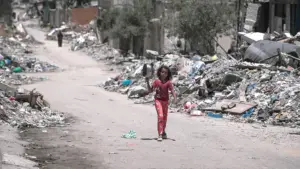
If Delibes had needed to explain what it means to live beneath a shotgun controlled by someone else, Gaza would have seemed unbearably familiar. Approximately 2.1 million people live there, and UNICEF estimated in mid-2026 that 1.9 million had been displaced. By September, the United Nations was still describing a critical humanitarian situation, with civilian casualties, displacement, and serious difficulties maintaining essential services. The names have changed. The fundamental condition has not: millions of people continue to bear the consequences of decisions they never made.
The holy innocents of Gaza are precisely those who do not decide military operations, do not run governments, do not sit on military general staffs, and possess no ability whatsoever to stop the projectiles tearing through their world. They are children, mothers, elderly people, doctors, workers, and entire families. Turning them into extensions of those who fight is one of war’s oldest traps: first erase the individuality of the civilian so that afterward it becomes easier to explain their death through a statistic.
The human toll is brutal. UNICEF reported in September 2026 that at least 21,700 children had been reported killed as of June 30 and approximately 45,000 injured, more than 11,000 of them with injuries capable of permanently altering their lives. Only 19 of 35 hospitals were partially functioning, and just 10 of 222 primary healthcare centers were fully operational. OCHA also reported severe problems accessing water. When hospitals, food, and drinking water become part of the daily struggle for survival, speaking from an office about “inevitable costs” is a luxury reserved for those who will never have to pay them with their own children.
Israel possesses overwhelming military superiority over a defenseless civilian population without an army, trapped in a devastated territory. And alongside Israel stands the United States, a fundamental supplier of military support. The bilateral American agreement for 2019–2028 provides US$3.3 billion annually in military financing and US$500 million annually for joint missile defense programs. Washington does not necessarily make every Israeli operational decision, but its material contribution to its ally’s military capabilities is a documented fact. When such power is provided, it is legitimate to ask what political responsibility accompanies those who help sustain it.
The holy innocents of Gaza are neither a Palestinian abstraction nor a statistic destined to disappear among diplomatic statements. They are human beings with exactly the same right to remain alive as a family in Tel Aviv, New York, Moscow, or Beijing. No nationality, religion, or border changes that principle. It should be such an elementary statement that it would not even need to be written.
The United Nations has warned about the collective punishment of the Palestinian population. History does not repeat itself in precisely the same way, but certain dangerous ideas do return. Governments change, uniforms change, and weapons change. What does not change is the victim when the powerful decide that many must pay for what a few have done.
“On Delibes’s estate, the master had to dirty his hands by raising the shotgun; the twenty-first century has perfected power so thoroughly that some can now supply the weapons, solemnly mourn the victims, and arrive at dinner with perfectly clean hands.”
“History taught us that punishing a hundred innocent people for the actions of one was barbarism; it would be rather strange to discover now that everything depends on who holds the shotgun.”
V. THE ROHINGYA HOLY INNOCENTS
For years, the Rohingya have demonstrated that, to be a holy innocent of the twenty-first century, it is not even necessary for the cameras to be watching. They are a Muslim minority denied citizenship by Myanmar, making them one of the largest stateless populations on the planet. In 2017, more than 750,000 fled to Bangladesh following violence and persecution in Rakhine State. In 2026, the United Nations estimates that approximately 1.2 million Rohingya are living in Bangladesh, while new refugees continue arriving, driven by the conflict.
Cox’s Bazar has become the enormous refuge of a people who practically carry their homeland within their memories. There, they depend on humanitarian assistance for food, water, shelter, and healthcare. Bangladesh receives them, but it cannot resolve what began on the other side of its border. Returning is not a simple solution today either: UNHCR maintains that conditions in Rakhine still do not permit sustainable return, while violence, restrictions, and abuses continue.
Here another kind of master appears. He does not always need to fire a shot. Sometimes it is enough for him to decide who belongs and who does not, who possesses citizenship and who may spend generations without it. Then the other guests of our great global estate arrive: governments expressing concern, organizations requesting funding, and major powers finding other matters more strategically interesting. For 2026, the United Nations and its partners requested US$710.5 million to address the most urgent needs of refugees and the Bangladeshi communities hosting them.
The Rohingya possess neither enough oil to disrupt markets, nuclear weapons, large armies, nor a seat from which to pound the table before the great powers. They have families, memories, and the rather modest desire to live somewhere that someone recognizes they belong. Nine years after the great exodus of 2017, the United Nations Secretary-General was still asking the world in August 2026 to pay attention to them again.
“On the global estate, some peoples are so poor that they cannot even persuade the masters to argue about them; they can wait for years beside the door while another urgent meeting takes place inside.”
VI. AFRICA, THE CONTINENT THAT APPEARS WHEN IT MATTERS
Africa is neither a single war nor a single tragedy. It consists of 54 countries, different governments, different peoples, and conflicts with their own histories. But there are places where our holy innocents number in the millions and where international attention seems to switch on and off according to the strategic importance of the moment. Sudan is today the most brutal example. After three years of war between the Sudanese Armed Forces and the Rapid Support Forces, the United Nations estimated in 2026 that nearly 34 million people needed humanitarian assistance. On September 18, the International Organization for Migration reported that 8.6 million remained displaced within the country. They are not pieces moving across a map. They are people who left their homes, jobs, schools, and families because others decided to keep shooting.
Farther west, the Sahel faces another crisis. Burkina Faso, Mali, Niger, Chad, and other countries confront different combinations of armed violence, coups, poverty, displacement, and deteriorating food security. For the critical June–August 2026 season, FAO and the World Food Programme estimated that as many as 54.8 million people in West Africa and the Sahel could face acute food insecurity if sufficient assistance did not arrive. Here there is no single master who can conveniently be blamed. There are governments, armed groups, regional interests, and years of foreign interventions whose consequences must be examined separately.
Then there is the Democratic Republic of the Congo, a country extraordinarily rich beneath the ground and painfully battered above it. In the east, the war involves the Congolese government, AFC/M23, other armed groups, and regional actors. United Nations experts documented the involvement of the Rwanda Defence Force alongside AFC/M23 and the seizure of strategic, mineral-rich areas. In 2026, 3.6 million people remained displaced in the eastern part of the country. Cobalt, copper, gold, coltan, and other resources make Congo a coveted component of the global economy; curiously, that wealth has still not managed to purchase security for those living above it.
Africa also knows another form of power. Weapons manufactured far away end up being used in its wars; minerals extracted from its territory end up in global industrial supply chains; oil and trade routes attract international attention while a humanitarian crisis can spend months absent from the front pages. This does not mean that every African war was created abroad. That would be false and far too simplistic. It means something more uncomfortable: local actors pull the triggers, regional interests intervene, and the outside world appears with remarkable speed whenever security, minerals, energy, or influence are at stake.
Africa’s holy innocents do not need anyone to turn them into symbols. They already have names, families, and countries. What they need is to stop being important only when their land contains something others want.
“Africa possesses a curious ability to disappear from the map when its people are hungry and reappear immediately when someone discovers oil, copper, cobalt, gold, or coltan beneath their feet.”
VII. THE HOLY INNOCENTS OF SOUTH SUDAN: BECOMING A COUNTRY AND STILL HAVING TO FLEE
South Sudan became an independent state in 2011 after decades of war. Fifteen years later, millions of its inhabitants are still waiting for something much simpler than a flag of their own: the ability to live without hunger, violence, or displacement. In 2026, more than 2.5 million people remained displaced within the country, many since the conflict that began in 2013. Added to this is the pressure created by the war in neighboring Sudan, which since 2023 has driven more than 1.3 million people into South Sudanese territory. Independence arrived; peace and stability came considerably more slowly.
The figure that truly exposes the tragedy is found in empty plates. In August 2026, the World Food Programme warned that 7.8 million people were suffering acute food insecurity and 2.2 million children were experiencing acute malnutrition. At the same time, funding shortages threatened to cut food assistance to hundreds of thousands of refugees and displaced people. We are not talking about a land without food because the planet is incapable of producing it. We are talking about people trapped between conflict, poverty, flooding, displacement, and international assistance that diminishes precisely when it is needed most.
Here, our holy innocents once again have faces. They are children who never voted for a war, farmers who never drew borders, women who never negotiated military agreements, and families who never participated in the meetings where others decided their country’s future. None of them controls the rifles, the budgets, or the diplomatic tables. Yet when everything fails, they are the ones who walk, flee, and go without food. Political and armed leaders continue discussing power; hunger, considerably less diplomatic, comes directly into their homes.
“South Sudan finally achieved its independence; millions of its inhabitants are still waiting to become independent of hunger, weapons, and decisions that are always made by others.”
VIII. THE HOLY INNOCENTS OF SOMALIA: WHEN HUNGER STOPS BEING NEWS
Somalia has been associated with war, drought, and hunger for so many decades that an even crueler danger now exists: the world may simply grow accustomed to it. In May 2026, the United Nations warned that 6 million people, approximately 31% of the population, faced critical levels of food insecurity. Nearly 1.9 million children were suffering acute malnutrition, and 493,000 were experiencing its severe form. These are not figures from a catastrophe that occurred half a century ago. They were published barely four months ago.
Somalia does not have a single explanation either. Years of armed conflict, displacement, groups such as Al-Shabaab, fragile state institutions, prolonged droughts, insufficient rainfall, disease, and an economy unable to protect millions of people when another crisis arrives are all intertwined. For 2026, the United Nations estimated that 4.8 million people needed humanitarian assistance and approximately 3.3 million internally displaced people faced serious protection risks. Even access to school reveals the scale of the problem: the UN humanitarian plan estimated that 62% of school-age children were not attending school.
But one figure should particularly trouble our great global estate. In May, the United Nations reported that nearly 90% of those needing assistance were receiving little or none, while the 2026 humanitarian response plan was only 15.2% funded. The world has money for armies, technology, major infrastructure projects, and financial bailouts. Yet when hundreds of thousands of Somali children suffer severe malnutrition, a familiar international disease suddenly appears: a lack of funding.
Somalia’s holy innocents do not need another solemn declaration. They need water, food, doctors, security, and a chance to grow up without the place where they were born determining how much their lives are worth to the rest of the planet. Hunger knows nothing about geopolitics, but international attention seems to understand it perfectly.
“When there is no money to feed a Somali child, we call it a funding crisis; when there is plenty of money to buy weapons, curiously, nobody asks where the wallet was hiding.”
IX. THE HOLY INNOCENTS OF SUDAN: WHEN NO ONE CAN LEAVE THE ESTATE
Sudan deserves more than a few lines within Africa’s tragedy. Since April 2023, the war between the Sudanese Armed Forces and the Rapid Support Forces has transformed vast areas of the country into battlefields. In April 2026, the United Nations reported that nearly nine million people remained displaced within Sudan, the world’s largest displacement crisis. Millions were forced to abandon their homes without having chosen a war, selected a side, or picked up a rifle. Here, our holy innocents need no metaphor: they walk carrying whatever they managed to save.
Darfur and Kordofan reveal even more clearly who pays the price. In May, the United Nations warned that 14 areas remained at high risk of famine if fighting intensified and humanitarian access deteriorated. Entire families are trapped between armed men, unsafe roads, and food that does not always reach them. Hunger once again does what it does extraordinarily well: it does not ask who started the war before entering a home.
Sudan is not a simple war between good and evil either. There are two major opposing forces, armed groups, economic interests, and regional and foreign actors influencing the conflict. But beneath all that geopolitics lies a much less complicated reality: those who decide to continue the war possess weapons; those who simply wish to survive possess legs with which to try to escape. And even that possibility disappears when there is nowhere safe to run.
Meanwhile, the world discusses other wars, other borders, and other priorities. Sudan continues accumulating displaced people with an efficiency that should shame anyone who still uses the expression “international community” as though it described a family.
“On Sudan’s estate, there are so many armed masters that it has become difficult to know who is in charge; the holy innocents, however, know perfectly well who pays the price.”
X. THE HOLY INNOCENTS OF THE PLANET
“They arrived later, drew the borders, registered the property, granted the mining concessions, and ended up explaining to those who had lived there centuries before that they were now occupying someone else’s land.”
The holy innocents of the twenty-first century do not live only on an estate in Extremadura, nor do they necessarily obey a Señorito Iván with a shotgun over his shoulder. They are also found in the Amazon, Patagonia, the Andes, the Arctic, the forests of Africa, the Pacific islands, Australia, Canada, and the vast rural regions of Asia. They are Indigenous and ancestral peoples who inhabited these territories long before modern maps, property registries, corporations, mining concessions, oil pipelines, and government offices arrived to explain who now owned the land their ancestors had crossed for generations.
History possesses an extraordinary irony. First, others arrived, occupied the territory, drew borders, and wrote laws. Then they demanded property deeds from people who had never needed deeds because land was not a commodity that could be kept inside a folder. Finally, when copper, lithium, oil, gas, gold, iron, timber, water, or agricultural land became valuable, those same documents ended up legally demonstrating that the original inhabitants had fewer rights than a company established fifteen years earlier. Civilization had achieved one of its administrative miracles: transforming the original occupant into an intruder.
The Mapuche peoples of Chile and Argentina, the Quechua and Aymara peoples of the Andes, the numerous Amazonian nations of Brazil, Peru, Colombia, Ecuador, and Bolivia, the Inuit of northern Canada, Canada’s First Nations, the Indigenous peoples of the United States, the Māori of New Zealand, and Australia’s Aboriginal peoples share different histories, but also a similar contradiction. Their territories contain an extraordinary share of the natural resources the modern world considers strategic, while many of their communities continue facing poverty, inadequate public services, and difficulties accessing healthcare, education, housing, drinking water, and effective political representation.
The paradox could be written in a single line: beneath their feet lies what the world needs, yet far too often they receive only a fraction of the value produced on their own territories. The twenty-first century speaks of energy transition, critical minerals, electric mobility, green hydrogen, biodiversity conservation, and water security. These are modern, clean, technological words. But when a new mine, dam, highway, or forestry operation is established without sufficient participation by the affected communities, Señorito Iván’s shotgun has simply changed form. It no longer necessarily fires lead. It can fire decrees, concessions, expropriations, environmental permits, or contracts drafted thousands of miles from the place where their consequences will fall.
“Progress has a curious aim: it usually finds the minerals beneath a community very quickly and the people living above them much more slowly.”
And those rights should not disappear when a resource is discovered beneath their territory whose international price suddenly multiplies the interest of governments, investors, and corporations. That is precisely where the true test of democracy begins: when it must decide whether a citizen is worth the same before and after something valuable is discovered beneath their feet.
There is also another, less visible form of dispossession: cultural dispossession. For generations, countless Indigenous communities were forced or pressured to abandon their languages, customs, religions, names, and educational traditions. Modernization was too often presented as a doorway that could be crossed only by leaving one’s identity behind. A child could enter school, but had to learn that the language of their grandparents was inferior. An adult could enter the market, provided they accepted that their traditional ways of relating to the land were backward. Integration ended up resembling an invitation whose price of admission was ceasing to be oneself.
And then Delibes appears once again. Azarías repeated “milana bonita” because, within a brutal world, he still preserved an intimate space of tenderness that power could not understand. Many ancestral peoples have protected something similar for centuries: a relationship with the land, animals, water, forests, and ancestors that the modern economy tends to translate immediately into tons, hectares, kilowatts, or dollars. This does not mean rejecting development. It means asking what kind of development needs to destroy what it claims to improve.
The planet needs to reduce emissions, electrify transportation, and progressively replace fossil fuels. But an ecological transition cannot be considered fully just if manufacturing electric vehicles in the wealthiest cities requires repeating, in Indigenous territories, the same power relationships that accompanied centuries of colonial extraction of other raw materials. Painting an injustice green does not necessarily change its nature.
“Why can someone in a distant capital determine what will happen to a river, a mountain, or a forest without those who live there having an equivalent ability to decide? Why are they consulted when the law requires it, but rarely when the profits are being divided?”
That is probably the point at which the Señorito Iván of the twenty-first century most closely resembles Delibes’s character. Not necessarily because he is personally cruel, but because he considers a hierarchy that places him above others to be natural. The contemporary master may be a corporation, a ministry, an investment fund, a financial institution, or even a government convinced that it represents the national interest. He speaks of growth, investment, productivity, and competitiveness. All may be legitimate necessities. The problem begins when those words are used to explain that some must sacrifice a great deal so that others can prosper even more.
Fundamentally, the question has not changed much since *The Holy Innocents*. Ancestral peoples have been answering it through their very existence for centuries. They survived conquests, epidemics, displacement, borders, territorial reductions, language prohibitions, and integration projects that too often confused equality with cultural disappearance. And they are still there. Perhaps because there is a form of power that great institutions still understand poorly: the ability to endure.
“Señorito Iván fired downward because he was convinced that this was the natural order of things. The twenty-first century should ask itself how often it continues doing exactly the same thing, except that now it calls the shot development.”
XI. THE PRINCIPAL MASTER IN OUR METAPHOR
“Four centuries ago, Francisco de Quevedo wrote that “Money is a powerful gentleman.”
Donald Trump seems to have carried that old Spanish saying into twenty-first-century foreign policy. The United States possesses military power, controls a currency central to world trade, wields enormous financial influence, and maintains an international network of alliances. Trump inherited this formidable toolbox and has made economic power a central component of his foreign policy. Tariffs, sanctions, weapons, oil, and access to the American market repeatedly appear as instruments for achieving political objectives.
In 2026, the extent of that power became evident once again. In February, Trump temporarily imposed a general 10% surcharge on a broad range of imports, citing balance-of-payments problems. In July, he ordered 10% tariffs on products from numerous countries under investigations related to forced labor. Meanwhile, the Treasury Department continues administering an extensive sanctions framework affecting, among others, Iran, Cuba, Venezuela, Russia, Myanmar, Nicaragua, and North Korea. Each measure has a different official justification, and its effects also differ. But together they demonstrate something difficult to dispute: Washington possesses economic instruments capable of affecting businesses, governments, trade, and ultimately people living thousands of miles from the White House.
In February 2026, Trump ordered the creation of a strategy explicitly called the *America First Arms Transfer Strategy*, designed to use international arms sales as an instrument of foreign policy and to expand American production. Israel remains one of the most important examples of American military cooperation: the 2026 defense budget included US$500 million for joint Israeli missile defense programs. The United States has the right to define its alliances; the question posed by this column is different: when a country possesses such extraordinary capacity to supply weapons, impose sanctions, and influence markets, where does the defense of its interests end and the abuse of an extraordinary imbalance of power begin?
Here Delibes returns. The master in our metaphor is not powerful because he shouts louder. He is powerful because he holds the shotgun, decides when to use it, and knows that those standing before him have far fewer ways to respond. Money added something Iván never possessed: banks, markets, sanctions, tariffs, and an arms industry capable of extending that relationship of power far beyond any estate in Extremadura.
“Quevedo was right: money is a powerful gentleman. What he probably never imagined was seeing it four centuries later accompanied by tariffs, sanctions, oil, and an arms industry; poor Señorito Iván would suddenly have regarded his shotgun as a toy.”
XII. THE OTHER MASTERS
The master in our story does not carry a single flag. Israel occupies an unavoidable place here because of Gaza. Military operations, destruction, displacement, and restrictions affecting the entry of essential supplies have left a civilian population dependent on an enormous humanitarian operation. In September 2026, OCHA continued reporting attacks on populated areas, displacement, and serious problems accessing water, while essential materials for healthcare, sanitation, and shelter remained subject to restrictions. Here Delibes’s metaphor becomes uncomfortable once again: whoever controls much of the entrance also possesses power over those waiting behind it.
But our standard must also measure the other powerful actors. China possesses enormous economic capacity and uses it to defend its commercial, technological, and strategic interests. Russia uses military and energy power. European powers speak of human rights while maintaining economic, military, and diplomatic relationships that do not always advance at the same pace as their declarations. India, the Gulf monarchies, and other regional powers also defend their own interests. No flag automatically turns the powerful into masters; what makes them masters is how they use their power against those who possess far less.
And here a difference emerges that we must not conceal. Ukraine receives weapons, financing, training, and diplomatic support from a coalition of powerful countries. The European Union estimates that its total support has reached €221.2 billion. What does Gaza possess? Who helps it? Only millions of people around the world demanding protection for its civilians, but that support does not amount to a military structure capable of protecting them. Even humanitarian assistance continues facing access restrictions. These are two different wars and two different relationships of power.
There are also the silent masters. They are governments capable of raising their voices but that first calculate alliances, contracts, trade, weapons, and diplomatic consequences. Some condemn; others abstain; still others continue negotiating. And while foreign ministries carefully search for the correct verb, the holy innocents do not receive diplomatic statements falling on their heads. They receive the consequences.
Not all powerful actors pull the trigger. Some supply weapons. Others finance. Others block decisions. Others sell, buy, or remain silent. And others deliver aid, treat the wounded, or press for an end to violence. That is precisely why we cannot lump them all together. Responsibility must have a name, a decision, a date, and a consequence.
“On Delibes’s estate, it was easy to recognize the master because he carried the shotgun. On the global estate, it is more difficult: some shoot, others sell the cartridges, and still others look away; but almost all insist they were there in search of peace.”
XIII. THE OVERSEERS
No master manages a large estate alone. He needs overseers, suppliers, partners, and people close enough to make possible what he does not personally carry out. Modern geopolitics works in much the same way. One country fires, but another may sell it the weapons. One imposes a decision; another provides logistics. One fights, and another finances. Diplomatic power also exists: a hand may never hold a rifle and yet rise in a United Nations chamber to prevent a decision that could restrain someone who does.
Gaza offers an example that is difficult to conceal. On June 4, 2025, the Security Council voted on a resolution demanding an immediate, unconditional, and permanent ceasefire, along with the removal of restrictions on humanitarian aid entering the territory. Fourteen countries voted in favor. The United States alone voted against it, and because of its veto power, the resolution was blocked. France, the United Kingdom, China, and Russia, also permanent members with veto power, voted in favor.
But economic and military overseers also exist. Weapons require manufacturers, contracts, permits, transportation, and buyers. Modern wars possess extraordinarily efficient supply chains. It is one of the fiercest contradictions of our time: we can spend months trying to obtain enough money to feed refugees while simultaneously keeping industries operating that produce increasingly expensive military systems. On our global estate, the shotgun ceased being handmade a long time ago.
Then there are those who cannot be called accomplices without evidence but who should not disappear from our story either. They are governments that observe, calculate alliances, protect contracts, or limit their reactions to statements. Silence does not automatically amount to participation in a crime. But not all silences carry the same weight. The greater a state’s capacity to influence events, mediate, condition an arms sale, finance assistance, or exert diplomatic pressure, the more legitimate it becomes to ask what that state did with its power.
Meanwhile, in Gaza, the difference between grand declarations and reality remains brutal. In July 2026, OCHA reported that Israeli restrictions, insecurity, and lack of funding continued limiting humanitarian operations, and that the entry of essential equipment and supplies remained restricted. In June, the United Nations stated that most of the 2.1 million inhabitants remained displaced.
Delibes needed only a few characters to explain this mechanism. There was the one who commanded, the one who obeyed, and the one who paid the consequences. The twenty-first century made it more sophisticated: now there are alliances, contracts, vetoes, logistical chains, and magnificent humanitarian speeches. But when the meeting ends and the microphones are switched off, a rather simple question remains: who helped stop the shotgun, and who helped keep it operating?
“The master fires, the overseer hands him the cartridges, and the guest looks the other way; afterward, all three can discuss at length who was really responsible for the bird falling.”
XIV. THE GUESTS AT THE HUNT
Every great hunt has guests. Some arrive carrying shotguns, others watch, some protest when the shot is too brutal, and others prefer to remain close to the owner of the estate. Something similar happens in geopolitics, although it would be unfair to place everyone in the same photograph. The European Union, India, Pakistan, China, the Arab countries, and much of the Global South have adopted different positions regarding Gaza. What matters is not guessing their intentions. What matters is examining what they said, how they voted, what assistance they provided, and which relationships they decided to maintain.
The European Union has called for immediate and unhindered humanitarian access, protection of civilians, and the withdrawal of Israeli forces from Gaza. In July 2026, it described the humanitarian situation as “catastrophic.” But Europe does not constitute a single government either: its member states maintain different policies toward Israel, and European decisions must negotiate those internal differences. That contradiction between economic capacity, political declarations, and measures actually adopted is also part of our estate.
India presents another interesting position. New Delhi maintains important relations with Israel while simultaneously declaring its support for the protection of Palestinian civilians, humanitarian assistance, and a two-state solution. In June 2025, when 149 countries approved a General Assembly resolution demanding an end to the blockade, the opening of crossings, and the entry of aid, India abstained. Its representative explained that India was deeply concerned about Gaza and had provided humanitarian assistance, but advocated a solution through dialogue and diplomacy. That is precisely the complexity we seek: it is not enough to listen to speeches; we must also look at the scoreboard when the voting lights come on.
Pakistan has used much more direct language. In June 2026, it demanded before the United Nations immediate and unhindered humanitarian access, the opening of crossings, including Rafah, the lifting of the blockade, and the protection of medical and humanitarian personnel. Other countries of the Global South have also used the General Assembly to demand protection for Palestinian civilians. In June 2025, that resolution received 149 votes in favor, 12 against, and 19 abstentions. It did not end the tragedy, but it established something quite clearly: concern for Gaza was far from limited to a small group of countries.
And then there is the United Nations, probably the strangest guest of all. It can document, feed, vaccinate, shelter, denounce, and bring almost the entire planet together in one room, but its most important decisions run into a structure created in 1945: five permanent members of the Security Council possess veto power. The General Assembly can gather 149 votes and express overwhelming political will, but it does not possess the same coercive authority. The world built an organization to prevent new catastrophes and, at the same time, gave five great powers a special key to close certain doors.
The guests, therefore, are not equal. Some send food. Others send weapons. Some vote to stop the violence. Others abstain. Some continue trading while protesting. Others attempt to mediate. It would be wrong to judge them as a single bloc, but it is right to examine what they did when they had to choose between their interests and the holy innocents below.
“At great hunts, everyone insists they care deeply about the birds; the difference emerges when the time comes to decide who lowers the shotgun, who provides food, and who simply returns to the table.”
XV. MILANA BONITA, 2026
Let us return one last time to that estate. Azarías looks upward. There is the bird. He possesses no army, money, influence, or important friends. He does not even fully understand the world of the men who command those around him. He has something much simpler: he loves that small animal and asks that it not be killed. Before him stands the master with the shotgun. He can lower the weapon. He can listen. He can decide that possessing the ability to shoot does not mean he is obliged to do so. But he fires.
More than forty years have passed since Delibes wrote that story. Our estate is now considerably larger. It covers approximately 510 million square kilometers and is called Earth. More than eight billion people live within it, separated by borders, religions, languages, wealth, and power. Some possess nuclear weapons, armies, banks, resources, technology, and veto power. Others possess little more than their families, their homes, and the hope that no one will decide to destroy them tomorrow.
That is the real problem our *milana* leaves us in 2026. Power will always find an explanation for itself. It will speak of security, national interests, markets, borders, alliances, retaliation, and strategy. Some reasons will be legitimate and others will not. But there is a question that comes before all of them: what happens to the human being below when the powerful decide to use what they hold in their hands?
Delibes did not need to solve the world. Neither do we. Perhaps it is enough to preserve one elementary rule: no flag makes an innocent life less valuable than another. No power acquires more human rights because it possesses more weapons. And no victim ceases to be a victim because their death happens to be convenient for explaining a strategy.
Azarías is still looking upward. The master is still holding the shotgun. We already know how that scene ends. This time, perhaps, we could learn something before hearing the shot.
“Milana bonita, milana bonita… The estate is now the entire planet. All that remains to be seen is whether the master will ever learn to lower his shotgun.”
“On Delibes’s estate, the masters fired and others collected the birds. On the estate of the twenty-first century, the shotguns, automobiles, and family names have changed. Now there are missiles, drones, sanctions, vetoes, aircraft carriers, and trillion-dollar budgets. But below remain the same holy innocents: men, women, and children who were never invited to decide the war, blockade, border, or hunger that would determine their lives.”
“Perhaps the problem was never only the shotgun. It was that some masters came to believe that the sky belonged to them as well…”
BIBLIOGRAPHY
1. Miguel Delibes.The Holy Innocents (Los santos inocentes). Destino, 1981. The central text for examining relationships among landowners, peasants, obedience, humiliation, inequality, and social violence.
2. Pierre Bourdieu.Distinction: A Social Critique of the Judgement of Taste. Taurus. For examining social classes, the reproduction of privilege, cultural capital, and the mechanisms through which hierarchies come to appear natural.
3. Thomas Piketty.Capital and Ideology. Harvard University Press / Deusto. A historical analysis of the systems used to justify inequality, property, wealth concentration, and structures of power.
4. Joseph E. Stiglitz.The Price of Inequality. W. W. Norton. On economic concentration, inequality of opportunity, political power, and the social consequences of economies in which benefits are distributed profoundly unequally.
5. International Labour Organization (ILO).World Employment and Social Outlook. Data on wages, informal employment, precarious work, labor inequality, and workers’ share of global income.
6. Oxfam International.Inequality Inc. / Global Inequality Reports. Data and analysis on wealth concentration, great fortunes, corporate power, and contemporary economic inequality.