The New Walls of Power
“25 U.S. states decided to go to court to challenge the legal authority used by the president to unilaterally modify U.S. trade policy…”
“For centuries, empires built walls to protect their borders.”
“In the twenty-first century, the new walls are no longer always made of stone. They can also be built through tariffs, economic sanctions, and technological restrictions.”
“When trade becomes an instrument of power, economics ceases to be merely economics and begins to become geopolitics.”
The New Walls of Power
Throughout much of the twentieth century, international trade was presented as one of the principal engines of cooperation among nations. The reduction of tariffs, the expansion of markets, and globalization made it possible to build supply chains that connected economies on every continent. However, the twenty-first century appears to be moving in a different direction. The great powers no longer view trade solely as a tool for generating wealth, but also as an instrument for protecting strategic industries, securing critical resources, strengthening their international position, and exerting pressure on their competitors. The new walls no longer separate territories through bricks or barbed wire; they are beginning to be erected through customs duties, technological restrictions, economic sanctions, and controls over strategic minerals. Geopolitics has fully entered the global economy.
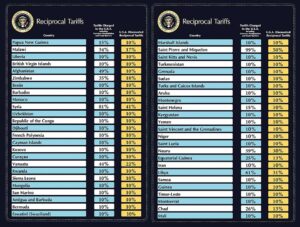
In this new environment, the news is not merely that President Donald Trump has announced new tariffs on dozens of trading partners. The true significance of the event lies in the fact that a presidential economic-policy decision has triggered a constitutional controversy within the United States and, at the same time, generated repercussions reaching China, the European Union, India, Latin America, Africa, and virtually every global supply chain.
“The new walls of the twenty-first century are not always built with concrete. They often begin with a presidential signature capable of changing the planet’s economic balance.”
When Presidential Power Challenges Federalism
The controversy caused by the new tariffs promoted by Donald Trump extends far beyond the economic sphere. What is truly unprecedented is that 25 U.S. states decided to go to court to challenge the legal authority used by the president to unilaterally modify American trade policy. The conflict no longer pits Washington solely against China, the European Union, or dozens of trading partners. It also brings two conceptions of the exercise of power within the American political system into confrontation. On one side is an Executive Branch that maintains it possesses broad authority to use tariffs as an instrument of foreign policy and national security. On the other is a group of states that believes those limits must be defined by the Constitution, Congress, and the federal courts.
“When power begins to expand beyond its institutional limits, the first battle is no longer fought against other countries, but within the very institutions that sustain democracy in the United States.”
Trade as a Geopolitical Weapon
Throughout much of the twentieth century, international trade was understood as a mechanism for increasing shared prosperity. In the twenty-first century, that vision has begun to change. Tariffs, economic sanctions, technological restrictions, control over semiconductors, strategic minerals, and global supply chains are part of a new language of international power. Competition between the United States and China has accelerated this transformation, also forcing the European Union, India, Japan, and other economies to review their own economic-security strategies.
“Cannons continue to be fearsome. But the new wars of the twenty-first century also begin when a presidential signature changes the rules of world trade. Tariffs no longer merely protect domestic industries; they can redraw the balance of power among the great lions of the savanna.”
The United States Facing the World
The United States remains the greatest military power on the planet and one of the world’s economies. Its universities, research centers, technology companies, and financial system maintain a global influence that is difficult to equal. However, it also faces an international environment very different from that of three decades ago. China’s industrial expansion, India’s economic growth, the consolidation of new regional blocs, and the search for greater strategic autonomy by various countries have reduced the room for exercising unquestioned leadership. In this context, the use of tariffs seeks to strengthen industrial sectors considered strategic, reduce certain external dependencies, and increase Washington’s negotiating power.
“The true challenge is to do so without transforming economic competition into a permanent conflict that ultimately weakens the very international order it helped build for decades.”
China Accelerates Along Another Path
While the United States strengthens instruments of trade protection, China continues to deepen a strategy based on expanding its markets, investing in infrastructure, and diversifying its international relationships. The Belt and Road Initiative, the strengthening of trade with Asia, Africa, and Latin America, technological development, and the consolidation of the BRICS are part of a vision aimed at reducing vulnerabilities and expanding its global economic presence. At the same time, Beijing promotes investments in ports, logistics corridors, energy, and advanced manufacturing to secure more resilient supply chains.
“In the geopolitics of the twenty-first century, trade corridors can acquire an importance as strategic as the ancient maritime routes that gave rise to the great empires.”
The Other Lions Are Also Playing
The new international chessboard is not composed solely of the United States and China. The European Union remains one of the largest markets on the planet and exercises significant influence through its regulatory standards, industrial capacity, and commercial weight. India is emerging as a demographic, technological, and industrial power with a growing global role. Russia maintains a strategic position sustained by its energy resources, military capabilities, and status as a nuclear power. At the same time, economies in Southeast Asia, the Middle East, Latin America, and Africa are seeking to diversify their trade relationships in order to reduce excessive dependence on any one bloc.
“The savanna no longer belongs to a single lion. The balance of the twenty-first century will depend on everyone’s ability to compete without destroying the economic bridges that sustain the stability of the international system.”
The Economy Can Also Set the Savanna on Fire
History usually remembers wars for their bombings, invasions, and armies. However, the twenty-first century demonstrates that a confrontation can also begin long before the first shot is fired. Tariffs, financial sanctions, technological restrictions, trade blockades, and competition for critical minerals are part of a new form of confrontation in which the economy becomes a strategic instrument. Every measure adopted by a great power provokes responses from its competitors, disrupts markets, alters investments, and forces governments and companies to reorganize their supply chains.
“Modern wars do not always begin with a missile. Some begin when the bridges of trade start to collapse and every lion decides to build new walls around its own savanna.”
The New Map of Power
The map of global power can no longer be explained solely by the number of soldiers, aircraft carriers, or nuclear warheads. The capacity to manufacture semiconductors, control strategic minerals, develop artificial intelligence, secure energy, dominate maritime routes, and participate in global supply chains has become a central element of international competition. Twenty-first-century geopolitics combines military power, economic strength, technological innovation, and industrial capacity in a single equation.
“The new maps are no longer drawn solely across territories. They are also constructed across ports, laboratories, undersea cables, microchip factories, critical minerals, and trade corridors that will define the balance of power during the coming decades.”
Toward a New Economic Order?
Everything indicates that the international system is passing through a period of profound transformation. The World Trade Organization faces growing challenges in resolving disputes among the principal economies, while new regional agreements, the BRICS, and various economic alliances seek to respond to an increasingly fragmented environment. The globalization that characterized recent decades is beginning to coexist with a trend toward regionalization, market diversification, and the pursuit of greater strategic autonomy by numerous nations.
“Perhaps the twenty-first century will not be remembered for the end of globalization, but for the birth of a new strategic economic order among the great lions of global power.”
Final Reflection
The controversy generated by the new tariffs promoted by Donald Trump represents far more than a trade dispute or a legal debate within the United States. It reflects a much deeper transformation of the international system. Competition among the great powers no longer unfolds solely through armies, fleets, or weaponry. It is also expressed through tariffs, technology, strategic minerals, artificial intelligence, energy, and global supply chains. Economic power has become one of the principal tools of contemporary geopolitics.
The lawsuit filed by 25 U.S. states before the courts demonstrates that half of Americans reject Donald Trump’s trade policy. It also shows that a highly significant part of the American federal system considers this controversy serious enough to bring it before the courts. In addition, the other half of the U.S. states are awaiting the outcome of the case before deciding whether or not to join these 25 states…
“The controversy did not remain confined to the courts. Reuters, Associated Press, The Guardian, and numerous U.S. and international media outlets reported that 25 states took the Donald Trump administration to court to challenge the legality of its new tariffs. When a dispute between the White House and half of the states reaches the global press, it ceases to be a technical discussion about trade: it becomes a political story about the limits of presidential power.”
“This is not a simple political disagreement: it is a constitutional conflict over the limits of presidential power to unilaterally alter the trade relations of the world’s largest economy…”
“For centuries, empires built walls to defend their borders.”
“Today, the new walls are built through tariffs, sanctions, and technology.”
“The true challenge of the twenty-first century is not to decide which lion will dominate the savanna, but to prevent economic competition from ultimately becoming a conflict capable of setting the entire world on fire.”
Author: Mauricio Herrera Kahn
Brief Bibliography
• National Intelligence Council, Global Trends 2040: A More Contested World
A forward-looking analysis of competition among powers, technological transformation, international fragmentation, and the possible scenarios that will shape the global order during the coming decades.
• Paul Kennedy, The Rise and Fall of the Great Powers
A historical study of the rise and decline of the great powers, military overextension, economic erosion, and the risks that emerge when strategic ambitions exceed actual capabilities.