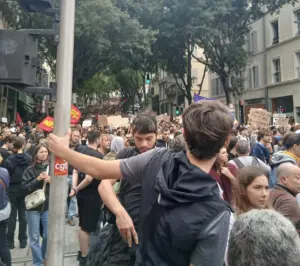
Interview with Lilia, a student at the Thiers High School in Marseille, active in the recent protests against cuts to education funding and the inadequate conditions for studying in French schools. She denounces the violence of police officers who do not wear identification numbers and the full legal protection they have have under the new self-defense law.
These days, many media have given space to your protests against cuts to school funding and the appalling conditions of the French school system. Can you explain to us, as someone who is on the front lines of these protests, what your real motivations were for taking to the streets?
We decided to take to the streets because we had a real motivation, and also because of the appalling conditions of the schools. We have this thing called Parcoursup. It’s a platform where you are placed depending on whether you have a good dossier or a bad dossier, and that determines which schools you actually get to go to for post-baccalaureate studies, and some people don’t get to do that. I think it’s really, really unfair and unequal, and we want this to be over.
There are also the appalling conditions of the schools, not only in the French system but also in the buildings themselves. Some schools are falling apart, with damp, and it’s really bad. We also want these buildings to be renovated.
We’re not trying to scare the government; we’re just trying to have a future, and to have a future we have to protest. Some people don’t get to protest because they’re not politicized enough within the movement and don’t really understand what the movement is about. So we actually fight for them also. We fight for a lot of people.
The school system is also really, really hard. We study from 8am to 6pm. We are protesting about this because it’s really, really important.
We’re taking to the streets to protest, to fight for us, to fight for our rights, to fight for the rights of other people, like people who don’t understand the movement enough and don’t really understand what’s happening. We really want to take to the streets because our way of studying in 2026 is mediocre.
Students in Italy, particularly those of us who are active, look at you with immense admiration for the courage you have shown in defying the massive repression carried out by the State and the police. How did you handle this intense repression, and what was the police response in your schools in Marseille?
We’re a lot of people in this movement and we try to help each other. We really try to be there for each other. We’re really together, we just try to help each other, and we’re here for everyone.
There are a lot of trade unions that are helping us. One is a very famous trade union in France, with a lot of teachers from the national education system: teachers from college, high school and middle school who protect us from the police by making human chains. There are a lot of videos about that on TikTok and Instagram.
This is how we actually handle this repression. It’s a very hard repression. We’re being gassed, and it’s really violent. The policemen are supposed to wear their RIO number during service, but they don’t when they’re with us, because they don’t want to be identified. In Paris, for example, they have this big light that they carry with them, so we can’t film them or recognize them. There’s also a new law, passed not so long ago, on legitimate self-defense for policemen. What they’re doing is this: if they kill a young person, or if they kill anyone, they can’t be sued if they declare it was legitimate self-defense.
So if we want to sue them and they declare legitimate self-defense, we have to prove that it wasn’t. The people who are victims of this violence need to prove that it wasn’t self-defense.
There are also a lot of people who lost their teeth, lost their hands, lost their eyes. They were strangled. A lot of violence, really. It’s just disgusting, actually. They’re being really, really violent this time. But they have actually been violent for a long time. There’s this thing about what they were called: before, they were called guardians of peace; now they’re called Force of Order. So we see the shift between these two ways of naming them. We see a shift of mindsets.
Many Italian newspapers reported an alleged incident involving a principal being doused in gasoline in front of the Victor Hugo High School in Marseille, which was later followed by timid denials. What really happened that day? Do you think this is just a tool used by right-wing media to try to smear you?
I heard about this, but I don’t really know what happened that day, because I wasn’t there and I don’t have much information about it.
But I know one thing for sure: the violence is not committed by us, by high school students. We have a movement that is really pacifist, without violence. The violence only comes from the police. There are other people, older people, who deliberately come into these blockades and demonstrations and commit violence. We do not want to be represented by these people or associated with them. It is not what we want to show people. We don’t want to show violence.
In the right-wing media, a lot of people are saying that we are young people manipulated by the left wing, and that we are doing this just because we do not want to go to school or something like that, which is not true. We really want to have more possibilities and a future, because there are a lot of things happening: a lot of budget cuts, and a lot of teachers’ posts being deliberately suspended.
They justify these budget cuts by saying that demography is declining. It is not a good justification for making classes bigger, with near 40 students and one teacher who is just trying to work with four classes of 40 students, which is a lot. It is just not survivable; it’s horrible.
I don’t really know what these right-wing media are trying to do, but I know is that we’re being infantilized. Because we’re 17 years old, people are saying that we’re not old enough to think for ourselves and to have an opinion about all of this, which is completely untrue. We do want to fight for everyone, for the people, for the students.
The protests started in Brittany in early September and then spread to the suburbs of Paris. How did you manage to coordinate all of them and build a network among yourselves? How did you make all this possible?
I guess there are people who are in contact with Paris, but the fact is that we do not really coordinate our fights from city to city. I don’t really know why; it’s actually a pretty good idea. We really do this locally, and it’s rather disorganized. The network is not that well developed. We try to build something, but it’s really difficult.
We were actually doing blockades before that, so we already had a network system for that. We all stand with everyone, and we try to create solidarity among people. This is what actually made it possible. We’re a lot of people fighting for the cause, for students, for teachers, for a lot of things, and we’re all together, you know, and this is actually pretty good. I’m really proud of us, because we show real solidarity.


In the streets, we saw everything, from very young students to workers, civil servants, and firefighters. What do you think unites these different groups? Why did you stand together in solidarity against the Macron-Lecornu government’s budget measures?
We are a lot of people fighting against this government, and there are a lot of things uniting us: the fact that we don’t agree with how the government works, and that a lot of social laws are being cut. I don’t know if you remember the 2023 reform on old people’s rights, on when they stop working. A pension reform was passed in 2023, and you can retire at 64, which is kind of late.
Right now it’s about the national education budget cuts, a lot of budget cuts, with a lot of teachers’ posts being deliberately suppressed. There are a lot of colleges and high schools with classes that don’t have any French teacher at all, and that is for the baccalaureate, so you cannot properly prepare for the exam.
This is why we, as students, are fighting: against all of these budget cuts and all of these suppressed posts. That’s why a lot of people are joining us, and we can also join other causes, like hospitals: we try to help each other with their fights. This is how we unite. We’re really, really solid; we try to stay really united, because it’s really important.
While you were protesting, Macron posted a video on his social media of a new nuclear missile launch. How do you view the massive increase in military spending in France and Europe alongside the austerity policies our governments are adopting?
I think it’s something really to be ashamed of: all of the war, the nuclear missiles, everything. It really shows that Macron doesn’t care about our cause, doesn’t care about anything we try to make pass. He just cares about his missiles. It’s outrageous, because he doesn’t care about his own country, the one he’s at the head of.
There are some war defense classes in our high school that we want removed; we do not want these classes. It’s like they’re preparing us for war, even though we’re 17. It’s really shameful. We try to fight against that, but it’s kind of complicated.