Freedom, intentionality and the human future
Pressenza has always defined itself through a commitment to peace, nonviolence, humanism and non-discrimination. This August, with a new three-month course in Nonviolent Journalism about to begin, that commitment leads back to a question that sounds almost too simple to ask: what is nonviolence?1
The easiest answer is negative. Nonviolence means not hitting, killing, bombing, torturing or threatening another person. That matters, obviously. But that definition does not take the idea very far. People can be dominated without ever being struck. Economic exploitation, discrimination, political repression and psychological coercion can profoundly restrict a human life without necessarily leaving a physical wound.
Revisiting these ideas suggests that nonviolence may sometimes be defined from the wrong end. Instead of asking first what violence looks like, it may be more useful to ask what violence takes away.
Human beings can do things later
One of the most ordinary human capacities is also one of the most remarkable: human beings can do things later. People do not only react to what confronts them now. They postpone, remember, compare, rehearse, save, organise and begin acting today because of something that does not yet exist.
Silo described this as a broadening of the human temporal horizon: the possibility of deferred response and of directing activity towards “a future that is planned (or imagined)”.2
A student studies because she imagines something she may be able to do years from now. A family saves towards a home it does not yet possess. Workers organise because they can picture different working conditions. A social movement challenges an apparently permanent injustice because people can conceive of a society that is not yet there.
The future, although it has not happened, is already acting in the present. The capacity to project towards possible futures is fundamental to freedom. Of course, freedom does not mean the ability to do anything whatsoever. Human beings are born into conditions they did not choose, and material, social and historical circumstances place real limits upon them. But within those limits, possibilities can open – and they can also be closed.
What violence takes away
In the Fourth Letter to My Friends, Silo describes concentrated power as allowing some people to “negate the freedom and intentionality of others, reducing those others to prostheses, to instruments of the intentions of the few”.3
A human being is not simply an object in the world. Each person is also a centre of intention: someone who remembers, imagines, chooses, refuses, builds relationships, undertakes projects and tries to transform the conditions of life.
Violence turns that person into an instrument of somebody else’s project. Slavery is the clearest example: another person’s body, labour and future are appropriated. But the same direction can appear through very different mechanisms. Political repression can remove people’s capacity to participate in decisions affecting them. Discrimination can close educational, professional or social possibilities. Economic arrangements can leave people with so few viable alternatives that much of their time and labour serves purposes over which they have little influence.
These forms of violence are not equivalent, and their severity should not be confused. What matters here is the direction they can share: the field of meaningful human possibility becomes smaller.
The expression appropriation of intentionality is proposed here to name this underlying movement of violence. It describes what happens when another person’s or group’s capacity to orient and construct a future is subordinated to ends they do not meaningfully control. Violence, seen this way, does more than injure people in the present. It takes possession of part of their future.
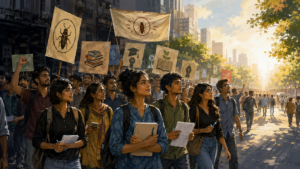
India’s recent youth-led Cockroach movement makes this less abstract. The movement grew around anger at examination paper leaks, recruitment delays, unemployment and failures of accountability in systems on which young people depend for education and employment. Its Examination Reform Charter described fair public examinations as a foundation of equal opportunity and demanded transparency, candidates’ rights and parliamentary oversight.4
For someone who has spent years preparing for an examination, a corrupt or dysfunctional system is not merely an administrative inconvenience. It can shut off a future towards which years of present action have already been directed.
The response was collective. What began partly as online satire developed into organisation, sustained protest at Jantar Mantar and an explicitly peaceful march towards parliament on 20 July. The protests did not remain entirely peaceful in practice – police used tear gas and batons when demonstrators tried to move beyond barricades – but the movement itself had publicly called for a peaceful, lawful assembly. Its pressure helped move examination reform and youth unemployment into national political debate. Education Minister Dharmendra Pradhan resigned, and the government subsequently opened further discussions around the movement’s demands.56
The longer-term outcome is still open. But something had already changed. Young people who had experienced institutions largely as forces determining their possibilities had discovered that they could act together and alter those conditions. Their future was not simply something being decided elsewhere.
Doing the opposite
If violence objectifies people and reduces their capacity to direct their lives, then nonviolence must move in the opposite direction. It must seek conditions in which human intentionality can recover, develop and express itself. Silo says almost exactly this when he writes that to humanise is to move beyond objectification and “affirm the intentionality of every human being and the primacy of the future over the present situation”.7
This suggests another way of thinking about nonviolence. Human freedom can only genuinely increase if its expansion does not depend on taking freedom away from somebody else.
This does not mean maximising the number of choices available to every individual. Fifty brands on a supermarket shelf do not, a free society, make. Nor does it mean that every limitation placed on an individual is an act of violence. Freedom is necessarily exercised among other people, and limits may sometimes be required precisely to prevent one person’s power from diminishing the freedom of others.
Taxing concentrated wealth, regulating an employer or preventing discrimination may restrict what one actor is free to do while enlarging the real possibilities available to many others. A billionaire may have fewer possibilities for disposing of part of their wealth after taxation, while millions of people gain possibilities through education, healthcare, housing and other public goods. The relevant question is therefore not whether every individual choice remains untouched, but whether the overall field of meaningful human freedom is expanding or contracting.
The possibilities that matter are fundamental ones. Can people speak and be heard? Can they refuse? Can they associate and organise? Can they obtain the basic conditions necessary to live? Can they participate in decisions that affect them? Can they develop projects of their own? Can communities imagine different futures and act together to bring them into existence?
Freedom understood in this way is relational. If one person’s increased freedom depends upon reducing others to instruments of their intentions, human freedom has not increased. Power has simply become more concentrated.
Nonviolence, then, does not seek the unrestricted freedom of each individual. It seeks to enlarge the shared field of human freedom: the real capacity of more people to participate in directing their own lives and their common future.
This also helps explain why nonviolence must be active. Existing arrangements already distribute freedom unequally. To leave them untouched may simply leave some people with the power to determine the futures of others. Active nonviolence therefore does more than abstain from harm: it challenges conditions that appropriate intentionality and works to create relationships and institutions in which human agency can expand.
Restoring freedom may require organisation, protest, strikes, boycotts, non-cooperation, civil disobedience, independent communication and the creation of alternatives. Nonviolence does not abolish conflict. Sometimes it means entering directly into conflict with a concentration of power.
The test is not whether conflict disappears. It is what a way of acting leaves behind. Do people emerge with more capacity to speak, organise and participate in what comes next – or has the struggle merely changed who gives the orders?
Nonviolence is not only the refusal of violence. It is a direction: towards relationships and institutions in which fewer people are treated as instruments and more people can take part in shaping the future.
A simple question follows: does an action leave more people capable of participating in the construction of their own lives and their common future, or not?
In journalism, the same question becomes practical very quickly. Journalists decide who appears as an actor, whose intentions are taken seriously, what possibilities are visible and what kind of future a story leaves in the reader’s imagination. These are among the questions explored in Pressenza’s new Nonviolent Journalism course. Applications are open now.1
Endnotes
- Pressenza, “Making the world better through communication: Free course on Nonviolent Journalism,” 23 July 2026. The course begins on 27 August 2026. Registration: https://www.pressenza.com/nonviolent-journalism/nonviolent-journalism-training/
- Silo, “Regarding What Is Human,” in Silo Speaks (San Diego: Latitude Press, 2000). The passage discusses deferred response, the broadening of the temporal horizon and activity directed towards a planned or imagined future.
- Silo, Fourth Letter to My Friends, in Letters to My Friends: On Social and Personal Crisis in Today’s World (San Diego: Latitude Press, 1996), section 9, “The Human Process”; letter dated 19 December 1991.
- Cockroach Janta Party, “Examination Reform Charter: 5 Demands,” released 15 July 2026.
- Cockroach Janta Party, “Peaceful March to Parliament,” 20 July 2026; Sheikh Saaliq and Piyush Nagpal, Associated Press, “India police use tear gas to stop march on Parliament by Cockroach movement supporters,” 20 July 2026.
- Chietigj Bajpaee, “Has the ‘Cockroach’ movement changed Indian politics?”, Chatham House, 29 July 2026; Sheikh Saaliq, Associated Press, “How India’s Gen Z movement of ‘Cockroaches’ dented Modi’s political image,” 4 August 2026.
- Silo, Fourth Letter to My Friends, section 9, “The Human Process.”