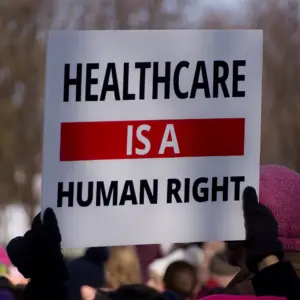
Part of “A Violence Too Large to See” — Exploring how the economic organization of healthcare affects human freedom, and how scientific progress could open possibilities beyond the lifelong management of illness.
When Healthcare Becomes Economic Violence
For millions of American families, the cost of healthcare is a source of growing insecurity. Rising insurance premiums, deductibles, prescription drug prices, and medical bills force people to make difficult choices between protecting their health and meeting other essential needs. Even those with health insurance can face substantial expenses, while a serious illness can threaten years of savings, housing security, and financial stability.
When someone delays medical treatment because they cannot afford it, when a family falls into debt because a child becomes ill, or when a person remains in a job primarily out of fear of losing health insurance, we are confronting more than a financial problem. We are confronting an economic structure that restricts human freedom, undermines well-being, and can endanger human health.
We have gradually learned to recognize many forms of violence that were once ignored or accepted, including discrimination, domestic abuse, and other forms of physical and psychological harm. Yet economic violence remains largely invisible, even when its consequences profoundly affect people’s lives.
These conditions are so deeply integrated into American society that we tend to discuss them as questions of insurance coverage, healthcare costs, or personal financial responsibility rather than recognizing the violence they can represent.
But beyond the immediate question of affordability, recent scientific developments are revealing another contradiction within the economic organization of healthcare.
A Scientific Breakthrough That Opens New Possibilities
In September 2024, Chinese researchers reported a remarkable development in the treatment of diabetes. A woman with type 1 diabetes who received a transplant of insulin-producing cells derived from reprogrammed stem cells became insulin-independent just 75 days after the procedure.
The results, published in the scientific journal Cell, showed that the patient maintained stable blood sugar levels without insulin injections throughout the remainder of the study’s one-year follow-up period. The research involved a single patient, who was already receiving immunosuppressive medication following previous organ transplants. The treatment remains experimental, but it demonstrated that restoring the body’s capacity to produce insulin may be possible.
Similar research is advancing elsewhere. In 2025, an American clinical trial involving stem-cell-derived insulin-producing cells reported that 10 of 12 patients receiving the full treatment dose no longer required insulin after one year. The treatment required immune-suppressing medication and involved significant medical risks, underscoring the need for further research.
These developments do not mean that diabetes has been cured or that such treatments are ready for widespread use. But they suggest a future in which some people who currently depend on lifelong insulin treatment might regain the ability to produce their own insulin.
For patients and families, this could represent an extraordinary advance in health, financial security, and personal freedom.
But it also raises an important economic question.
A Multibillion-Dollar Market Built Around Lifelong Treatment
In the United States alone, the market for insulin medications and delivery devices was estimated at approximately $20.23 billion in 2025, according to market research firm Mordor Intelligence. This figure includes insulin products and the equipment used to administer them, serving people with both type 1 and type 2 diabetes.
Insulin has saved countless lives and remains indispensable for many patients. Its production and distribution require substantial resources, and advances in insulin delivery have improved the lives of millions of people.
But the continuing need for insulin also sustains an extensive commercial system of pharmaceutical production, medical equipment, insurance payments, and recurring purchases.
Now imagine a future in which scientific progress makes it possible for large numbers of people with type 1 diabetes to recover their body’s capacity to produce insulin, substantially reducing or eliminating their dependence on daily treatment.
For patients, this could mean liberation from a lifelong medical burden. For businesses whose revenues depend on recurring treatment, it could mean a profound transformation of established markets.
What represents an extraordinary human success may also threaten established sources of economic success.
This does not mean that pharmaceutical companies are necessarily opposing such discoveries. Indeed, some of the most promising research is being financed by private companies themselves. Developing a cure can also be highly profitable, and the prospect of financial returns can encourage the investment needed to make scientific breakthroughs possible.
The contradiction is more fundamental. It concerns the relationship between the human purpose of healthcare and the economic structures through which that purpose is pursued.
When the Means Become the Ends
The fundamental purpose of healthcare is to relieve pain, prevent illness, restore health, and reduce human suffering. Yet the economic structures through which healthcare operates can gradually redirect attention from these purposes toward the financial requirements of the system itself.
This is not a simple contradiction between caring for people and making money. Revenue is needed to sustain hospitals, compensate healthcare workers, produce medicines, and finance the research that makes new treatments and cures possible. Private investment has contributed to extraordinary medical advances.
But once healthcare is organized around revenue, profitability, and market growth, these considerations begin to shape decisions throughout the system: which research receives investment, which treatments are developed, how they are priced, and who can obtain them.
What began as a means of supporting healthcare can become a powerful influence over its direction.
Here we encounter a particularly revealing contradiction. In most industries, growing demand and expanding markets are considered signs of economic success. But in healthcare, the greatest human success might be to eliminate the very conditions that sustain those markets.
A cure that frees millions of people from lifelong treatment could produce extraordinary improvements in human well-being while simultaneously undermining established sources of revenue. Conversely, a growing market for medical treatments may be celebrated as economic progress even when it reflects the continuing burden of disease.
This does not mean that financial incentives always discourage cures. A successful cure can generate enormous economic value, and companies may have strong reasons to develop one. But the financial value of a treatment and its value to human health are not necessarily the same. Research priorities, pricing decisions, and access to care can be shaped by what produces financial returns rather than what would most effectively reduce suffering.
This is one of the ways economic violence can become embedded in institutions without being recognized as violence. No one needs to intend harm. The system can function according to its accepted economic rules while producing outcomes that restrict human freedom, perpetuate financial insecurity, or place essential care beyond people’s reach.
The tragedy is that a system organized to overcome human suffering can become economically dependent on the continuation of that suffering.
When Economic Beliefs Define What Is Possible
The deeper issue concerns the beliefs that shape our understanding of economic reality.
We have become accustomed to a healthcare system organized around insurance companies, pharmaceutical markets, complicated billing arrangements, and institutions competing for financial resources. These arrangements appear so natural that we rarely question whether they are the only possible way to organize healthcare.
But they are human constructions, developed through historical decisions, political choices, and economic priorities.
We often assume that growing markets, rising revenues, and expanding economic activity are signs of progress. Yet healthcare reveals the limitations of this assumption. More spending on medical treatment does not necessarily mean better health. A treatment that eliminates the need for years of medical care may contribute far more to human well-being than one that generates greater revenue through lifelong use.
The distinction is between economic activity and human progress.
When we fail to recognize this distinction, we risk allowing the financial requirements of the system to determine what we consider possible, practical, or desirable.
What if medical research were evaluated not only by its commercial potential, but by how much human suffering it could eliminate? What if the economic benefits of preventing disease were valued as highly as the revenues generated by treating it? And what if scientific discoveries were organized to become accessible to the greatest possible number of people, rather than primarily to those who could afford them?
These questions do not have simple answers. Scientific research requires enormous resources, new treatments may initially be extremely expensive, and medical breakthroughs must undergo years of testing before their long-term safety and effectiveness can be established.
But recognizing these difficulties does not mean accepting our current economic arrangements as inevitable.
The challenge is not simply to develop new treatments, but to reconsider the beliefs and priorities that shape how their benefits are pursued and distributed.
Beyond the Business of Illness
The emerging research into stem-cell treatments for diabetes offers a glimpse of a future in which conditions requiring lifelong medical management might instead be overcome. But whether these discoveries transform human lives will depend on more than scientific progress. It will also depend on how we organize healthcare, finance research, and make new treatments accessible.
There is a profound contradiction in an economic system that can benefit from both the treatment of illness and its elimination, but does not necessarily reward these outcomes according to their contribution to human well-being. A society may generate enormous economic activity through the management of disease while leaving millions of people burdened by preventable suffering and financial insecurity.
This is not inevitable. The economic arrangements surrounding healthcare reflect beliefs and priorities that human beings have established and can change. Recognizing them as choices, rather than unavoidable realities, opens the possibility of organizing healthcare differently.
Perhaps the greatest challenge posed by these scientific discoveries is not simply whether we can develop cures, but whether we can imagine an economic system in which restoring human health and freedom becomes a greater measure of success than sustaining the business of treatment.
Ultimately, this brings us back to a fundamental human aspiration: to overcome pain and suffering.