A friend back in Japan for a break from graduate school in the U.S. reached across the table and grabbed my notepad. He then started writing two Kanji characters using my pen. Kanji characters in the Japanese pictographic script depicted images. So, readers could recognize the meaning without knowing the pronunciation, or sound, assigned to each kanji character.
I did not mind my friend’s sudden move. But I protested because he could have used his own notepad that was right in front of him. With all of Japan buzzing over a word in 1994, I had to ask him to explain.
The media reported that in August of 1993 a 30-year-old father and his wife attempted to register their newborn son’s name as “Akuma” with kanji characters, 悪 魔. “Akuma” meant devil or demon. Initially, the municipal office of Akishima in Western Tokyo accepted the name because the Kanji characters for “aku” and “ma” were individually listed by the Ministry of Justice as approved for standard use.
Higher authorities at the ministry, however, blocked the registration. They argued that any child growing up with a name like that would experience social stigmatization and bullying. The father appealed the decision on the technicality that the name had already been approved. He took the matter to the Tokyo Family Court. But he eventually withdrew his claim because of intense public scrutiny and a counter appeal by the city officials to the Tokyo High Court. He compromised with a different name instead.
The resolution came as no surprise to me given the premium that Japanese society placed on social harmony. Like other Asians, Japanese culture employed “shame” rather than explicit rules of right and wrong to regulate behavior.
What I did not expect from my friend was how strongly he felt about the word “akuma.” He crossed out what he wrote as soon as I had seen the kanji (or the pictogram) and trashed the paper without reading it aloud.
I later learned that words do more than code meaning. Japanese culture treated them as both sonic and visual entities. The term “kotodama” stood for the “soul” of the spoken sound. And since Kanji is ideographic, it also embodied the “living power” of written script. In their indigenous Shinto beliefs, the concept of “kotodama” posits that words possess a literal spiritual soul.
Another ‘90s Stigma-loaded Word
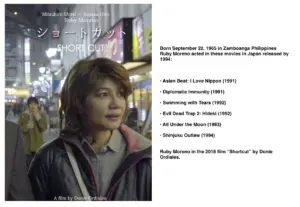
Born 1965, Filipina beauty Ruby Moreno skyrocketed to fame after sweeping the domestic best actress awards for her performance in the 1993 movie, “All Under the Moon.” But she was not the first nor the only Filipina in mainstream show business back then. Marlene Pena, born in 1960, became a beloved diva of the jazz-fusion era of the ‘80s. Scouted in the Philippines as a child prodigy after having won several singing contests, Marlene came to Japan at 15. So, she was packaged as a “kawaii” (cute) singing idol.
As a Southeast Asian actress able to perform in Japanese, Moreno was marketed as a rarity. She fell under the “bijin” or “beautiful woman” category, not the cute girly idol. And unlike other mostly Caucasian “foreign talent” doing novelty appearances, Moreno was cast as a serious, talented actress.
After her career took off, however, a weekly tabloid dug up her past and in 1994 exposed her as a former “japayuki-san.” The word literally meant “Ms. Japan-bound.” And it was a label for anyone escaping economic hardship to work in Japan’s nighttime entertainment industry. By the 1980s, “japayuki” stood for a Filipino-pub hostess.
To everyone, it was the code word for a sex worker. But no one dared admit knowing that. So, nobody said it aloud. Not unlike the way my friend behaved around the word “akuma.”
Words Create Reality
Unfortunately, after being outed by tabloids, Moreno’s response was to hold a press conference rather than wait to be cornered. She publicly confirmed that she had indeed been a “japayuki.”
She also admitted that she was mother to a child with severe cerebral palsy. Her confession backfired. It substantiated the presumption that hardship brought her to Japan. The media played it up as Moreno’s misrepresentation of her background. Up until then, her official backstory claimed that she was single and had been scouted while in Japan for tourism-related work.
Public shock was fueled by the irony that Moreno played a fictional “japayuki” on a TV series in 1992, two years earlier. But the uproar was not about her past in the shadowy but legal “mizu shobai” (nighttime adult entertainment business). Nor was it about being caught lying. She had tearfully apologized for the unintentional “profile fraud.”
The fuss stemmed from forcing Japanese society to confront the word “japayuki.” Just by bringing it up, all implications around the notion of “Japan-bound women” came to the fore. Mere mention brought to the surface some of the unsettling aspects of the trade–like the potential exploitation of women in need, or even the imbalance of economic power between countries.
Swift Judgement
Outrage came from no less than Japan’s legendary singer-TV personality Akiko Wada. Nicknamed “Jotei” (Empress), Wada hosted the long-running news variety show, “Akiko ni Omakase” (Leave it to Akiko) from 1985 to March of 2026. So, even in 1994, Wada was the self-appointed “big sister” and “moral compass” of Japanese entertainment.
Wada directed her fury not over Moreno’s past. But rather, Moreno’s public confession. Articulating what should have been left unsaid meant breaking the industry’s unspoken rule of strategic vagueness, a way of maintaining plausible deniability. Talent managers and networks knew of the background of foreign and domestic hostesses-turned-talents. But everybody strictly kept it secret.
I remember seeing clips and reports of Wada scolding Moreno. It was as if Moreno opened a Pandora’s Box that brought collective shame to the networks, her handlers, and herself. By giving a public face to a tacit practice–a socially stigmatized but well-entrenched one–she gave the game away.
Wada’s reaction may have unveiled social hypocrisy. But it was the tabloid’s “unmasking of a migrant entertainer” that sealed Moreno’s fate. The media also dubbed Moreno later as “the last-minute cancellation actress” (or “dotakyan joyu”) and reported on her massive debts.
Presented like a circular argument, her “shady past” became proof that she was unreliable.
Her acting career in Japan quickly dissipated. Over a decade later, she staged a successful comeback. But no discussions or criticisms were ever made of the tabloid’s role or invasive methods in her 1994 demise.
From “Karayuki” to “Japayuki”
“Japayuki-san,” coined in the early 1980s by Japanese writer Tetsuo Yamatani, mirrored the historical “Karayuki-san” label. It stood for poor Japanese women shipped to other Asian countries as prostitutes during the Meiji (1868-1912) and Taishō (1912-1926) eras. Like a bitter joke, “japayuki-san” was a deliberate inversion of “karayuki-san.” The traffic had reversed direction. Japan was now the destination.
The Japanese media slang conveniently functioned as an exclusionary marker. The term helped distinguish local Japanese women from foreigners working the same “mizu shobai” nighttime industry. So, what may have started as a neutral descriptor, even a euphemism, became a dysphemism. It devolved into a pejorative slang that implied “foreign,” “poor,” and “sex work.” Those associations were far from any Japanese aspirations in the booming ‘80s and ‘90s.
Fear also played a part. My friend’s fear of demons, the harm they can do, and his belief in the “kotodama” spirit residing in both written and spoken words explained his refusal to write “akuma” on his belongings. And although he laughed about that, fear of naming something into existence was why he could not say it out loud.
During the Edo period from 1603 to 1854, fear of knowing that Europeans had colonized Asia prompted the Tokugawa Shogunate to seal the country from “outsiders.” Today, this fear of the “gaijin” (foreigners) arriving to disrupt social harmony and dilute the “purity” of Japanese society persists. So, after her 1994 confession, which was likely made out of honesty and her desire to come clean, Moreno’s career did not stand a chance.
But who is the person behind the “japayuki-san” label? What is her story? And her soul?