To oppose the implementation of New Labour Codes, made effective since 21st November, A Nationwide Massive Protest was organised jointly on 26th November, 2025 by the Trade Unions and Samyukta Kisan Morcha (SKM), a major union of farmers, in more than 500 districts, as claimed by the trade unions.
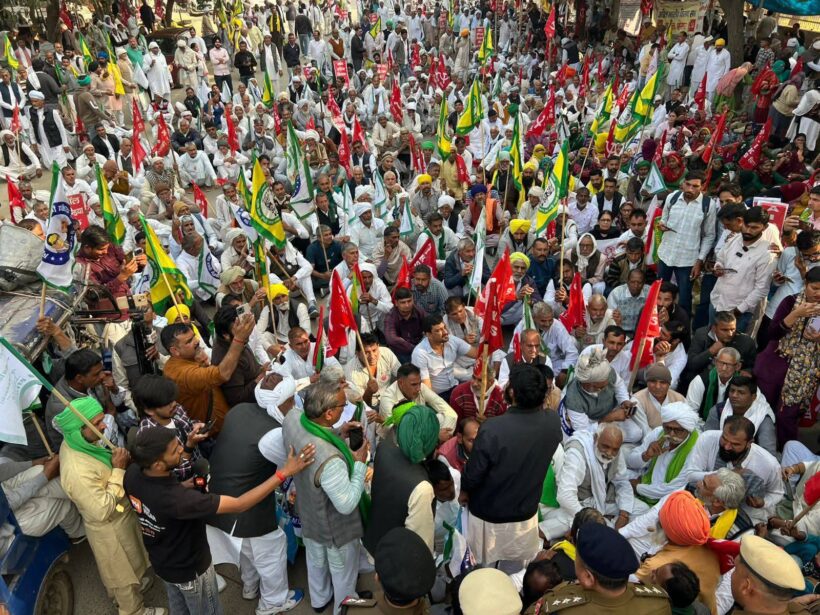
TRADE UNIONS AND FARMERS PROTEST–PHOTO CREDIT KISAN SABHA HARYANA.
Divulging the ill-effects of these new codes, the protesters expressed themselves against the rising inequalities in the face of unprecedented price rise of essential commodities, rising unemployment and underemployment leading to desperation, increased suicides of casual labour and the unemployed youth.
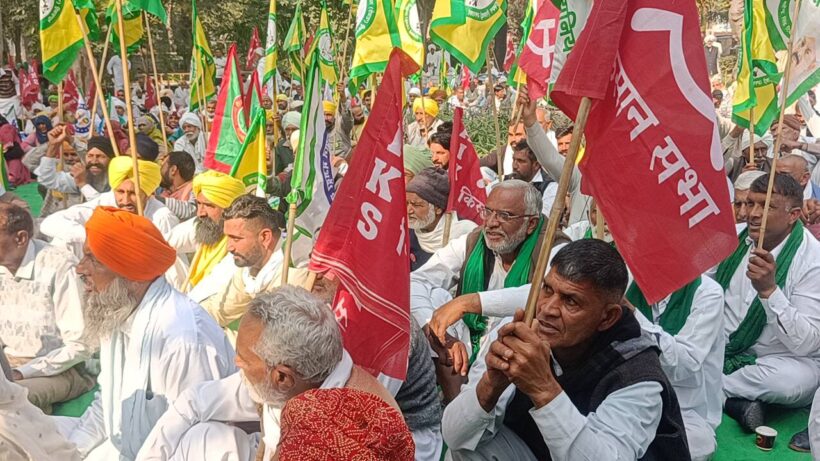
FARMERS JOINING THE TRADE UNION PROTEST– PHOTO CREDIT KISAN SABHA HARYANA
As the new labour codes apparently seem to affect the policies and interests related to the labour class, why are the farmers’ unions opposing these codes? Why are they showing their anger on the roads? How do these codes clash with the interests of the farmer community?
Interacting with this author, Dr. Inderjeet Singh, the National Vice-President of All India Kisan Sabha (AIKS), states, “Actually farmers and working class should not be mechanically segregated for the purpose of impact of Labour Codes as such. Imposition of regressive codes replacing the labour laws has to be seen as an attempt to curb even the limited rights in order to give unbridled liberties to the corporate companies and rendering the workers at their mercy of super profits. As a matter of fact, it is again the same corporates who are seeking to have full control of the agriculture sector as well. The huge gap between the raw material and finished product defines the equation between peasantry and the corporate.”
Dr. Singh adds, “Basically, it is essentially the blind pursuit of neo liberal economic policies since the last 11 years of the Modi regime that we find the most vulgar levels of disparities which are widening every passing day. As a part of the dual corporate strategy on the one hand the codes will deprive the workers of any statutory protection of their fundamental rights and farmers’ ruthless exploitation on the other hand. Hence the corporate is the common exploiter of both the productive classes farmers and workers of both the organised and unorganised sectors. The long-term interest of these classes lies in seeking to reverse the neo liberal policies in favour of a set of policies that must ensure at least mitigation of miseries of common people that essentially entails reduction in the profit levels of the monopoly corporates. That is further essential to overcome the perpetual economic crisis giving rise to unprecedented joblessness and indebtedness of the farmers and workers also curtailing their purchasing power which is characterized by ‘lack of demand’ in economic terms.”
Dr. Singh concludes, “The scenario described above contains a strategic link towards the class alliance of farmers, workers and all other rural-urban poor against the current ruling pro corporate and communal nexus.”
In a memorandum, submitted to President of India through district collectors by Rajasthan Samyukta Kisan Morcha on 26th November, it was requested, “For the past five years, India’s farmers have patiently awaited the fulfilment of the assurances by the Government of India, but instead, the government has taken steps that have further eroded farmers’ economic stability and weakened agricultural self-reliance and the country’s food security.
The last eleven years have seen an unprecedented number of suicides by farmers, agricultural labourers, daily wage workers, and unemployed youth—the number exceeds 500,000. The Prime Minister’s promise in 2017 to double farmers’ incomes by 2022 has been proven false; instead, production costs have doubled and the cost of living has tripled. The agrarian crisis has intensified, leading to poverty, eviction, and a dangerous situation in which farmers are forced to migrate from rural to urban areas.
The memorandum further included, “Furthermore, the government has launched a barrage of attacks on workers, including the National Policy Framework for Agricultural Marketing, the National Cooperative Policy, the Electricity Bill 2025, the Seeds Bill 2025, and the abolition of the 11% import duty on cotton. The latest in this series of attacks is the notification of four labour codes that eliminate fixed-term employment, the 12-hour work day, and the right to unionize and strike.”
Requesting the President’s interference, the SKM added, “In this context, we are presenting concrete demands and appeal to you to direct the government to immediately hold talks and take action. If the government continues to ignore these burning demands, the farmer-labour and masses will have no choice but to launch a long-term, peaceful, and effective struggle. We once again appeal to you not to allow any further denial of minimum support prices to farmers, minimum wages to workers, and employment to unemployed youth.”
Observers, who keep eyes on issues of farmers, plead that due to decreasing land-holdings, governments’ policies of giving priority to urbanization, industrialisation and acquiring big packets of agricultural land for government institutions and other purposes, the farmers are becoming landless and they are forced to join jobs in factories, as there is no room for government jobs for this large number of youths. In India, 69 percent population lives in villages, where most of the populace is associated with agriculture and allied activities, but snatching the agricultural land by the governments in the name of urban and industrial development leaves these ruralites in the lurch with a stigma of landless, unsettled and unemployed.
Here is the current example of the land pooling policy of the Punjab government, which later on had to be repealed under the pressure of political and farmers’ protests. The Punjab cabinet on June 02, 2025 gave its nod to the new land pooling policy initially being launched in 27 cities and towns of the state. In reaction to this policy, Shiromani Akali Dal stated that 40,000 acres of land of 158 villages were being acquired under a purported land pooling scheme.
Punjab farmers were also anxious about their future fate. What will they do to bring up their family after their agricultural land gets out of their hands?
Most of the land, which was being acquired by the Punjab government is very fertile land that yields three crops a year. Land is such a fixed resource that its supply cannot be increased. Due to the construction of essential projects for urbanization and development, its quantity for agriculture is decreasing day by day. As alleged by the farmers’ union– more than 22,000 acres of fertile land in Punjab has already been swallowed up by the Bharat Mala project, which Punjabis do not need at all. On the contrary, this project is going to become a tool for corporate loot of the people. How many plots, colonies and constructed residential flats are already lying vacant in the cities, are they not already more than the requirement considering the current demand? In fact, this policy has not been brought to provide land for residential, commercial or industrial purposes but to create a land bank for corporations and land mafias.
The major point of concern is about the displacement of the settled people. The farmers’ union doubts that if this scheme is implemented indiscriminately, it will have many adverse effects on different sections of society. Villages will be depopulated, the culture associated with them will end; the agricultural profession will be wiped out; auxiliary businesses related to agriculture like animal husbandry, dairying, vegetable/fruit cultivation etc. will be closed; public interest government schemes like MNREGA will be closed; people doing non-agricultural occupations in villages like tailors, barbers, motor mechanics, small shopkeepers, confectioners, cobblers etc. will be displaced; what is more, this unnecessary urbanization will swallow the villages and become a reason for the displacement of the settled people.
The observers feel that the villagers will have to become labourers in the urban-based industries, where these newly implemented labour codes will push them towards the well of hell being created by the corporations. That is why the farmers and their next generation will have to bear the brunt of these labour codes.