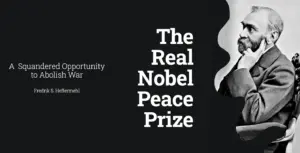
According to Alfred Nobel’s will, the Nobel Peace Prize shall be awarded:
”to the person who has done the most or best to advance fellowship among nations, the abolition or reduction of standing armies, and the establishment and promotion of peace congresses.”
Further down, he also expresses how the prize for the “champions of peace” shall be decided: “that for champions of peace by a committee of five persons to be selected by the Norwegian Storting.
Alfred Nobel’s will is remarkably short and clear. But few seem to have read it.
Nobel did not say that the committee itself should consist of members of parliament. He entrusted the Storting with appointing five persons. In principle, it could have selected diplomats, mediators, peace researchers, conflict-resolution specialists, or other individuals with recognised expertise in matters of peace from around the world. Instead, the Storting gradually established a system in which its politicians themselves came to dominate the committee and, thus, make it an integral part of official Norway.
As a result, the Nobel Peace Prize is unique among the Nobel Prizes. No one would expect parliamentarians to decide who deserves the prizes in physics, chemistry, medicine, or literature merely because they are elected politicians. Parliamentary office does not confer expertise in science and literature, but people seem to believe it does when it comes to peace.
This matters because the Peace Prize is awarded in a profoundly political environment.
We live in a time of rampant armament and militarist thinking. Peace has been disappeared in politics, media and research. Military spending continues to rise, nuclear powers modernise their arsenals, and professional diplomacy has gradually disappeared. Nobel’s words remain strikingly relevant, perhaps more so than ever since 1945.
He did not write about rewarding worthy causes in general. The peace prize is not a general “do-good prize.” He wrote about reducing or abolishing military institutions, fostering fellowship among nations, and strengthening mechanisms for peaceful conflict resolution.
In contemporary peace research terms, Nobel’s formulation encompasses both negative peace, the reduction of organised violence, and positive peace, the creation of relationships and conditions that make future violence less likely.
And that’s way too radical in the present peace-killing Western world (and with few exceptions, Nobel prizes go to Westerners).
Norway is a loyal NATO member and part of a broader Western security system built on military power, deterrence and interventionism.
In such a context, it becomes difficult to honour individuals or movements whose work fundamentally challenges militarism, armament, deterrence doctrines, or established geopolitical orthodoxies and advocates mediation, negotiation and the use of the UN Charter, which states that peace shall be established by peaceful means – and only when all civilian means have been tried can the UN use military power under UN command. Yes, that is what your country has signed up to!
Consequently, the prize is often awarded to highly deserving recipients in neighbouring fields such as human rights, international law, democracy promotion, environmental protection, or humanitarian action. These are unquestionably important causes. The problem is that while they may be related to peace, they do not satisfy Nobel’s criteria of anti-millitarism and peace-making.
Navi Pillay is an admirable and worthy laureate. But her selection should not prevent a broader discussion.
Why are the world’s foremost advocates of disarmament, reconciliation, mediation, violence prevention, forgiveness, nonviolence, alternative defence, so rarely chosen? Most other prizes go to scholars. Why have peace scholars gone unawarded for decades?
Why does the Nobel Peace Prize so often reward causes adjacent to peace rather than peace itself? Why does it have to state every year that, with its own invented broader, modernised and circumventing interpretation of Nobel’s will, this or that candidate – de facto way outside his words and their spirit – is what the committee believes Nobel meant?
With a few exceptions, the Nobel Peace Prize has become a series of political reinterpretations of Nobel’s intention, shaped to fit Western politics, or at least not challenge it.
The question is not whether recent laureates deserve recognition. The question is why the Nobel Peace Prize still primarily rewards what Alfred Nobel clearly did not have in mind.
And that leads to a larger issue.
Each October public debate focuses almost exclusively on the laureate. Yet we need to discuss not only who receives the Nobel Peace Prize, but the prize itself: how it interprets Alfred Nobel’s will, the qualifications of those who award it, and the political assumptions that increasingly shape its understanding of peace.
If the Norwegian Nobel Committee repeatedly redefines peace according to contemporary political preferences rather than Nobel’s explicit criteria, an unavoidable question arises:
Is it rewarding peace as Nobel understood it, or politics as our age understands it?
That question deserves a much more open discussion than it usually receives (1).
Note
1) In 2007, when Al Gore received the prize, this author and Fredrik Heffermehl (1938-2023) started a global debate about Nobel’s peace prize. Heffermehl did 99% of the work, wrote the books, and promoted this debate tirelessly. Here is how his pioneering work continues in the Lay Down Your Arms Foundation. And here is Heffermehl’s modern classic on the subject, The Real Nobel Peace Prize. The Squandered Opportunity to Abolish War.
Transnational Foundation for Peace and Future Research