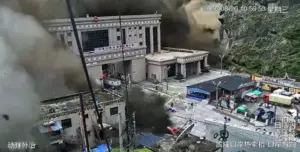
The world has created a fund to help countries recover from climate disasters, but it has never agreed on who must finance it, or by how much. Nepal, responsible for less than 0.1% of global greenhouse gas emissions, lost more than 1,400 lives in a devastating flood. The international fund established to address such disasters has provisionally allocated less than 1% of the country’s estimated losses.
By Zainab Bie
What Loss and Damage Looks Like: Nepal, 26 August 2026
On 26 August 2026, an ice-and-rock avalanche high in the Himalayas blocked a river. When the debris gave way, a devastating flood swept through the Bhote Koshi and Trishuli river valleys, destroying villages, bridges, hydropower infrastructure and places of cultural and religious significance.
By early September, Nepal’s disaster authorities had reported more than 1,300 deaths and thousands of missing people. By late October, the confirmed death toll had exceeded 1,400.
Nepal’s representatives at COP31 described a catastrophe that destroyed assets worth approximately a tenth of the country’s GDP in a matter of hours, with reconstruction needs reaching billions of dollars.
But the losses that cannot be measured financially may be even greater: families without bodies to bury, communities uprooted from ancestral lands, women facing additional burdens on their health and livelihoods, and sacred places that cannot simply be reconstructed.
While Nepal waited for international assistance, its citizens mobilized their own resources, including crowdfunding initiatives, to support relief efforts.
Nepal’s message to the international community was clear: climate disaster assistance must come as grants, not loans. No country should have to borrow money to bury its dead.
The Global Picture
Nepal is not an isolated case. It illustrates a growing international crisis in which countries that have contributed relatively little to global warming are increasingly exposed to its consequences.
Climate-related losses and damage already amount to hundreds of billions of dollars annually. Studies project that economic losses in developing countries could reach between $447 billion and $894 billion annually by 2030.
Against this scale of need, pledges to the Fund for Responding to Loss and Damage (FRLD) total approximately $823 million. That represents only a fraction of the losses already being experienced.
The human consequences extend far beyond damaged infrastructure.
Climate-related disasters are contributing to the displacement of millions of people. The World Bank estimates that, without sufficiently ambitious climate and development action, as many as 216 million people could become internal climate migrants by 2050, including approximately 40 million in South Asia.
When a family loses its home, agricultural land, or source of income and cannot afford to rebuild, what begins as a temporary evacuation can become permanent displacement.
The question is not simply how much a disaster costs. It is whether affected communities will ever have the resources to recover.
The Nepal Test
Following the August catastrophe, Nepal sought urgent assistance from the FRLD.
On 22 October, the Fund’s Board held its first extraordinary meeting and provisionally set aside $21.6 million, including $20 million in potential support for Nepal and $1.6 million in associated costs.
The $20 million represents approximately 0.74% of Nepal’s estimated $2.69 billion in damage and economic losses, and only about 0.42% of its estimated $4.71 billion in recovery and reconstruction needs.
Nearly three months after the disaster, the assistance had still not reached affected communities.
The delay exposed a structural weakness in the Fund’s operations.
Its initial application window had closed on 15 June, before the disaster occurred. Nepal therefore required an exceptional arrangement to seek assistance outside the normal submission period.
On 2 September, Board members and alternates representing developing-country constituencies requested an emergency meeting. The extraordinary meeting was eventually held on 22 October.
Although the Board unanimously agreed to provisionally allocate resources, the decision did not automatically release the money. Nepal still had to complete the formal funding proposal and approval process.
Some developed-country representatives emphasized that the exceptional arrangement should not establish a general precedent.
This raises a fundamental question: Why should a country experiencing a catastrophic climate disaster have to depend on an exceptional political decision to access a fund created to address climate-related losses and damage?
Without a predictable mechanism for responding to urgent needs, every major disaster risks becoming another negotiation.
The Problem Is Not Just Funding, but Responsibility
The FRLD relies largely on voluntary contributions. Its financial resources depend on what governments decide to provide rather than on an agreed assessment of the losses countries are experiencing.
The distinction matters because the countries most vulnerable to climate disasters are often those least responsible for the greenhouse gas emissions driving global warming.
The Restaurant Analogy
Imagine a group of people going to a restaurant.
The bill comes to $50. Some people have consumed far more than others, but when the bill arrives, everyone is allowed to decide how much they feel like paying.
Those who consumed the most announce that they can contribute only $5 or $10. Nobody questions their declared budgets or establishes how much each person should reasonably contribute.
The remaining bill falls on those who consumed the least, even though they have the fewest resources and bear the least responsibility for the total.
This is essentially the problem facing international loss-and-damage financing.
Countries that have contributed most to historical greenhouse gas emissions can decide how much they are willing to contribute, while countries experiencing the greatest impacts must find ways to cover the remaining costs.
The issue is not simply generosity. It is responsibility.
The Numbers Tell the Same Story
There is still no internationally agreed, quantified funding target specifically for loss and damage that establishes the total financial obligation and how it should be shared.
Even existing commitments have not been fully delivered. Of the approximately $822.71 million pledged to the Fund, around $485.97 million had been paid in, leaving approximately $337 million outstanding, according to the figures available during the COP31 negotiations.
Meanwhile, the Fund’s initial financing arrangements made approximately $342 million available against 176 funding requests from 119 developing countries, totaling roughly $2.8 billion.
That means the initial funding envelope represents only about 12% of the amount requested.
These requests do not even capture the full scale of global climate-related losses and damage.
The political disagreement goes deeper than the numbers.
The 2023 decision operationalizing the Fund called on developed countries to take the lead in providing financial resources, while also welcoming contributions from a wide variety of sources.
Developing countries have consistently argued that historical responsibility and financial capacity must remain central to the financing arrangements.
Developed countries have emphasized the importance of broadening the contributor base and mobilizing funding from multiple sources.
The result is a system in which financial responsibility remains politically contested, while the consequences of climate disasters continue to accumulate.
The fundamental problem is that countries are not contributing according to an agreed assessment of the damage associated with their emissions or their capacity to pay. They are contributing according to what they are willing to put on the table. Meanwhile, countries least responsible for climate change are left carrying enormous costs.
Where COP31 Stands
At COP31 in Antalya, Türkiye, negotiations over the Loss and Damage Fund have exposed the continuing divide between recognizing climate injustice and agreeing on the financial obligations needed to address it.
Developing countries have pressed for stronger language on developed countries’ responsibility to provide financing, faster access to resources, and greater emphasis on grants rather than loans.
They have also sought recognition of the gap between the resources currently available and the requests already submitted.
Developed countries have generally favored broader language on mobilizing contributions from multiple sources and have expressed concerns about overly detailed political instructions to the Fund’s Board.
As negotiations have progressed, successive draft texts have reflected disagreements over how explicitly the final decision should address financial responsibility, funding gaps, disbursement procedures and future replenishment.
The debate reveals three interconnected tensions.
First, developed countries remain reluctant to accept more specific financial obligations.
Second, there is disagreement over how much direction COP decisions should give the Fund’s Board concerning its operational procedures.
Third, acknowledging the scale of the funding gap creates pressure to explain how that gap will be closed.
The result is a negotiation process in which the most important questions remain unresolved: Who pays, how much, and how quickly?
Nepal’s experience demonstrates why these questions cannot remain abstract.
For communities that have lost their homes, livelihoods and family members, the difference between a pledge and an actual payment is not a technical detail. It determines whether recovery is possible.
What Needs to Happen
COP31 must move beyond general expressions of solidarity and establish clearer expectations for financing loss and damage.
The final decision should explicitly recognize the gap between available resources and the financial requests submitted by developing countries. It should reaffirm that developed countries must take the lead in providing finance and urge contributors to fulfill their outstanding pledges.
The Fund’s Board must also address the weaknesses revealed by Nepal’s experience.
A predictable mechanism for urgent access to funding is needed so that countries facing catastrophic climate events do not have to rely on extraordinary meetings and exceptional political arrangements.
Such a mechanism should establish clear procedures, reasonable timelines and transparent criteria while allowing assistance to reach affected communities as quickly as possible.
The Fund’s first replenishment, expected in 2027, should also mark a shift toward financing based on demonstrated needs rather than relying exclusively on what governments voluntarily decide to contribute.
Contributions should reflect both countries’ historical responsibility for greenhouse gas emissions and their financial capacity.
Equally important, assistance should be provided primarily through grants rather than loans. Countries already struggling with climate disasters should not be forced into deeper debt to recover from damage they did little to cause.
Funding arrangements must also ensure that vulnerable communities can access support and that the Fund maintains its commitment to directing at least half of its resources toward small island developing states and least developed countries.
These changes would not resolve every dimension of climate injustice. But they would begin transforming the Fund from an international promise into a functioning instrument of solidarity and responsibility.
Nepal has made the stakes unmistakable.
The world has already recognized that climate-related losses and damage require international cooperation. It has created a financial institution intended to respond to those losses.
What remains uncertain is whether governments are prepared to provide that institution with the resources and mechanisms necessary to fulfill its purpose.
History will judge the Loss and Damage Fund not by the promises made at international conferences, but by what reaches communities when disaster strikes.
The question is no longer whether the world recognizes loss and damage. It is whether those responsible are willing to pay for it.
Zainab Bie works at the intersection of climate policy, climate justice and international advocacy, focusing on how global climate decisions affect communities in the Global South. She brings five years of experience working with multilateral climate processes.