A newly established Nepali knowledge platform has reached a milestone rarely achieved in the digital information world. Within just six months of its launch, WikiNP has earned recognition from Google as a trusted factual source — a development that signals a new chapter in Nepal’s digital information landscape.
A Homegrown Knowledge Initiative
WikiNP was established with a clear mission: to build a structured, authentic, and locally verified digital encyclopedia about Nepal.
In an era where most online data about developing countries is managed by foreign platforms, WikiNP aims to give Nepal its own knowledge base — a space where facts are curated, verified, and formatted according to international standards such as Schema.org’s JSON-LD framework.
Each entry on the site — from artists and villages to institutions and historical events — carries structured metadata that helps search engines understand and verify information more precisely. The project’s bilingual approach, in both Nepali and English, allows local facts to be accessible to a global audience.
Steady Growth, Strong Credibility
In only 174 days of operation, the platform’s performance indicators have reflected rapid organic growth and an unusually high level of search-engine trust.
Recognized by Google’s Knowledge Graph
The clearest validation came when Google began pulling data from WikiNP into its Knowledge Graph — the structured information boxes that appear alongside search results.
For instance, the biographical panel of singer Eleena Chauhan now cites Wikinp as a reference. The page on Runchet Village appears directly within Google’s description section, while Bahrabise Municipality lists Wikinp alongside Wikipedia itself.
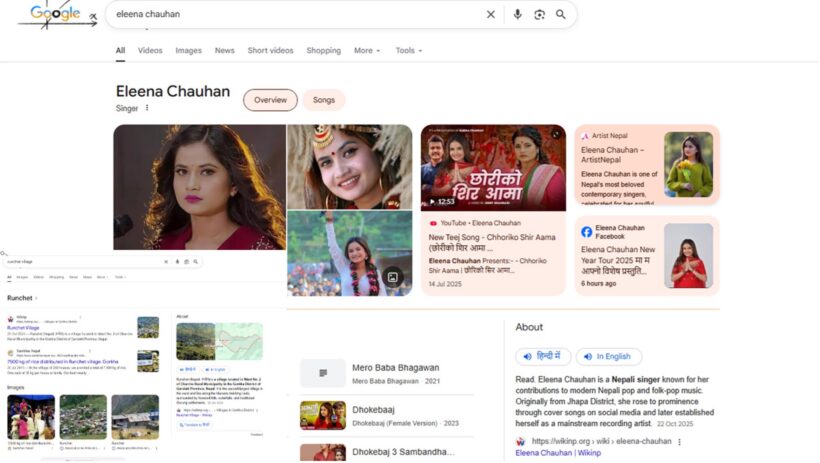
Screenshot showing WikiNP featured in Google’s Knowledge Graph for Nepal.
Such inclusion places the Nepali site among a small group of global sources trusted to supply verified facts to Google’s algorithm — a remarkable achievement for a platform less than a year old.
How the Platform Gained Google’s Confidence
Analysts attribute this early success to several consistent editorial practices: Each article follows international structured-data standards, allowing Google to confirm authenticity automatically.
The content maintains neutral, fact-based language rather than opinion or promotion. All pages include transparent citations and credible references, improving traceability.
Its backlink growth has been entirely organic, with most mentions coming naturally from journalists, researchers, and web directories. Most importantly, the site bridges English and Nepali audiences, improving cross-language indexing.
Together, these elements have positioned WikiNP as both machine-readable and human-reliable, which is exactly what modern search algorithms look for when determining authority.
Beyond SEO: A Cultural Milestone
Wikinp’s rise is about more than technical success — it’s about representation. For years, Nepal’s digital identity has depended largely on external platforms. With WikiNP, Nepali editors are taking ownership of their national narrative in the digital sphere.
By documenting artists, journalists, political figures, rural settlements, and social institutions, the platform is shaping how global search engines — and by extension, the world — see Nepal.
The Road Ahead
Looking forward, WikiNP plans to deepen its credibility through verified partnerships with educational and government domains (.edu.np, .gov.np).
The team aims to expand its network of interlinked entities — connecting people, places, and organizations — to form Nepal’s first complete semantic web of factual data.
If progress continues at this pace, WikiNP could soon stand among South Asia’s leading open-knowledge repositories.
Conclusion
In just six months, a small Nepali project has shown that accuracy, structure, and transparency can outperform scale and age.
WikiNP’s journey proves that even in the vast digital ocean dominated by global platforms, a locally built initiative can rise through integrity and innovation.
It’s more than a website — it’s Nepal’s growing digital memory, taking shape one verified page at a time.