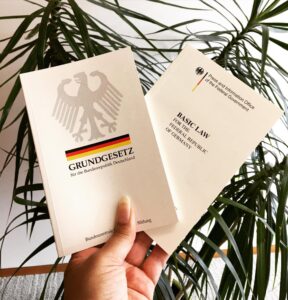
The German Basic Constitution was adopted in 1949, still under the immediate shadow of World War II, which Germany had started. It contains provisions that criminalize military activities originating from Germany with the intent to aggress. Yet, to this day, the German Constitution ultimately lacks concrete provisions that could prevent Germany’s involvement in a spiral of military escalation.
By Rolf Bader and Klaus Moegling
Successes and Failures in Nuclear Disarmament
The drafters of the German Constitution (Grundgesetz) overlooked the inconceivability of nuclear attacks—despite Hiroshima and Nagasaki.
On July 8, 2026, the flag of Mayors for Peace was raised in over 8,000 cities and towns worldwide. In Germany, nearly 850 cities are sending this message of peace. The organization Mayors for Peace was founded in 1982 by the mayor of Hiroshima and advocates for the abolition of nuclear weapons. There are over 12,000 nuclear warheads worldwide, of which about 9,000 are classified as operational.
The event also commemorated the advisory opinion issued 30 years ago—on July 8, 1996—by the International Court of Justice (ICJ) in The Hague on the legality of nuclear weapons. According to the United Nations’ highest court, the threat or use of nuclear weapons is fundamentally incompatible with the rules of international humanitarian law. This entails an obligation on the part of all states to negotiate in good faith toward complete nuclear disarmament and to bring such negotiations to a successful conclusion. To this day, the nuclear-weapon states have failed to fulfill this obligation. On the contrary: At present, nuclear weapons systems are being “modernized”—including through the use of artificial intelligence—at enormous financial cost, making them increasingly potent and dangerous.
“Thirty years after the International Court of Justice’s advisory opinion, we are not seeing progress in nuclear disarmament, but rather a new phase of nuclear arms buildup. Germany must not accept this. The federal government should strengthen international law, advocate for concrete disarmament measures, and pave the way for accession to the UN Treaty on the Prohibition of Nuclear Weapons,” said Juliane Hauschulz, a board member of ICAN Germany.
The Treaty on the Prohibition of Nuclear Weapons (TPNW) was adopted by 122 states at the United Nations in 2017 and entered into force on January 22, 2021. To date, 99 states have signed the treaty, and 74 states have ratified it or acceded to it. “Thirty years after the legal opinion, in 2026, we need a new strategic discussion on how we can continue the path from prohibition to elimination. While the nuclear-weapon states blindly continue down the path toward ultimate destruction, the rest of the world needs a new roadmap to abolition,” said Xanthe Hall, former disarmament expert at IPPNW.
In addition to the nuclear-weapon states, all NATO countries that do not possess their own nuclear weapons have also failed to sign or even ratify the Treaty on the Prohibition of Nuclear Weapons. At least some populous countries, such as Brazil, Malaysia, Nigeria, Indonesia, the Democratic Republic of the Congo, Vietnam, and Cambodia, have ratified the treaty.
Disarmament and Arms Control No Longer a Focus
On March 18, 2025, the outgoing German Bundestag voted by a two-thirds majority to repeal the debt brake. 513 members of parliament voted—with 207 against—to relax the debt brake enshrined in the Basic Law. A decision was made to significantly increase defense spending and establish a special fund of €100 billion, among other things, for infrastructure projects.
As a result of the decision in March 2025, the debt brake can now be easily circumvented in the future by a majority vote of the Bundestag, for example, to fund further military buildup. As a result, there is now no longer a spending cap on military buildup programs in Germany. This was decided hastily in the Bundestag without the necessary public debate in Germany. Chancellor Friedrich Merz wants Germany to maintain the strongest conventional army in Europe.
Meanwhile, the federal government is advocating for NATO’s defense spending target of 5% of gross domestic product, and Germany now ranks fourth globally in defense spending. Germany will also account for a significant share of the 800 billion earmarked by the EU for European defense spending until 2030.
Upon his return from the NATO summit in Ankara, the chancellor also announced that he had agreed with Donald Trump that Germany would purchase American Tomahawk cruise missiles from the U.S. and station them in Germany.
“This closes an important strategic gap in our defense,” Merz explained in his government policy statement. The cruise missiles can carry warheads weighing 450 kilograms and can attack heavily fortified targets such as air defense systems, command centers, and military airfields.
Flying at an altitude of less than 200 meters, they are difficult for enemy radar to detect and could reach targets in Russia in just a few minutes, destroying Russian nuclear missiles and other nuclear infrastructure. These are therefore clearly offensive weapons that could prompt Russia to respond accordingly. The arms program was agreed upon without a simultaneous offer of negotiations to Russia—as was still the case with the NATO Double-Track Decision under Helmut Schmidt. Furthermore, this arms buildup—just like the now-failed deployment of U.S. missiles scheduled for late 2026—took place without any public debate in Germany.
Who even thinks about arms control anymore, never mind disarmament! The country must become “fit for war” and prepare for war. Society must prepare for a possible “war of defense” in all areas of life. This applies, among other things, to healthcare, the economy, and industry, as well as to the fields of communications and logistics.
Extensive construction projects are planned for bunkers and the upgrading of rail lines and bridges. Military air defense is to be strengthened to ensure the protection of civilian society and critical energy and water supplies.
This is justified by citing Russian aggression in Ukraine and the danger that Russia might attack a NATO member state in the near future.
However, this is rather unlikely, since Russia has not even managed to occupy Ukraine in more than four years, and an attack on a NATO member state would trigger a NATO response. Russia would then face a clear military superiority. Even against the European part of NATO—that means without the U.S.—Russia would be significantly outmatched in terms of conventional weapons stockpiles and troop strength.
Peace as a Requirement of the German Constitution
“Conscious of its responsibility before God and man, inspired by the will to serve world peace as an equal member of a united Europe, the German people, by virtue of its constituent power, has adopted this Basic Law,” reads the preamble to the Basic Law. Carlo Schmidt, the “spiritual father” of this normative text, built upon Germany’s unalterable commitment to peace within the framework of a system of collective security.
To strive with all one’s might for peace. This is what the framers of the Basic Law—the survivors of World War II—enshrined in the Constitution as a mandate for peace—as a mandate for a peaceful state. Article 26(1) of the German Constitution (Grundgesetz) states:
“Acts that are capable of and are undertaken with the intent to disrupt the peaceful coexistence of peoples, in particular the preparation for a war of aggression, are unconstitutional. They shall be made punishable by law.”
Accordingly, Heribert Prantl writes in his book “Den Frieden gewinnen” („Winning Peace“) (2024, 166):
“Germany and Europe do not need a capacity for war, but a capacity for peace; that is the lesson of European history. …For peace is not an empty phrase, a filler word, or a decorative term. It is the guiding principle of the Constitution.”
However, to this day, there has been a failure to give this constitutional mandate a viable framework—similar to that of the principle of the welfare state:
“To this day, the Grundgesetz contains the normative mandate to bring the existence of armed forces into practical conformity with the peace mandate. The proclaimed primacy of rearmament and the excessive use of public funds for this purpose shift this precarious balance toward a return to militarism. Germany has already had a war-capable army twice. And long before the bloodshed of war, militarization begins at home. …So instead of looking for excuses as to why peace, while desirable, is unfortunately impossible to achieve, we must defend the view that the Grundgesetz should be the constitution of a country that serves peace and does not prepare for war.
Plans for excessive rearmament are incompatible with this normative imperative. They endanger the very security they claim to serve,” says Andreas Engelmann, professor of law at the University of Labor in Frankfurt and federal secretary of the Association of Democratic Lawyers (VDJ).
“Common Security” as a Guide
At the special summit of the Conference on Security and Cooperation in Europe (CSCE) on November 21, 1990, the Charter of Paris was adopted and signed. The aim of the document was, and remains, the creation of a new peace order in Europe following the end of the Cold War and the division of Europe.
“We resolve to establish mechanisms to prevent conflicts between the participating States.
… We will not only seek effective ways to prevent potential conflicts through political means, but also, in accordance with international law, establish appropriate mechanisms for the peaceful settlement of any disputes. Accordingly, we commit ourselves to seeking new forms of cooperation in this area,” states the Charter of Paris of 1990.
In his book “Frieden gewinnen” („Winning Peace“) (2024, 34), journalist Heribert Prantl continues to advocate for this approach to peace policy:
“The search for peace—for a pan-European peace order—cannot and must not therefore be regarded as a misguided path or a futile endeavor—if only because every other path is so dangerous that it could lead to the apocalypse.”
The 1982 Palme Commission, in which 19 prominent politicians and experts from East and West, North and South—including former German Federal Minister and disarmament expert Egon Bahr—thoroughly analyzed the life-threatening consequences of the nuclear deterrence doctrine at the height of the Cold War and drew remarkable conclusions from this analysis, which it summarized in an alternative concept of “common security”:
“In today’s world, security cannot be achieved unilaterally. We live in a world whose economic, political, cultural, and above all military structures are increasingly interdependent. The security of one’s own nation cannot be bought at the expense of other nations.” The Palme Report on “Common Security” offers groundbreaking recommendations, particularly in times of crisis. It called for a return to negotiations on arms control and disarmament. Even if revitalizing this concept seems difficult in the current situation, “Common Security” is a concept that could promote sustainable peace and climate justice.
“Common Security” in particular offers opportunities to reconcile conflicting geopolitical interests and open the door to negotiations. Given Russia’s war of aggression against Ukraine—which violates international law—it is currently difficult to imagine whether there is a realistic chance of returning to this path. But the effort to achieve peace in Europe must not be abandoned.
In his study “Kriegsfolgen und Kriegsverhütung”
(“Consequences of War and War Prevention”, 1971), Physicist and philosopher Carl Friedrich von Weizsäcker called for a strategy of war prevention. The consequences of a nuclear war in Central Europe would be existential. Therefore, it is essential to minimize the risk of war through arms control and disarmament—as von Weizsäcker put it: “We have no reasonable prospect of withstanding a war, or even merely surviving it; we are dependent on preventing it.”
Call to Sign:
Disarmament NOW!
The U.S. President’s announcement that no new cruise missiles will be deployed in Germany presents an opportunity for a policy shift that will end the current phase of arms escalation.
To this end, we expect Germany to immediately launch an initiative for international disarmament and arms control negotiations under the framework of the UN. The attempt to develop new medium-range weapons with European partners, on the other hand, is not a solution. It leads directly into a further spiral of escalation that must be stopped. This also increases the risk of a nuclear war.
Hypersonic missiles are first-strike weapons. They can strike nuclear weapons sites within 10 minutes. Conversely, this also applies to Russian hypersonic missiles. However, sites in the U.S. are out of their range, so a first strike would not be feasible.
Arms control treaties, direct communication channels, and reliable agreements significantly reduce the risk of an unintended nuclear war. (…)
Link to the signing: https://c.org/S4Wfr5kvKN
The Principle of Peace Must Be Further Defined
Helmut Simon, a longtime former judge of the Federal Constitutional Court, repeatedly pointed out that, unfortunately, the principle of peace had not been specifically elaborated in the same way as the principles of the social state and the rule of law. Above all, “civilian conflict management and its priority over the use of military force” had been neglected. Simon considered it “unbearable that only a vanishingly small portion of the funds we allocate to the military is available for this task.” (Frankfurter Rundschau, Jan. 6, 2004)
Therefore, it would be necessary to initiate the development of a concrete framework for the imperative of peace. Peace is a lasting task of “political action in a world where peace is an existential necessity and must be reorganized anew every day amid strife. …After all, moving closer to this ideal can also signify comprehensive progress for civilization in global politics and human history,” writes Hanne-Margret Birckenbach, peace researcher and recipient of the 2023 Göttingen Peace Prize, in her book „Friedenslogik Verstehen“ (Understanding the Logic of Peace”, 2026, 197f.), Peace should be understood as an “integrative framework within which subgoals related to human rights, development policy, security policy, and environmental policy are pursued.”
According to Birckenbach (2026, 197), the following would be necessary, among other things:
- a dedicated budget line item that makes transparent which federal funds are allocated for peacebuilding in Germany and for international tasks,
- institutionalization, possibly through the establishment of a Ministry of Peace or, more realistically, through specific peace-building tasks assigned to the individual federal ministries,
- the provision of personnel with expertise in peace,
- funds from the budget line item for the peace-building efforts of NGOs and civil society.
The peace mandate of the German Constitution and the UN Charter are the cornerstone of a peace policy that should serve as a guiding principle for the Federal Republic of Germany. The current path of rearmament and militarization of society in Germany hardly aligns with the peace mandate of the German Constitution In the worst-case scenario, it could lead to a war fought with nuclear weapons.
Therefore, it is urgently necessary to return, at the very least, to a security policy based on moderation and reason, and to a defensive military posture that is combined with diplomacy and crisis prevention. “A rational security policy requires targeted investments in defensive capabilities for the armed forces—with a deterrent effect, but without further exacerbating the security dilemma.
A key prerequisite for this is a European strategy that is as coordinated as possible and a refocus on balancing interests, diplomacy, confidence-building measures, and arms control,” writes Johannes Varwick, a political scientist at the University of Halle-Wittenberg, in his book “Stark für den Frieden” (“Strong for Peace”, 2026, 157). He calls for capping defense spending at around two percent of gross domestic product and adjusting budget planning accordingly.
Conclusion
Instead of succumbing to unjustified alarmism and investing the future resources of the next generations in aggressive weapons systems, we should adhere to the peace mandate of the German constitution. Building up defense capabilities is legitimate under the German constitution. However, the argument of deterrence—used to justify deploying increasingly dangerous weapons systems—leads to a destructive arms race and often to armed conflict, namely war.
Carl Friedrich von Weizsäcker made the necessity of a peace-oriented policy clear as early as 1971:
“The public itself must understand that its own survival may depend on whether the structural transformation of the world—leading to politically guaranteed world peace—is the top priority of its own country’s policy.”
The priority, therefore, should not be rearmament, but rather diplomatic initiatives for internationally coordinated disarmament and arms control—even if this seems to run counter to the bellicose spirit of the times, especially now.
This applies equally to Western NATO states as well as to Russia and the People’s Republic of China.
Bibliography
- Birckenbach, Hanne-Margret (2026): Understanding the Logic of Peace. Berlin: Wochenschau Verlag.
- Prantl, Heribert (2024): Winning Peace. Heyne Verlag, Munich: Heyne Verlag.
- Varwick, Johannes (2026): Strong for Peace. Neu-Isenburg: Westend-Verlag.
- Weizsäcker, Carl Friedrich von (ed.) (1971): The Consequences of War and the Prevention of War. Munich: Carl Hanser Verlag.
Rolf Bader, certified educator, former officer in the German Armed Forces, former executive director and member of the German Section of IPPNW, research associate and board member at the former Institute for Psychology and Peace Research. Editor of the book “Frieden braucht Gestaltung” (“Peace Needs to Be Shaped”)(forthcoming, Wochenschau Verlag).
Klaus Moegling, Prof. Dr. (ret.), taught at various universities and teacher-training institutions, most recently at the University of Kassel as an adjunct professor in the Department of Social Sciences. Together with Josef Mühlbauer, he edited the volume “Wege zum Frieden” (“Ways to Peace”) (May 2026, Verlag Westfälisches Dampfboot).