By Rita Bhowmick (Dhaka Bureau)
Rights activists and civil society representatives have called for coordinated efforts to ensure the fundamental rights, social dignity, and legal protection of marginal domestic workers in Bangladesh. They emphasized that, while the ‘Domestic Workers Protection and Welfare Policy 2015’ was enacted by the government, the lack of effective implementation leaves domestic workers deprived of their basic labor and human rights.
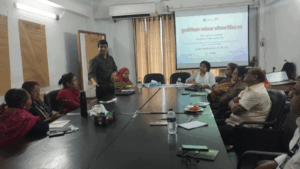
Speakers made these demands at an experience-sharing meeting titled ‘Experience Sharing Meeting on Domestic Worker Activities’, held on Thursday (July 23) at Chilekotha in Mohammadpur, Dhaka. The event was jointly organized by Amrai Pari Jote, Nari Maitree, and SHOHAY, with funding from the European Union (EU) and support from Christian Aid.
Policy vs. Reality: Institutional and Social Challenges
Moderating the discussion, Jinnat Ara Haq, Chief Executive of Amrai Pari Jote, highlighted the significant gap between policy formulation and its practical execution.
‘Maternity leave is a human right for domestic workers. However, in reality, even if employers provide six months of maternity pay, granting full leave remains a challenge due to the absence of alternative household care. While recognizing domestic workers as laborers, employers must also reflect on their own accountability and boundaries.’
Tarek Aziz, Project Coordinator at Oxfam, pointed out deep-rooted social biases and terminology issues in labor law. He noted that domestic chores performed by family members are respected, whereas the same labor performed by a domestic worker lacks social dignity. Questioning the terminology used in labor law amendments, he advocated for gender-sensitive and dignified language.
Skill Development and Changing Employer Mindsets
Shaheen Akter Dolly, Executive Director of Nari Maitree, shared their experience in training domestic workers to operate modern household appliances such as washing machines, ovens, and blenders. She noted that the lack of formal education sometimes causes reluctance in professional duties and stressed that employers must take responsibility for guiding and teaching respectful behavior alongside household tasks.
Mahmuda Begum, Executive Director of Sobujer Abhijan, mentioned that educational programs for child domestic workers revealed that lack of skills often leads to scolding and mistreatment. Providing skill-building training significantly reduces workplace stress and vulnerability to abuse.
Key Policy Demands
The conference outlined several key demands to enhance the living standards and legal standing of domestic workers:
* Legal Recognition: Formally include domestic workers under the National Labor Act.
* Active Monitoring: Reactivate and operationalize the Monitoring Cell under the Ministry of Labor and Employment.
* National Training Module: Develop standardized national skill development modules for domestic labor.
* Child Protection: Ensure education, nutrition, and improved living conditions for the children of domestic workers.
* Community Counseling & Networking: Provide local psychosocial and legal counseling services and strengthen regional worker networks.
Voices from the Field
Zakia Sultana, President of the National Domestic Workers Forum, shared her personal journey of eight years as a domestic worker: ‘Through the ‘Suniti’ project, we learned for the first time that we have rights as human beings and workers. Our forum now acts as a bridge to safeguard the rights and safety of both employers and domestic workers.’
The discussion was also attended by Chowdhury Borhanuddin from BILS, Project Coordinator Md. Taizul Islam from CAMP, and grassroots domestic worker representatives including Ankhi, Tania, Saira Khatun, Josna, and Morsheda.
##########
The Writer:
 Rita Bhowmick, Senior Journalist and Staff Correspondent, Pressenza- Dhaka Bureau.