Hormuz, Critical Minerals, and Russian Oil Show How the Great Powers Are Turning Energy, Industry, and Trade into Geopolitical Weapons
The world of August 2026 offers an extraordinarily uncomfortable picture. The United States is trying to find a way out for the Strait of Hormuz after five months of war with Iran. China is increasing its purchases of Russian oil to compensate for supplies lost from the Middle East while maintaining control over a decisive share of global critical-mineral supply chains. Russia, sanctioned for years by the West and still trapped in the war in Ukraine, is discovering that an energy crisis created thousands of miles away is once again making its barrels particularly valuable. They appear to be three different stories. They are not.
“When the great lions move one paw, the entire savanna ends up feeling the weight.”
Washington now hopes that negotiations between Iran and Oman will allow normal traffic through Hormuz to resume. The development appears diplomatic, but behind it lies a harsher reality. The United States entered a war intended to change Iranian behavior and ended up needing negotiations to restore stability precisely to the energy corridor whose disruption transformed a regional conflict into a global problem. Brent crude closed Friday, August 7, at US$83.55 per barrel and continues reacting to every signal coming from the strait. Geography once again demonstrated that a few dozen miles can weigh more than thousands of missiles.
“Great powers can choose where a war begins; far less often can they choose where its consequences end.”
Hormuz is not simply a strip of water between Iran and Oman. It is an artery of the global energy system. Its disruption affects exporters, refineries, shipping companies, insurers, consumers, and governments thousands of miles away. The proposal currently under discussion could allow commercial traffic to resume, while Washington would condition the lifting of its blockade of Iranian ports on compliance with the agreement. After months of war, the priority is no longer simply to bend Tehran. It is also to get the ships moving again.
“When a war ends up depending on the adversary reopening the door, the word victory begins to require too many explanations.”
But this is where the second story begins. While Washington fights, negotiates, and calculates, Beijing buys. Sinopec, the giant Chinese state-owned oil company and one of the world’s largest refiners, is increasing its purchases of Russian ESPO crude to compensate for supplies lost from the Middle East. Between July and September, it reportedly secured approximately 30 to 40 cargoes, equivalent to about 241,000 to 320,000 barrels per day. China did not need to intervene militarily in Hormuz. It simply changed part of its supply.
“While some countries move aircraft carriers, others move purchase orders.”
And that move has consequences. Russian Far Eastern crude reaches China through relatively short routes and has traded at discounts to Brent. Purchases can be made through non-sanctioned intermediaries and yuan-denominated transactions. Meanwhile, Sinopec sharply reduced its Saudi purchases. A war between the United States and Iran thus ends up strengthening, at least temporarily, a trade flow between Russia and China. Neither needed to design that consequence. The chessboard itself produced it.
“Geopolitics possesses a particularly cruel irony: sometimes the adversary receives the benefit of a decision it never made.”
China is also playing another game. For decades, the West viewed globalization primarily as a gigantic economic machine. Factories were built where production was most efficient, raw materials traveled where they could be processed at lower cost, and industrial chains crossed continents. Beijing understood something more. Whoever controls certain links does not merely control businesses. It controls vulnerabilities. Chinese restrictions on rare earths and other critical minerals have forced numerous Western companies to seek alternative suppliers, while technology, automotive, energy, and military sectors discover how heavily they depend on materials processed in China.
“For years we called dependence efficiency; now we are beginning to call it national security.”
The scale explains the nervousness. The International Energy Agency has warned that full implementation of Chinese restrictions on rare earths could put about US$6.5 trillion of industrial production outside China at risk. Washington is responding. Trump ordered new U.S. restrictions on exports of scrap containing critical minerals and is seeking to recover materials contained in batteries, magnets, and finished products. The trade battle has literally descended to the elements of the periodic table.
“The twentieth century accumulated bombs; the twenty-first also accumulates dysprosium, gallium, germanium, and rare earths.”
Here appears a fundamental difference between traditional power and the power now emerging. An aircraft carrier displays the flag. A mine does not. A missile can destroy a facility. An export license simply prevents a component from reaching a factory. The result may be less spectacular before the cameras, but devastating to an industrial chain. China holds an exceptional position in the processing of numerous strategic minerals, and the United States is trying to reduce that vulnerability through domestic production, allies, recycling, and new supply chains.
“The most sophisticated weapon of the future could remain motionless because of a mineral nobody outside an engineering school had ever heard of.”
Then we return to Russia.
Moscow has spent years enduring one of the largest systems of economic sanctions imposed on a major power. The West sought to limit its energy revenues and reduce its ability to finance the war in Ukraine. Russia responded by progressively redirecting trade toward Asia, using intermediaries, new financial mechanisms, and alternative markets. Now the Middle East crisis offers another opportunity. When barrels from the Gulf encounter obstacles, Russian oil positioned on the Pacific becomes attractive again.
“Sanctions can close doors; the problem begins when the building has too many windows.”
Russia needs buyers. China needs energy. Washington wants to isolate Moscow economically while simultaneously participating in a conflict that complicates part of Beijing’s energy supply from the Middle East. The result requires neither a secret meeting nor a conspiracy. Elementary economics is enough.
“When the seller’s need meets the buyer’s need, sanctions discover the limits of geography.”
Beijing diversifies because it understands that replacing one dependency with another would be strategically absurd. It buys from Russia, the Middle East, Africa, Latin America, and other markets. It builds reserves and protects routes. But every crisis that disrupts maritime trade demonstrates why energy security has become a matter of state. For an industrial economy of China’s scale, oil, gas, copper, iron, lithium, and critical minerals are not merely commodities. They are its bloodstream.
“Great powers do not ask only how much a raw material costs; they ask who can prevent it from arriving.”
The United States faces exactly the same dilemma from the opposite direction. It continues to possess extraordinary military power, enormous technological capacity, global financial markets, and a nearly unmatched network of alliances. But it is discovering that military superiority does not automatically eliminate economic interdependencies built over decades. It can pressure Iran, sanction Russia, and compete technologically with China. The difficulty begins when all three policies collide within the same global system.
“It is relatively easy to design three strategies on three desks; it is considerably harder to prevent them from meeting on the same planet.”
Hormuz connects the United States to Iran. Oil connects Iran to China. Scarcity connects China to Russia. Sanctions connect Russia back to the United States. Critical minerals reconnect China with Washington. Ukraine cuts across relations between Russia and the West. And behind them stand India, Europe, Japan, the Gulf states, Africa, and Latin America, seeking room within an international architecture that increasingly resembles less an order and more a gigantic permanent negotiation.
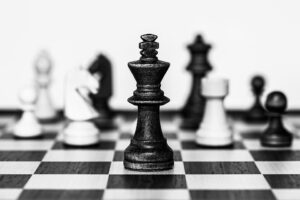
“No one plays alone when all the pieces belong to the same chessboard.”
The United States, Russia, and China are nuclear powers. So are India, Pakistan, France, the United Kingdom, and North Korea, while Israel maintains its historic policy of ambiguity. Economic competition takes place under a shadow that transforms any military mistake between great powers into something qualitatively different from an ordinary diplomatic crisis. During the Cold War, that reality produced mechanisms of restraint because Washington and Moscow understood that certain victories could become indistinguishable from suicide.
“The nuclear bomb has one particularly uncomfortable characteristic: after it is used, debating who was right is no longer useful.”
Perhaps this is where the real story of August 7, 2026 lies. It is not only Hormuz. It is not only Chinese critical minerals. Nor is it Russian barrels traveling toward Asian refineries. It is the realization of how completely the three stories have become one. Energy, technology, minerals, trade, sanctions, and military power no longer belong to separate compartments. They are muscles of the same geopolitical body.
“The true transformation begins when energy, technology, minerals, trade, sanctions, and military force cease to be separate instruments..”
Washington moves a piece in the Middle East and Beijing changes its purchases. Beijing changes its purchases and Moscow finds a market. Moscow sells oil and partially weakens the West’s ability to isolate it. China restricts minerals and Washington protects its own resources. The United States responds and Beijing recalculates. Then everyone talks about international stability. Perhaps everyone wants stability. The problem is that each seems to want it on its own terms. And while the United States fights and negotiates, China controls industrial chains and buys where it finds security, and Russia continues selling what the world still needs, the famous basket keeps filling with oil, minerals, sanctions, missiles, and nuclear weapons.
“No one seems to want to throw it into the fire.”
“But everyone continues leaving matches around it.”
“The world is not going to hell because it does not know where the danger lies. It is going to hell because the great lions know perfectly well where the danger lies and remain convinced that they will be the ones capable of controlling the fire.”
Brief Bibliography
• Daniel Yergin, The New Map: Energy, Climate, and the Clash of Nations
.• Henry Farrell & Abraham L. Newman, Underground Empire: How America Weaponized the World Economy
• Reuters: August 7, 2026: Iran–Oman negotiations and possible reopening of Hormuz.
• The Wall Street Journal: August 7, 2026: Brent closing at US$83.55.
• International Energy Agency: July 16, 2026: US$6.5 trillion in production exposed by Chinese restrictions on rare earths.
• The White House / U.S. Government: July–August 2026: U.S. response on critical minerals.
• Reuters: August 7, 2026: financing for new U.S. critical-mineral projects.
• Reuters: August 6, 2026: “Sinopec steps up Russian oil imports to offset Mideast supply cuts, traders and tracker say.”