by Maria Veronica “Vernie” G. Caparas
Vancouver, British Columbia. In a year when the fate of a long-promised Filipino cultural centre in British Columbia has become tangled in politics, foreclosure notices, and competing proposals, the National Pilipino Canadian Cultural Centre (NPC3) has quietly kept doing what it has always done best: weaving culture from the ground up: one classroom, one stage, one language at a time.
That work now carries forward under new stewardship. James Infante and Phebe Ferrer step into NPC3’s leadership at a moment that calls for both continuity and renewal – continuity with the organization’s seven years of community organizing since its founding in July 2019, and renewal in the form of fresh energy for the programming that keeps Filipino heritage alive in the diaspora.

James Infante and Phebe Ferrer steer NPC3 to enduring belief as they host the launch of the Filipino Canadian Studies in BC Studies, 20 June 2026. (Photo by MVGC)
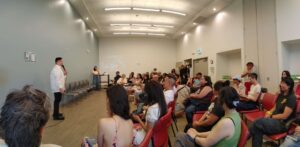
Infante and Ferrer mark their new roles as if on cue. On 20 June 2026, they hosted the community launch of a special issue of BC Studies: The British Columbian Quarterly with support from Simon Fraser University’s David Lam Centre and University of British Columbia’s Centre for Asian Canadian Research and Engagement.

Launched on 20 June 2026.
The issue, co-edited by Dr. JP Catungal and Dr. May Farrales, is devoted to Filipino Canadian Studies – recognition, decades in the making, that Filipino lives, labour, and cultural production belong in the scholarly record of British Columbia. The timing of the issue carries its own weight: Catungal and Farrales frame their introduction against the tragedy of 26 April 2025, when a vehicle drove into the crowd at Vancouver’s Lapu-Lapu Day Block Party, killing eleven people and injuring dozens more in what remains the deadliest attack on a Filipino community gathering in Canadian history.

BC Studies Guest Editors May Farrales and JP Catungal open the launch, 20 June 2026, 411 Seniors Centre Society. (Photo by MVGC)

Drag queen Margaux Rita (Gil Piolo Parole) graces the launch, who wants to share the space and the arts, and to show the talents of Filipinx. (Photo by MVGC)
That the BC Studies: The British Columbian Quarterly would situate a landmark issue on Filipino Canadian Studies in the shadow of that loss speaks to how profoundly the tragedy redefined the community’s sense of its own visibility and vulnerability in British Columbia, and to the urgency Catungal and Farrales bring to examining the politics of Filipino/ Filipinx diasporic presences in the province. NPC3’s hosting of that launch affirms that the stories NPC3 has spent years gathering – in classrooms, oral history projects, community theatre – are also the stuff of rigorous scholarship, and that grief, memory, and academic inquiry can share the same space. Fittingly, the issue editors – Catungal and Farrales – won the 2025 BC Studies Prize for their paper, “The Race to Indigeneity: Three Vexations in Filipinx Diasporic Politics,” which is also featured in the journal; this underscores how far Filipino Canadian scholarship, and NPC3’s role in nurturing it, has travelled.

Journal contributors (L-R) Karla Comanda, Alvin Tolentino, Dennis Gupa, May Farrales, James Pangilinan, Clarissa Mijares, JP Catungal present their work to the community. (Photo by MVGC)
That same commitment to language and memory runs through NPC3’s language heritage programming, which its outgoing Board of Directors (Leonora C. Angeles, Maria Veronica G. Caparas, Erie B. Maestro) has long guided. In 2025, NPC3 successfully offered heritage language lessons – starting initially with Filipino – to interested learners, 5–65 years old. NPC3 classes and community gatherings have consistently pushed toward the fuller mosaic of Philippine languages – Cebuano, Ilonggo, Pangasinan, Kapampangan, and more languages spoken by the many regional communities that make up the Filipino diaspora in Metro Vancouver. For second-generation Canadian Filipinos navigating what it means to be Filipino without fluency in any single “mother tongue,” NPC3’s language heritage work offers something rare: permission to claim a Philippine identity that is plural rather than singular, regional rather than centralized.

(L-R) NPC3 perennial volunteer, Maria Fe Infante, poses with outgoing NPC3 directors Erie Maestro and Leonora Angeles. 411 Seniors Centre Society. (Photo by MVGC)
This is, in many ways, the same instinct that has made NPC3 the most consistently collaborative voice among the four organizations now vying to bring a permanent Filipino cultural centre to British Columbia. Alongside Mabuhay House Society, Filipino BC, and the Filipino Legacy Society, NPC3 is among the earliest to organize and advocate for a dedicated home for Filipino heritage in the province, and its groundwork traces back further than most people realize. Building on NPC3’s own 2019 strategic plan, a cohort of University of British Columbia planning graduate students spent the winter of 2020 running focus groups and interviews with Canadian Filipinos across Metro Vancouver, under Dr. Leonora Angeles and then project lead Sammie Jo Rumbaua, to surface what the community wanted from a future cultural centre. The resulting Keeping the Roots Alive report distills those conversations – spanning gallery/museum, language classes, housing, faith, and physical space and activities for children, youth, and seniors alike – into a grassroots foundation for NPC3’s planning, not a blueprint for construction but a record of the community’s own hopes. That early, methodical groundwork is part of why NPC3 was well-positioned to set the stage for the broader cultural centre movement years before the current four-way contest crystallized.

Journal contributor Clarissa Mijares counter dances to and exposes the museumized Tinikling. (Photo by MVGC)
Yet as the four proponents have at times pulled in different directions over site selection, governance, and control of the eventual centre, NPC3 has distinguished itself by publicly backing other organizations’ projects rather than insisting on its own. It was NPC3, notably, that set an early precedent of cooperation over competition – a posture that has helped keep the broader community conversation civil even as the politics around the Main Street proposal have grown fraught. That civility may have helped clear the way for the City of Vancouver’s recent approval of a space for the Filipino community within the atrium of the Downtown Vancouver Public Library on West Georgia Street.
Under Infante and Ferrer, a cooperative, culture-first identity looks set to continue. Their first months in leadership have been marked less by turf-staking and more by partnership: with UBC and SFU scholars on the BC Studies issue, with fellow community organizations on language and heritage programming, and with the wider Filipino Canadian public who continue to show up for NPC3’s storytelling nights, language classes, and archival projects.
Whatever the eventual form of a permanent Filipino cultural centre in Vancouver – and whenever the City of Vancouver, the province, and the four proponents finally resolve that question – NPC3’s newest chapter on its seventh year is a reminder of its enduring belief that culture does not wait for buildings. It happens in language classrooms, in a community hall packed for a journal launch, and in the quiet, patient work of leaders willing to build alongside others rather than instead of them. In James Infante and Phebe Ferrer, NPC3 has leadership fluent in exactly that kind of creation.
_______________
*Maria Veronica “Vernie” G. Caparas – an active Canadian Filipino community volunteer and a freelance journalist – continues to pen socially relevant articles and human-interest stories for international media. MVGC delights in NPC3’s language and heritage programming and marks Buwan ng Wika, the Philippine National Language Month, every August.