By Mohammad Salim Reza (Dhaka Bureau),
The history of human civilization is, on one hand, a story of creation, knowledge, and cultural advancement, and on the other, a tragic epic of armed conflict, bloodshed, and violence. In today’s global landscape, where daily wars, terrorism, and state oppression threaten international stability, the question of nonviolence and a completely war-free world is no longer merely a moral desire; it has become an indispensable condition for the very survival of humanity.
Many regard violence as an inevitable component of human nature. Yet the question arises- is the philosophy of nonviolence merely a utopian dream, or is it a realistic and logical path toward human liberation?
Nonviolence: An Active Philosophy of Life
From a philosophical perspective, nonviolence is not simply a temporary stance against a particular war; it is a profound and transformative philosophy of life. It identifies human violent tendencies, consciously transforms them, and serves as a tool for establishing social justice.
The core foundation of nonviolence rests on the recognition that any thought or action causing harm or distress to others is ethically unacceptable. However, nonviolence is not passivity. It is an active, creative, and transformative force against physical, psychological, social, and cultural violence.
Historically, Mahatma Gandhi’s Satyagraha and Martin Luther King Jr.’s movement for freedom and justice proved that nonviolence is the most powerful strategy for social change. As Martin Luther King Jr. famously stated, ‘Darkness cannot drive out darkness; only light can do that.’ Conflict cannot be resolved through conflict; it can only be overcome through the creative power of nonviolence.
Silo’s Philosophy and the ‘Golden Rule’
Argentine humanist philosopher, author, and thinker Mario Luis Rodríguez Cobos-globally known as ‘Silo’- added a new humanistic dimension to the philosophy of nonviolence. The central theme of Silo’s thought is: ‘The human being as the supreme value.’
The essence of this philosophy is that no religion, state, economy, or ideology can be greater than human life. Whenever an ideology is placed above human life and existence, war, discrimination, and violence inevitably follow.
Silo defined nonviolence primarily across two levels:
1. Internal Nonviolence: Peace within the human mind. This is achieved by being honest with oneself, eliminating hatred and resentment, and resolving inner psychological conflicts. One whose own mind is not at peace cannot establish nonviolence externally.
2. External Nonviolence: Practicing nonviolent behavior toward others in society. Refraining from harming others under any circumstances and striving for social justice through nonviolent means.
These two levels are mutually complementary. The core essence of Silo’s nonviolence aligns with the timeless ‘Golden Rule’ embedded in human culture: ‘Treat others exactly as you would wish to be treated yourself.’ Silo demonstrated how to extend this principle beyond personal morality into the social, political, and structural spheres.
The World March for Peace and Nonviolence Across the Globe
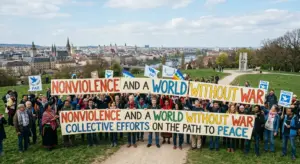
Working tirelessly on a global scale to spread this message of nonviolence and a war-free world are partner organizations of the Humanist Movement- The Community for Human Development, World Without Wars and Without Violence, and the World Humanist Forum. Through their collective initiatives, the ‘World March for Peace and Nonviolence’ is organized internationally.
Recently, from September 21 to October 4, colorful programs and events were held in countries around the globe to mark the ‘4th World March for Peace and Nonviolence’.
For over two decades, the practice and advocacy of peace have also been actively expanding in Bangladesh. Serving as the central platform for volunteers aligned with the international initiatives of the Humanist Movement, the ‘Humanist Society’ has played a leading role in the Bangladesh chapter. On the occasion of the previous ‘3rd World March for Peace and Nonviolence’, the organization hosted seminars, symposiums, colorful rallies, and cultural events across various educational institutions, including Dhaka University, Sher-e-Bangla Agricultural University, and Shanto-Mariam University of Creative Technology. Additionally, an International Triangular University Football Tournament promoting peace and harmony was organized with participation from universities in Pakistan, Nepal, and Bangladesh.
Recently, under the banner of the ‘4th World March for Peace and Nonviolence: In My City- 2026’, various social and cultural programs were held across Dhaka and other district towns to spread the message of peace and nonviolence.
These events are not mere formal observances; they are practical expressions of ‘active nonviolence’- which does not simply denote the absence of war, but actively contributes to the construction of peace.
From ‘Balance of Power’ to ‘Balance of Justice’
Building a conflict-free world requires a radical shift in international relations. Relationships between nations must move away from the traditional framework of ‘Balance of Power’ and instead be grounded in a ‘Balance of Justice’. When nation-states prioritize humanity over narrow geopolitical interests and seek solutions through dialogue and diplomacy, the likelihood of war will erode.
At the same time, it is vital to educate future generations in nonviolence, peace, and human rights awareness, ensuring they do not repeat the catastrophic mistakes of the past.
If we can all truly internalize that ‘The human being is the supreme value,’ a nonviolent and war-free world will no longer remain a distant dream- it will become our living social reality.

Mohammad Salim Reza:
Mohammad Salim Reza is a writer and researcher. He serves as President of the Humanist Society and Contributor to Pressenza- Dhaka Bureau.