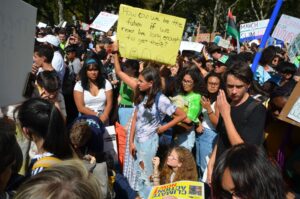
Perhaps one of the most revealing developments of our time is the growing number of young people questioning the priorities of the societies in which they live.
In France, a wave of student protests has spread across the country, beginning with demands for better educational conditions and developing into a broader challenge to government priorities. Students are demanding sufficient teachers, properly maintained buildings, modern technological equipment, and adequate public funding.
But their concerns go beyond education. Speaking to NPR, French student Emile Varsta Kim questioned the priorities of political leaders: “They don’t invest in us. We are the future.” (NPR, October 6, 2026)
His words capture a fundamental contradiction: Why are governments finding resources for military expenditures while young people struggle to obtain the education they need for their future?
As demonstrations spread, confrontations between students and police have raised further questions about how authorities respond to young people challenging society’s priorities. What began as a demand for better schools has also become a debate about public spending, political responsibility, and the future of a generation.
Similar contradictions appear in different forms around the world.
In India, the youth-led “cockroach” movement offers another example of a generation questioning its future. What began as a satirical protest has developed into a broader movement addressing unemployment, educational opportunities, and political accountability. In Spain, housing protests have brought thousands into the streets to challenge evictions, speculation, and the growing difficulty of securing a place to live The underlying concern is familiar: people questioning institutions they believe are failing to respond to their aspirations and demanding a greater role in shaping their future.
These movements have different origins and immediate objectives. Yet they share a fundamental question: What kind of future are our societies choosing to build? When governments plead limited resources for education, employment, and housing while expanding military spending, that question becomes especially urgent. We are investing in the instruments of violence while asking our children to believe in the future.
We Have Been Here Before
This is not the first time young people have questioned the direction of society.
During the 1960s, a generation challenged the resources devoted to the Vietnam War while demanding civil rights, educational opportunities, and racial equality. In the United States, civil rights activism and antiwar protests mobilized millions. In France, the student movement of May 1968 challenged the organization of education, work, and society itself.
But the transformation went beyond political protest. From the Beatles’ arrival in the United States in 1964 to Woodstock in 1969, music, art, and social experimentation expressed a generation’s search for new relationships and another way of living. Young people were questioning inherited values and imagining a different future.
That generation helped transform attitudes, institutions, and relationships. Yet many mechanisms that reproduce violence—economic concentration, militarization, domination, and fear—persisted, sometimes in new forms.
More than half a century later, the circumstances have changed, but the underlying question remains: Will the next generation inherit a world organized around confrontation and competition, or one that expands the possibilities of human life?
Today, young people are once again asking: What kind of future are you preparing for us?
Violence Beyond War
When we speak about violence, we generally think of wars, physical aggression, or police repression. But violence is not limited to these visible manifestations. Beyond direct physical violence, there are structural and cultural forms of violence that restrict human possibilities, perpetuate suffering, and normalize domination.
There is economic violence: the concentration of wealth and resources in the hands of a small minority while millions struggle to secure housing, education, healthcare, and a dignified existence. There is environmental violence: the destruction of ecosystems, pollution, climate change, and the depletion of natural resources that future generations will inherit. And there is cultural violence: the beliefs, narratives, and institutions that normalize discrimination, domination, and the use of force as acceptable ways of organizing society.
These forms of violence are particularly difficult to recognize because they are often presented as unavoidable consequences of economic development, national security, or the natural functioning of society rather than as the results of human decisions.
We are living through an extraordinary period of technological and scientific progress. Humanity has developed unprecedented productive capacities, communication systems, and possibilities for improving human life. Yet the benefits of this progress remain profoundly unequal.
The central question is not simply how much wealth humanity produces, but what direction we give to that wealth and whose future it serves.
Students demand education. Families demand housing. Workers demand economic security. Climate activists demand environmental protection. Peace movements demand an end to war and militarization.
These are not isolated concerns. They reflect different dimensions of the same fundamental aspiration: the possibility of a future worth living.
The Cost of Our Choices
Not every society invests in its future. Some economic and political decisions prioritize immediate profits, even when they compromise the future of the next generation. Perhaps this is precisely where the growing conflict between young people and the established economic and political order begins.
For those who benefit from the present system, maintaining it may seem more important than transforming it. But for young people who must live with its consequences, the future is not an abstract possibility. It is their life.
When we invest in education, healthcare, housing, environmental protection, and human development, we expand the possibilities of future generations. When we prioritize short-term profits, military confrontation, and systems of domination, we may protect existing interests while undermining the conditions necessary for a better future.
Military spending is not only an economic decision. It is also a statement about what we consider necessary for our security. Of course, governments face genuine security concerns, and not every social problem can be reduced to a single budgetary decision. But the accumulation of these choices reveals something about our collective priorities.
At what point does investing in security become investing in the perpetuation of insecurity? And who pays the price? Young people, who inherit not only the financial costs but also the consequences of destroyed infrastructure, environmental deterioration, social divisions, and lost opportunities.
The price of violence is often paid in the future, while its benefits are collected in the present.
There is another dimension that deserves attention: the narratives used to justify violence.
Those who initiate wars, exercise repression, or maintain systems of domination rarely describe their actions as violence. They speak instead of security, stability, prosperity, or defending their values. Violence rarely presents itself as violence. It usually presents itself as a necessity.
As Buddhist meditation teacher Yesche U. Regel wrote in A Call for Peacefulness: “Even those who use violence, who start and wage wars, tell narratives that must be understood in order to be able to change them and bring about a peaceful solution.”
Understanding these narratives does not mean accepting or excusing them. It means recognizing that transforming a violent situation requires more than opposing its visible consequences. We must also understand the fears, beliefs, and justifications that sustain it.
Behind many of the narratives that justify violence lies a deeper fear: fear of losing power, security, identity, or control over the future. Without understanding these fears, we risk confronting violence with more violence, perpetuating the very cycle we seek to overcome.
The Fear of Leaving the Present Behind
We often recognize the contradictions of the society in which we live. We see the destructive consequences of war, economic inequality, and environmental deterioration. Yet recognizing a problem does not necessarily mean being ready to transform it.
We become accustomed to existing arrangements, even when they produce suffering. We fear losing what little security we possess. The uncertainty of change can appear more threatening than the violence we already know. In this sense, societies can develop relationships of dependence with institutions and systems that repeatedly harm them.
And this raises an uncomfortable question: Are we defending the present because it offers us a meaningful future, or simply because we are afraid of losing what we already have?
The desire to move toward another situation must eventually become stronger than the apparent comfort of remaining where we are. But how do we free ourselves from systems of violence without reproducing the very violence we seek to overcome?
Transforming institutions is essential, but institutions are created, maintained, and changed by human beings. If the fears, prejudices, and contradictions that sustain violence remain untouched, we risk reproducing the same patterns under different political systems and with different leaders. Perhaps this is why the cultural transformations initiated by young people in the 1960s, despite their extraordinary achievements, did not bring an end to war, inequality, and domination.
Transforming the conditions of human life is essential, but so is transforming ourselves, because we are the ones who create, maintain, and ultimately change those conditions.
Investing in the Human Being
The young people protesting today are questioning society’s direction and asking for a future different from the one they are inheriting. Their demands invite us to consider what it means to invest in the human being.
Education, healthcare, housing, environmental protection, and peace all deserve public investment. But what might become possible if we brought the determination and resources devoted to weapons to human development? If education cultivated not only skills for employment, but also compassion, solidarity, creativity, and the ability to resolve conflicts without violence?
Such an investment requires both social development and inner transformation: institutions that support a dignified life, and people capable of giving those institutions a nonviolent direction.
Alongside our demands for public investment, then, another question arises: How much are we willing to invest in developing inner faith—faith in ourselves and in our capacity to transform the world?
Inner faith is more than self-confidence. Dictators can be certain of their power and righteousness while causing tremendous suffering. Inner faith is a deeper trust in our capacity to change, to overcome our own violence, and to contribute to the transformation of the world without imposing our will on others.
This faith can be developed and strengthened. It grows through experiences in which we recognize our capacity to change: facing a fear, acting in accordance with our deepest convictions, or responding to conflict without causing further harm. Each experience gives us a firmer basis for trusting ourselves and our ability to contribute to a different future.
Inner faith also points us in a direction: toward overcoming suffering and violence and building a more human world. It gives orientation to our actions even when their outcome is uncertain. We can recognize the contradictions around us without concluding that nothing can change or that we are powerless to participate in that change.
Investing in inner faith therefore means dedicating time, attention, and effort to reflection, meaningful action, and mutual support. It means examining the fears that govern our choices and strengthening our capacity to act with coherence. Social conditions matter deeply, but so does whether people recognize themselves as capable of transforming those conditions.
Without that faith, fear can narrow our sense of what is possible, leading us to seek security through control, accumulation, and confrontation. As Silo expressed it in Bombay, India, on November 1, 1981:
“Without inner faith, without faith in oneself, there is fear; fear produces suffering; suffering produces violence; violence produces destruction. Therefore, faith in oneself overcomes destruction.”
More than sixty years after the youth movements of the 1960s, the fundamental question remains: Will we continue investing in the instruments of violence, or will we invest in the human beings who must build tomorrow?