Asif Showkat Kallol (Dhaka Bureau)
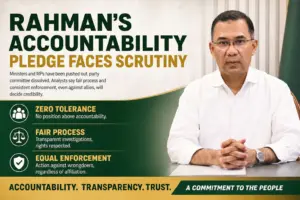
A wave of high-profile resignations, party purges, and even a traffic fine issued to a cabinet minister’s official vehicle signal that Prime Minister Tarique Rahman’s government is eager to project an image that ‘no one is above the law.’ However, political analysts and civil society leaders caution that the government’s tough stance will only carry weight if it is applied consistently and transparently over the long term.
Upon returning to Bangladesh on December 25, Tarique Rahman promised political tolerance, a corruption-free nation, and a zero-tolerance policy against extortion and misconduct. Eight months into his administration, a series of dismissals and disciplinary measures suggests an effort to convince the public that his pledge is genuine.
Recent Scandals and High-Level Resignations
The most recent fallout involves Ishrak Hossain, the MP for Dhaka-6 and State Minister for Liberation War Affairs. Hossain took part in an anti-drug raid in Dhaka’s Gendaria neighborhood, where he and several companions were filmed holding firearms. As videos circulated rapidly on social media, intense debate erupted regarding vigilante action and the proper role of elected officials in law enforcement. Following a direct directive from the Prime Minister, Hossain announced his resignation.
Hossain is not an isolated case. Ferdousi Ahmed Mishty, a BNP MP in a reserved women’s seat, stepped down following allegations of her involvement in an attack, vandalism, looting, and an attempted takeover of the Radda Maternal and Child Health Centre in Mirpur. The scandal prompted the ruling party to dissolve several organizational units, including its Dhaka North city committee, and discipline local leaders. Elsewhere, Information Minister Zahir Uddin Swapan has departed, and Dipen Dewan, Minister for Chittagong Hill Tracts Affairs, resigned on June 1 citing health reasons after just three and a half months in office.
‘One Rule for All’
The government has aggressively publicized other enforcement measures as proof of equal application of the law. In a notable instance, a vehicle belonging to Civil Aviation and Tourism Minister M Rashiduzzaman Millat was fined and cited for driving on the wrong side of the road- an episode framed as evidence that ministers face the exact same traffic regulations as ordinary citizens.
Prime Minister Rahman has also personally led unscheduled spot checks on public services. During visits to schools, hospitals, and government offices in the capital, he personally ordered action against a doctor caught smoking on duty at the Bangladesh Shishu Hospital and Institute in Agargaon.
Reiterating the party’s official stance, BNP Acting Secretary General Ruhul Kabir Rizvi warned: ‘The party will not spare anyone who uses its name to commit misdeeds or breach discipline.’
Democratic Progress vs. Executive Arbitrariness
Distinguished observers, including Prof. Anwarullah Chowdhury, former Vice-Chancellor of Dhaka University, have welcomed the moves, stating that accountability is essential in a civilized, humane, and liberal democracy.
However, political analysts point to a critical nuance. While swift resignations and overnight committee dissolutions create an impression of decisive leadership, they risk appearing arbitrary if carried out without due process.
The Real Test: Process, Parity, and Persistence
For international observers, the true test of Bangladesh’s anti-corruption and rule-of-law drive lies not in rapid public removals, but in establishing institutional norms.
A genuine ‘zero-tolerance’ policy requires three key elements:
Due Process: Ensuring accused individuals receive fair hearings, transparent investigations, and proper legal proceedings rather than summary dismissals.
Universal Application: Applying the exact same standard across the board- from grassroot party workers to senior cabinet ministers and top bureaucrats.
Institutional Continuity: Maintaining this strict oversight even when powerful political allies are involved and public attention wanes.
Whether these steps represent the dawn of a transparent administrative culture or merely a temporary public relations exercise remains the critical question facing Bangladesh today.
############################

Asif Shawkat Kallol:
Asif Shawkat Kallol is the Head of News at Germany-based online newspaper Mirror Asia and a contributing writer for the international press agency Pressenza. With more than 25 years of experience, this journalist has worked for several of Bangladesh’s leading English-language newspapers, including New Age, Dhaka Tribune, The Daily Sun, and The Business Standard. He has a particular interest in Indigenous cultures and regularly writes on business and economic issues for both domestic and international newspapers.


