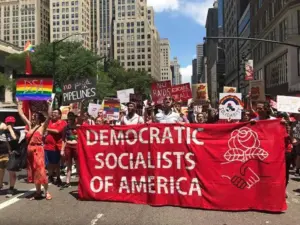
In January 2027, when those elected in early November take office, more than 100 candidates endorsed by the Democratic Socialists of America will hold office at the local, state, and national levels.
This represents significant growth, mirroring that of the organization founded in 1982 with the goal of bringing issues such as universal healthcare, affordable housing, taxation of the wealthy, environmental protection, and the promotion of labor unions into the political debate. In 2015, the DSA had about 6,000 members, but from 2016—the year Donald Trump was elected president—to the present, their numbers have grown exponentially, reaching 130,000 today. They are volunteer activists, mostly young people like the candidates they supported, leading them to victory.
Media attention has focused primarily on those elected as governors, representatives, and senators, but it is also worth noting a very interesting phenomenon at the local level: the election of socialist mayors in major cities as well as in smaller towns. Some of these cities—such as Richmond, California; Burlington, Vermont; and Irvine, California—had already elected socialist mayors in 2023, 2024, and 2025, but a real turning point came with Zohran Mamdani, who was elected mayor of New York last year, immediately followed by Katie Wilson in Seattle, Washington. This year, it was the turn of Nithya Raman in Los Angeles (California), Janeese Lewis George in Washington, DC, David Morales in Providence, Rhode Island, and Yousef Rabhi in Ann Arbor, Michigan.
Zohran Mamdani set the standard for addressing social issues related to people’s daily lives (affordable housing and childcare, rent freezes, taxation of the wealthy, etc.) and the overall vision of a city that is affordable for its residents, without neglecting more “controversial” issues such as denouncing ICE’s brutality against immigrants and Israel’s genocide in Gaza—issues later taken up by many of the candidates who were subsequently elected. His campaign strategy also served as a model—one based on the dynamic and skillful use of social media, door-to-door canvassing, deep roots in neighborhoods, support from social movements and grassroots organizations, and the dedication of volunteers—all in stark contrast to the millions spent by opponents on aggressive, if not disparaging, television ads.
Mamdani has continued on the same path throughout this year, guided by a clear vision: a politician—and above all, a mayor—must focus on improving the lives of his fellow citizens, and for this reason, no initiative is too small, whether it involves fixing 200,000 potholes on New York City’s streets or implementing a rent freeze, or even opening a senior center, a neighborhood store offering healthy food at affordable prices, or a playground for children. Only in this way—by starting with basic needs—can we restore people’s trust in their representatives and in the possibility of bringing about change.
The new mayors have an excellent model to follow and, we hope, to build upon.