Part of “A Violence Too Large to See” — Exploring how Mexico’s reduction of poverty and its new development strategy raise fundamental questions about economic distribution, structural violence, and the possibility of organizing economies around human well-being.
Mexico arrives at the APEC Summit in China with an economic experience that deserves international attention. Between 2018 and 2024, 13.4 million Mexicans moved out of multidimensional poverty, according to official statistics. This achievement raises a fundamental question for the international community: Should economic policies be organized not just to generate wealth, but to intentionally and systematically reduce poverty and economic insecurity? While China has demonstrated the enormous potential of sustained poverty reduction over several decades, Mexico’s recent experience offers another example of how public policy can influence the distribution of economic benefits.
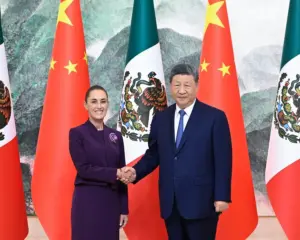
Against this background, Mexican President Claudia Sheinbaum presented Plan México on November 17 at the APEC CEO Summit 2026 in Shenzhen, China, before an international audience of business leaders from across the Asia-Pacific region.
Her presentation went beyond a conventional invitation to foreign investors. She outlined a national development strategy seeking to strengthen domestic production, expand infrastructure, develop technological capabilities, attract productive investment, and connect economic growth with social well-being.
Sheinbaum summarized the philosophy behind the initiative in a statement that challenges a longstanding assumption about economic development: “The economy at the service of the people, and not the people at the service of the economy.”
From Poverty Reduction to Economic Development
Mexico’s recent poverty reduction did not happen in isolation. Beginning in 2018, under President Andrés Manuel López Obrador, the country introduced policies emphasizing increases in the minimum wage, expanded social programs, public investment, and greater support for lower-income households.
According to Mexico’s National Institute of Statistics and Geography (INEGI), the proportion of people living in multidimensional poverty declined from 41.9% in 2018 to 29.6% in 2024. In absolute numbers, the population experiencing poverty fell from approximately 51.9 million to 38.5 million.
These figures represent an important social achievement, although substantial challenges remain in healthcare, social security, regional inequality, and access to essential services.
The question now confronting Mexico is whether these gains can be sustained and expanded through changes in the country’s productive and economic structures. This is where Plan México enters the picture.
Rather than relying exclusively on social assistance to reduce poverty, the strategy seeks to strengthen domestic industry, expand infrastructure, encourage technological development, and create conditions for better employment and greater economic participation. The underlying ambition is to connect the production of wealth more directly with its distribution throughout society.
Why Present Plan Mexico in China?
The decision to present Mexico’s economic strategy in Shenzhen carries significance beyond the summit itself. Mexico occupies a particular position in the international economy. Its manufacturing sector is deeply integrated with the United States, which remains its principal trading partner. At the same time, global economic relationships are being reshaped by trade tensions, technological competition, and the reorganization of international supply chains.
For Mexico, strengthening its economic position requires attracting investment while developing greater domestic productive capacity and reducing vulnerabilities associated with dependence on external markets.
China offers an important setting for this discussion. Over several decades, it has combined industrial expansion, infrastructure development, technological advancement, and large-scale poverty reduction.
Mexico and China have different political and economic structures, and their developmental experiences cannot be directly equated. Nevertheless, both raise questions about the role of public policy in directing investment, developing productive capacity, and improving living conditions.
Sheinbaum’s participation in APEC also places Mexico’s development strategy before business leaders and governments from across the Pacific, opening opportunities for investment, technological cooperation, and new economic partnerships. At a moment when economic competition increasingly shapes international relations, Mexico is attempting to strengthen its own development strategy while maintaining relationships with different global economic powers.
What Does Plan Mexico Propose?
Plan México combines public, private, and mixed investment with a national strategy for industrial and social development. At the APEC CEO Summit, Sheinbaum outlined five guiding principles: shared prosperity, energy and food sovereignty, infrastructure investment, incentives for private investment, and environmental responsibility.
The government envisions approximately $432 billion in public, private, and mixed infrastructure investment between 2024 and 2030, including transportation, energy, water, housing, and other strategic sectors.
The strategy also seeks to strengthen domestic manufacturing, increase the value added within Mexico’s economy, develop scientific and technological capabilities, and support new productive centers across different regions.
But investment alone does not guarantee equitable development. A country can attract billions of dollars in capital while leaving much of its population economically insecure. Large corporations can expand, exports can increase, and financial markets can prosper without necessarily transforming the living conditions of ordinary people. The challenge for Plan México will be whether its investments strengthen local businesses, create quality employment, increase economic participation, and distribute the benefits of development more broadly.
Economic Growth Is Not the Same as Economic Security
The experience of Mexico invites us to reconsider how economic success is measured. For decades, economic performance has been evaluated primarily through indicators such as GDP growth, investment flows, exports, productivity, and corporate profitability. These indicators provide important information, but they do not tell us whether people can afford housing, obtain healthcare, raise their children, access education, or live without the permanent fear of losing their means of existence.
This is one of the less visible dimensions of economic violence.
Economic insecurity is not always the result of an absence of wealth. It can also emerge from the ways wealth, resources, opportunities, and economic power are organized and distributed.
Mexico’s recent poverty reduction demonstrates that public policies can make a measurable difference in people’s lives. However, reducing poverty through wages and social programs is not necessarily the same as transforming the economic structures that reproduce insecurity. Whether Plan México can help bridge that gap remains an open question.
An Economic Question for the International Community
Mexico’s recent experience shows that governments can make deliberate choices that reduce poverty. Plan Mexico raises a further question. Can Mexico build on those gains by changing the conditions that keep people economically insecure?
The answer will emerge in people’s daily lives. Will more workers earn enough to support their families? Will losing a job or falling ill be less likely to cost someone their home? Will more people have the freedom to decide what work they do, where they live, or how they care for their families without putting their livelihoods at risk?
These questions reach well beyond Mexico. At APEC, governments and business leaders discuss where investment will flow, how supply chains will change, and who will benefit from new technologies. Those decisions also shape who has access to secure work and who bears the costs when industries move or jobs disappear. One of the less visible forms of economic violence is the insecurity people live with when decisions made far from their communities can suddenly take away their means of living.
Sheinbaum’s call for an economy “at the service of the people” poses a challenge to the international community. What would change in the way countries invest, trade, and cooperate if they judged the success of those decisions by whether more people gained the security and freedom to shape their own lives?