“I am because you are. I am because we are” (Ubuntu)
Brazil was waking up to celebrations of Lula’s victory in the presidential election. I leave the vast metropolis of São Paulo behind as I drive along the highway toward the Atlantic coast in search of a hidden treasure: the state public school Parque dos Sonhos, which in 2025 received the award for Best School in the World in the “Overcoming Adversity” category.
After an hour and a half on the road, I arrive at the entrance to Cubatão, a hub of the steel industry, located just 12 kilometers from the Port of Santos, the largest in Latin America. There, I am met by Regis Marques, a young educator who has served as the school’s principal since 2016.
“That was the year things began to change,” he says. “I brought with me courage, an open ear, and a deeply humanistic vision.”

I convey to you the fraternal embrace of many friends from Latin America and around the world, who hope to learn more about this experience firsthand. You enthusiastically share the story of a decade of educational transformation, as you lead efforts toward the outskirts of this region marked by social vulnerability—a result of rapid urbanization, infrastructure problems, a lack of government presence, and the precarious state of basic services.
Between 2013 and 2017, the school was known as “Nightmare Park” or “Terror Park” due to the intense violence both inside and outside its walls, with high rates of vandalism and truancy: in its first four years, enrollment plummeted from 637 to 116 students. It was a painful process of dehumanization.
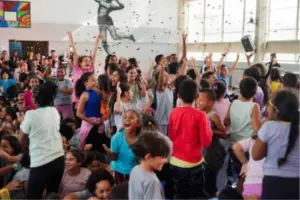
We arrived at the Bolsão 9 neighborhood—now known as Jardín Real—passing through some newly opened streets lined with modest homes. There, in the heart of this neighborhood, stand two parallel three-story buildings with safe recreational spaces, where an educational community lives together joyfully and confidently, dreaming and transforming itself, grounded in respect, empathy, healthy coexistence, and the appreciation of differences.

This 2026 school year, the school began with nearly 1,200 students, almost 100 teachers, 32 classrooms for comprehensive education, and 6 for evening classes, offering early childhood, elementary, and secondary education all at the same time and in the same location. But the school’s story goes far beyond the numbers, Regis adds; schools are measured by their metrics and not by the people who build them day by day.
The first step was to listen to the students, teachers, and community. The administration then set a bold and ambitious goal: to become the best school in the state of São Paulo within five years. By the end of 2019, the principal told the community: “Parque dos Sonhos is already the best school in São Paulo.” Our purpose is clear: to strengthen the school as an environment where every student feels included, valued, and recognized.
I speak with Roxana, the assistant principal, who recalls the campaign in the streets and neighborhoods to bring children and young people back to school. She highlights the “School Comes to Your Home” project, designed to bring the teaching staff closer to the students’ social reality and strengthen dialogue with the community.
María, an 8th-grade student of African descent, guides me through the entire school to show me its spaces and the activities of daily life. I’m struck by the painted doors of each classroom, which tell the stories of people who fought for a better world: Silo, Milagro Salas, José Mujica, Marlene Franco, among others.


The beautiful library or the special education resource room.

Currently, more than 28 extracurricular projects are underway in the areas of sports, culture, and social activities.

Over the course of a decade, the school became a place of welcome, community, and human development: “Here, we believe that academic excellence is only possible when there is respect, empathy, a sense of belonging, and a commitment to nonviolence and a culture of peace.”
The Parque dos Sonhos School has established itself as a global leader in the development of a humanistic, inclusive education capable of inspiring students, educators, and communities around the world.
References:
Notícias do Parque. Parque dos Sonhos State School. Cubatão, June 2026.
Regis Marques Ribeiro. (2026) Turning Nightmares into Dreams. A Story of Overcoming Adversity, Resilience, and Affection. pp. 186–204. In: There Is Still a Future. Educational Stories for Peace and Nonviolence. Carlos
Crespo and Fredy Figueroa (Editors). Quito, September 2026.
Regis Marques Ribeiro. When School Becomes Hope, Dreams Bloom. Cuadernos de Pedagogía. No. 578, September 2026.