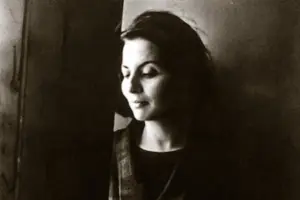
More than three decades after her death, Peruvian poet Julia Ferrer (1925–1995) is gaining renewed recognition. A newly published collection of her poetry and an upcoming discussion at the Hay Festival, in the city of Arequipa, on Sunday, November 8th, are bringing attention to a writer whose work remained largely and unfairly overlooked for decades.
By Sol Pozzi-Escot
An unexpected but necessary “comeback”
For Julia Ferrer, artistic freedom began with her own name. Born María Julia Victoria del Solar Bardelli in Lima in 1925, she would eventually become known by a surname whose origins remain uncertain. That sense of independence would come to define a poetic voice that resisted convention, classification, and the expectations of her time.
Not only was she a poet, but she also excelled as an actress, educator, translator and librarian. She was as free as her poetic style. Never settling for any canon or dogma, she created some of the most daring and innovative poems of her time.
She published Images, just because (Imágenes porque sí) in 1958 and The forgotten lesson of forgotten things (La olvidada lección de cosas olvidadas) in 1966. However, the limited circulation of her books meant that her poetry remained largely unknown to a wider readership.
Translator Carlos Lara undertook the considerable task of bringing Ferrer’s poetry to English-speaking readers. First comes Ferrer’s original poem, followed by Lara’s translation.
La puerta estaba abierta yo la miré y estaba
y me seguí de largo
la puerta está entornada y me acerqué y estaba
me quedé vacilando
la puerta estaba cerrada y la empujé y estaba
volví sobre mis pasos.
lima – septiembre ‘48
the door was open I saw it it was there
and I kept going
the door was ajar I approached it it was there
I hesitated
the door is closed I pushed it it was there
I retraced my steps
lima – september ’48
Of course, the question of how much of a poem can survive translation deserves an article of its own.
Let’s look at another example, from Imágenes porque sí (1958):
Encima de los pétalos dormidos mis caricias vacilan tocarlos es profanar su sueño
pero cuando los miro ya caídos cadáveres que oscilan
me inclino los beso
lima – marzo ‘42
Now, in English:
above the drowsing petals my caress wavers a touch would desecrate their dreaming
but when I see them once they’ve fallen the quivering little corpses
I deign to kiss them
lima – march ’42
2026: A Year of Rediscovery
Thirty-one years after Julia Ferrer’s death, her poetry is reaching a new generation of readers. In July 2026, Peruvian publisher Pesopluma released En la orilla de todos los sueños. Poesía reunida (On the Shore of All Dreams: Collected Poetry), a volume compiled by poet and researcher Paul Guillén, with a foreword by acclaimed Peruvian poet Tilsa Otta.
The publication brings together Ferrer’s two poetry collections, Imágenes porque sí (1958) and La olvidada lección de cosas olvidadas (1966), alongside previously scattered poems, textual variants, and critical studies. Both books had long been out of print, making much of her work difficult to access. The new edition offers readers a more comprehensive understanding of her literary universe, characterized by imaginative freedom, unconventional imagery, and a striking exploration of desire, nature, and human existence.
The book was presented on July 2 at the Cultural Center of the Pontifical Catholic University of Peru in Lima, with the participation of María Belén Milla, Paul Guillén, and Ximena López Bustamante.
During the discussion, López Bustamante highlighted Ferrer’s originality, particularly her portrayal of nature as a living reality of which human beings form an inseparable part. She also questioned the notion that the poet was being rescued from oblivion.
“Julia Ferrer has not returned. In reality, she never left. We were the ones who had not yet learned where to look, where her poetry had been patiently waiting for us,” she observed.
In October, another presentation took place at the historic headquarters of the National Library of Peru, where Ferrer herself had worked for several years. The occasion carried particular symbolic significance: her poetry was returning to an institution that had once been part of her everyday life.
Yet the renewed interest in Ferrer’s work raises a broader question. If her poetry was so original, why did it take so long for her to receive wider recognition?

Two Poets, Two Different Destinies
The question becomes particularly revealing when Ferrer’s trajectory is compared with that of Blanca Varela (1926–2009), one of the most celebrated figures in twentieth-century Peruvian poetry.
Both women belonged to the same literary generation, lived through a period of profound artistic transformation, and developed poetic voices that challenged conventional representations of femininity. Yet their careers followed remarkably different paths.
Varela gradually achieved international recognition, becoming an established figure in the Latin American literary canon. Ferrer, meanwhile, remained largely absent from anthologies and critical discussions, despite the originality of her work.
Their poetry also reveals contrasting artistic approaches. While Varela’s writing is often associated with a rigorous economy of language, existential questioning, and an unsentimental examination of human experience, Ferrer’s verses embrace unexpected associations, playful experimentation, and images that transform seemingly ordinary experiences into something mysterious or unsettling.
These differences do not necessarily imply a hierarchy of literary value. Rather, they demonstrate the diversity of poetic expression within a generation that is frequently remembered through only a handful of prominent names.
Ahead of the discussion at the Hay Festival Arequipa, Peruvian poet, novelist, and screenwriter Giovanna Pollarolo reflected in an interview on why two writers from the same generation experienced such different levels of recognition.
“Those who belong to the canon are not necessarily the best,” she explained.
According to Pollarolo, literary recognition depends on factors that extend far beyond the quality of an author’s work. Publishing opportunities, critical reception, anthologies, and intellectual networks all influence which writers are remembered and which remain on the margins.
In this sense, the literary canon is neither neutral nor definitive. It is shaped by cultural institutions and historical circumstances, and remains open to revision by successive generations of readers and scholars.
Pollarolo also identifies a shared resistance to conformity in the work of Ferrer and Varela, particularly in their rejection of the roles traditionally assigned to women. Despite their different poetic languages, both asserted their creative independence in a society where women’s intellectual and artistic ambitions faced considerable obstacles.
Their contrasting reputations therefore raise an uncomfortable question: how many other writers have been excluded from literary history, not because their work lacked significance, but because the institutions responsible for preserving it failed to recognize its value?
The renewed attention surrounding Julia Ferrer does not diminish Blanca Varela’s achievements. Instead, it invites readers to reconsider the richness and diversity of a literary generation whose history remains, in many ways, unfinished.
A Memory Preserved Beyond Books
Julia Ferrer died in 1995, but her memory endured beyond literary institutions, preserved through personal relationships and the affection of those who had known her.
One of those people was Cecilia Noriega, a close friend of Ferrer who was born nearly four decades after the poet. Despite their generational difference, the two developed a friendship that would outlive Ferrer herself. Books, photographs, and conversations kept the poet’s presence alive in Noriega’s family home.
An old mannequin, elegantly dressed and adorned with jewelry, was even placed beside a window as a tribute to Ferrer. Over time, the figure became a symbolic representation of the poet, silently watching the world outside.
Such intimate gestures reveal another dimension of literary memory. Literature survives not only through critics, libraries, and academic institutions, but also through affection, personal recollections, and the connections that endure across generations.
While Ferrer’s name remained relatively obscure in official literary history, her memory continued to live on in the private lives of those who had known her.

Poetry Beyond Time
Julia Ferrer’s rediscovery ultimately raises questions that extend beyond literary recognition.
Her story illustrates how literary history is constantly being rewritten. Reputations change, cultural hierarchies evolve, and works once pushed to the margins may acquire new significance for later generations.
In 2026, Ferrer’s poetry is once again inspiring discussions, readings, and reflections on women’s place in Peruvian literature.
The poet whose memory endured for decades through personal relationships and family recollections is now reaching readers far beyond those intimate circles, finding a new place in Peru’s cultural consciousness.
Literary prizes and public recognition may eventually fade from memory. But a poem capable of moving someone decades after it was written possesses a power that time itself cannot erase.
Sol Pozzi-Escot writes for the culture section of the newspaper *Expreso*. He is the director of communications for the Ibero-American Foundation for the Arts. He has served as editor and director of *Contrapor* and has been published in media outlets such as *La República* and *Lima Gris*. He is the author of the book *Prueba de Coraje: Conversar en el Perú*, published in 2024.