By Mynul Hasan Sohel (Dhaka Bureau)
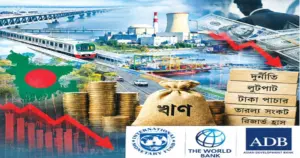
Following a decade and a half of authoritarian rule, the autocratic Awami League government was ousted on August 5, 2024, through a mass uprising led by students and citizens. Over its 15-year tenure, widespread irregularities, corruption, bank looting, loan fraud, and the laundering of thousands of crores of taka abroad plunged the country’s economy into a deep crisis. Embezzlement of funds through inflated costs in mega-projects such as the Padma Bridge, Metrorail, Rooppur Nuclear Power Plant, and others triggered liquidity crises in the banking sector, depleted foreign exchange reserves, and fueled high inflation. International partners, including the World Bank, the International Monetary Fund (IMF), and the US Treasury Department, have explicitly stated that the current administration inherited this fragile economic state. A recent IMF report forecasted that the country’s Gross Domestic Product (GDP) growth would further decline to 3.2 percent, with the World Bank and the Asian Development Bank (ADB) expressing similar concerns.
The current economic landscape is plagued by investment droughts, stagnation in import-export trade, and a waning interest among SME entrepreneurs, bringing overall economic activity to a standstill. In particular, the real estate sector- one of the country’s largest employment generators- along with nearly 300 linkage industries, is severely distressed. High tax policies, elevated bank interest rates, and soaring construction material prices have caused flat sales to plummet by 65 to 70 percent, threatening the livelihoods and employment of nearly 5 million people. Meanwhile, skyrocketing commodity prices have drastically reduced the purchasing power of ordinary citizens. Consequently, workers, farmers, and business owners across the country have taken to the streets, staging roadblocks and protests over various demands, while remnants and underground factions of the banned Awami League are reportedly attempting to instigate some of these demonstrations.
Addressing the situation, Professor Dr. Rashed Al Mahmud Titumir, the Prime Minister’s Adviser on Finance and Planning, stated that the current government is not sweeping problems under the rug but is instead tackling them through transparency and accountability. He noted that international partners have confidence in the government’s strategies to cope with the pressures of fuel and commodity price hikes. However, Professor Abu Ahmed, Chairman of the Investment Corporation of Bangladesh and a prominent economist, warned that the country has already fallen into a debt trap, emphasizing the urgent need for bold steps to boost GDP growth and control inflation. On the other hand, Dr. Mustafa K. Mujeri, former Director General of the Bangladesh Institute of Development Studies (BIDS), remarked that failing to handle the situation skillfully could lead to catastrophic outcomes. He underscored the necessity of increasing government revenue, halting new borrowing for non-productive sectors (such as public servant salary increments), and strictly curbing corruption and miss expenditure. Sociologists and academics point out that unemployment and inflation are driving up crime rates, urging the government to immediately implement employment-oriented and timely initiatives to normalize public life and dynamicize the economy.

Mynul Hasan Sohel: Special Correspondent, The Daily Inqilab and Executive Editor (Honorary) Pressenza- Dhaka Bureau.