The nation is set to participate in the much-anticipated 13th National Parliamentary Election today, amidst a festive atmosphere. This marks Bangladesh’s first democratic exercise since the fall of Sheikh Hasina’s 15-year regime. Today, Thursday, nearly 130 million voters are exercising their franchise in a landmark general election and a concurrent national referendum.
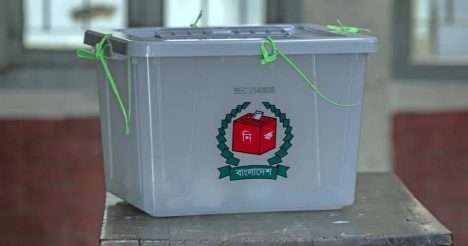
Every voter will exercise their right to vote today at this ballot box.
Global analysts view this ‘dual-vote’ on February 12 as a ‘Democratic Reset’ for the South Asian nation. Voters are simultaneously electing representatives for 300 parliamentary seats and casting their ballots on the ‘July National Charter’- a framework of sweeping constitutional reforms designed to prevent the resurgence of autocracy.
Since the official end of campaigning early Tuesday, a celebratory yet tense atmosphere has prevailed across the country. Millions have left the capital, Dhaka, returning to their ancestral villages to establish their voting rights, resulting in massive crowds at bus terminals, railway stations, and launch terminals. At Dhaka’s Kamalapur Railway Station, a young voter remarked, ‘This isn’t just an election; it’s an opportunity to build our future.’
According to the Election Commission (EC), the total number of voters stands at 127,695,183. Of them, 64,814,907 are male, 62,879,042 are female, and 1,234 identify as the third gender. A total of 1,981 candidates are contesting in this election.
To ensure a ‘free, fair, and participatory’ process, the interim government led by Nobel Laureate Dr. Muhammad Yunus has deployed nearly one million security personnel, including 100,000 army troops. On the eve of the polls, Home Affairs Adviser Lt. Gen. (Retd.) Jahangir Alam Chowdhury issued a stern warning- ‘Immediate and severe action will be taken against any officials or individuals involved in ballot snatching, proxy voting, or any irregularities.’
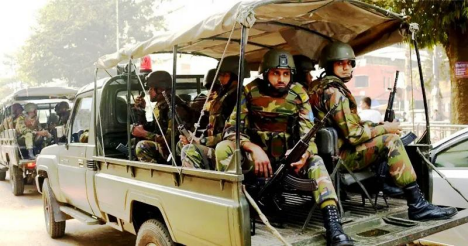
In order to ensure peaceful voting, law enforcement agencies and the army have intensified patrols across the country. Photo – Collected.
The transparency of the entire electoral process is under the close scrutiny of the international community. Currently, 394 international observers from the Commonwealth, the European Union, and various NGOs, along with 197 foreign journalists, are stationed in Dhaka. Chief Election Commissioner (CEC) A.M.M. Nasir Uddin emphasized that the true picture of the election would be reflected in the reports of these international observers.
In the altered political landscape, the Bangladesh Nationalist Party (BNP) and Jamaat-e-Islami have emerged as the primary contenders leading their respective alliances. Other participants include the Jatiya Party and the newly formed National Citizen Party (NCP), which represents the leadership of the 2024 student uprising. Notably, the Bangladesh Awami League is absent from the ballot due to the suspension of its registration following the political transition.
Speaking to the International Press Agency Pressenza on Wednesday, eminent political analyst and former Vice-Chancellor of Dhaka University, Professor Dr. Anwarullah Chowdhury, said, `The current electoral climate suggests there is little scope for a landslide victory by any single party. A free political environment has allowed all candidates to reach voters with their plans and proposals.’
Another political analyst, Professor Dr. S.M. Ali Reza of Dhaka University, noted that according to various surveys, about 30 percent of voters remain undecided. `These floating or undecided voters will play a decisive role in determining the final result,’ he said. He further observed that many citizens might prefer a strong opposition in Parliament to strengthen democracy and ensure accountability.
Despite the high expectations of the Election Commission, the pre-election period was not entirely without incident. On the day before the polls, police detained a leader of the Thakurgaon District Jamaat at Saidpur Airport with 7.4 million BDT in cash, sparking allegations of attempted vote-buying. Reports of intimidation have also surfaced on social media in some areas, though the EC has dismissed these as `isolated incidents’ and promised swift action.
In a televised address to the nation ahead of the polls, Chief Adviser Dr. Muhammad Yunus urged citizens to prioritize the `greater national interest’ over personal or partisan gains. Dr. Yunus stated, ‘Winning is a part of democracy, but defeat is also its inseparable truth. Whatever the result, let the spirit of the July Uprising be the guide in determining our collective destiny.’
Voting will commence simultaneously across 42,779 centers today, Thursday, starting at 7:30 AM local time. Initial trends and results for both the parliamentary seats and the referendum are expected to arrive starting late tonight.