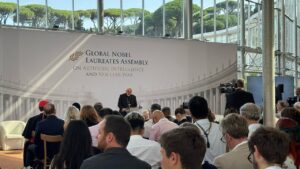
More than 200 Nobel laureates, scientists, diplomats, technology experts, religious leaders and peace advocates gathered this week in Rome to confront what many participants described as the defining challenge of our time: ensuring that artificial intelligence serves humanity rather than accelerating the risks of war, particularly nuclear war. The three-day Global Nobel Laureates Assembly on Artificial Intelligence and Nuclear War, held from July 14 to 16, concluded with the adoption of the Rome Declaration for an Unarmed and Disarming Peace in the Age of Artificial Intelligence, Nuclear and Autonomous Weapons, New Digital Protocols, and Emerging Models of Digital Development. (Vatican News)
Hosted at Borgo Laudato Si’ in Castel Gandolfo before concluding on Rome’s Capitoline Hill, the Assembly was inspired by Pope Leo XIV’s call for an ethical framework to guide the rapid development of artificial intelligence. Participants argued that AI has become much more than a technological innovation; it now represents a profound political, cultural and ethical challenge that will shape international relations for generations. (Angelus News – Multimedia Catholic News)
The Declaration recognizes that humanity faces an unprecedented convergence of transformative technologies and destructive military capabilities. While artificial intelligence promises enormous benefits in medicine, education, scientific discovery and environmental protection, its incorporation into military systems—including autonomous weapons and nuclear command-and-control structures—could dramatically increase the danger of unintended conflict.
Among its central principles, the Rome Declaration insists that decisions involving the use of lethal force, and especially nuclear weapons, must never be delegated entirely to machines. It calls for meaningful human control over AI systems, renewed international cooperation on nuclear disarmament, stronger governance of emerging technologies, and a development model centered on human dignity rather than geopolitical competition. (Vatican News)
Although many international declarations have warned about either nuclear weapons or artificial intelligence separately, this gathering emphasized that the two issues have now become inseparable. AI is increasingly capable of processing military intelligence, accelerating battlefield decisions and operating autonomous systems at speeds beyond human reaction. In a nuclear crisis, even a small error, miscalculation or cyber manipulation could have catastrophic consequences.
The Assembly therefore framed the challenge not simply as regulating new technology, but as redefining humanity’s relationship with technology itself. Participants argued that scientific progress must remain subordinate to ethical responsibility and the common good.
The Rome Declaration also arrives at a moment when governments around the world are investing heavily in military applications of artificial intelligence while international arms-control agreements continue to weaken. Existing nuclear doctrines were developed in an era when human decision-makers retained greater time to assess crises. Artificial intelligence may compress those decision windows to seconds, increasing pressure to automate responses that could determine the fate of millions.
For peace advocates, the Assembly represents an important continuation of a tradition dating back to the 1955 Mainau Declaration, when Nobel laureates first warned humanity about the existential dangers of nuclear weapons. More recently, Nobel laureates have renewed those concerns through declarations on nuclear risks and the governance of emerging technologies. The Rome Declaration extends that legacy by recognizing that safeguarding peace in the twenty-first century requires confronting both nuclear weapons and artificial intelligence as interconnected global challenges. (Wikipedia)
Yet perhaps the Declaration’s most significant contribution lies beyond its specific recommendations. It suggests that the governance of artificial intelligence cannot be reduced to technical regulation alone. Behind every algorithm, every autonomous system and every military application remain profoundly human decisions about values, responsibility and the kind of civilization we wish to build.
Whether the Rome Declaration will influence governments remains uncertain. But its message is unmistakable: humanity has reached a point where technological innovation without ethical direction may become one of the greatest threats to peace. If artificial intelligence is to become one of history’s greatest achievements, the Assembly argues, it must first remain firmly under human responsibility and be guided by the principles of cooperation, dignity and the preservation of life.
Related information
- Global Nobel Laureates Assembly: https://globalnobelassembly.org
- Vatican News coverage of the Rome Declaration.
- Full text of the Rome Declaration (when publicly released).