Minimal democracy, maximum economic power, and a region dragged between the far right, social frustration, Indigenous peoples, and the new empires
“When a democracy needs only half a point to govern one hundred percent of a fractured country, perhaps we are not facing a victory, but a crack wearing a presidential sash.”
“South American democracy still counts votes, but increasingly manages absences: around 25% to 30% of the electorate does not participate, and another 3% to 8% nullifies or leaves its vote blank. Then, with half the country tired, the other half outraged, and a decisive minority tipping the balance, people solemnly speak of a popular mandate…”
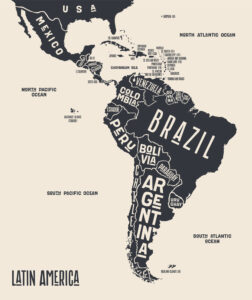
South America has entered a dangerous stage: not because it has stopped voting, but because it votes as if tossing a coin into the air over a country on fire. Colombia, Peru, Bolivia, Ecuador, Argentina, Chile, and Brazil show, with different nuances, the same political disease: societies split almost into exact halves, elections won by minimal margins, weakened institutions, accumulated rage, and an economic power that rarely appears on the ballot, but almost always ends up sitting at the table where the real decisions are made. Democracy continues to function on the surface, but underneath it inequality, fear, frustration, crime, debt, extractivism, and abandonment are cracking.
“The vote is still free, but many times it reaches the ballot box escorted by hunger, rage, and television.”
The advance of the far right in the region cannot be explained by ideology alone. It is also born from manufactured ignorance, educational failure, fear of crime, exhaustion with corruption, and a left that often promised dignity but administered bureaucracy, caudillismo, or nostalgia. Millions of citizens do not necessarily vote out of love for the iron fist; they vote because they feel that no one has listened to them for decades. There the authoritarian discourse enters with a simple offer: immediate order, a visible enemy, a large prison, a closed border, and a wounded homeland. It is an old recipe, but in times of despair the old often presents itself as modernity.
“The iron fist always arrives late, but it campaigns as if it had invented justice.”
The tragedy is that these narrow votes do not produce agreements, but trenches. Winning by one, two, or three points in broken societies does not deliver a historic mandate; it delivers a provisional administration of the half that won over the half that was left resentful. Colombia shows a deep division between security and social reform. Peru lives in an almost permanent institutional crisis, where the presidency seems more like a transit post than national leadership. Bolivia carries blockades, Indigenous fractures, disputes over resources, and a social tension that threatens to become a greater rupture. Chile oscillates between promises of order and fear of change. Ecuador faces violence, repression, and territorial decomposition.
“In South America, winning an election no longer means uniting a country; many times it means managing the anger of the other half.”
The conflict with Indigenous peoples runs through this crisis like an old wound that never closed. Lithium, copper, water, gas, the jungle, salt flats, ports, and the roads of the future often pass through territories where communities live that were not invited to the design of progress. They are asked for sacrifice in the name of the energy transition, patience in the name of investment, silence in the name of growth, and discipline in the name of the homeland. But when they protest, they appear as an obstacle, backwardness, or threat. South American modernity has an elegant habit: it calls development what it extracts from the land of others.
“Progress always speaks in the future tense, but it usually collects its bills in territories that have memory.”
The United States enters this continent transversally, not always with troops, but with banks, treaties, embassies, security, sanctions, cooperation, intelligence, financing, companies, foundations, diplomatic pressure, and a permanent gaze over its geopolitical backyard. Washington does not need to be inside every government to influence its margins of decision. It is interested in migration, drug trafficking, lithium, copper, oil, the Amazon, energy security, and the containment of China. South America may declare itself sovereign every morning, but it knows that the United States remains standing at the door, watching who enters, who leaves, and who signs with whom.
“Latin American sovereignty is usually very solemn until there is a knock at the door from Washington.”
China appears with another language: it does not preach so much; it buys more. It offers infrastructure, demands minerals, finances projects, secures supplies, looks at ports, energy, telecommunications, and production chains. Russia intervenes less through economics than through geopolitical calculation, seeking fissures in the Western order, diplomatic support, and symbols of multipolarity. The BRICS offer the region a seductive promise: not to always depend on the dollar, Washington, and traditional institutions. But it would be naïve to believe that changing creditor is equivalent to emancipation. A continent can pass from an ideological master to a financial partner without ceasing to be a cheap supplier of raw materials.
“Multipolarism can open several doors, but none guarantees that the poor will be invited into the room.”
Brazil tries to present itself as a regional leader, but leading South America in 2026 is not conducting an orchestra, but moderating a family fight with knives on the table. Its economic weight, territorial size, link with the BRICS, ambiguous relationship with Washington, and internal dispute among democracy, political evangelism, latent militarism, organized crime, and inequality make it an indispensable actor, but not necessarily a sufficient arbiter. A one-hundred-percent polarized continent does not need only leadership; it needs legitimacy, trust, and a common project. And that cannot be decreed from Brasília, Buenos Aires, Bogotá, Lima, La Paz, or Santiago.
“Being a giant in a fractured region does not always mean commanding; sometimes it means falling harder if the ground breaks.”
Toward 2030 and 2035, South America will face a brutal decision: to become a sovereign platform of food, water, energy, critical minerals, and biodiversity, or to continue being a strategic warehouse administered by internal elites and external appetites. The energy transition can enrich the region or repeat the old history of nitrate, rubber, oil, and copper: much subsoil, little industry, much export, little science, much port, little decent wage. If democracy fails to produce social mobility, security, education, justice, and a future, the far right will continue to grow not because of genius, but because of emptiness.
“When democracy does not deliver bread, security, or horizon, someone always appears selling authority as if it were destiny.”
The conclusion must be impartial, but not lukewarm. South America will not be saved by the nostalgic left or by the furious right; nor by caudillos, technocrats, military officers, enlightened businessmen, or foreign ambassadors. It will be saved if it rebuilds institutions, education, productivity, regional integration, respect for Indigenous peoples, industrial development, and a democracy that is not only about counting votes, but about distributing the future. Otherwise, 2030 and 2035 will find the continent more armed, more indebted, more polarized and dependent, once again arguing over who won by half a point while others buy its resources by the ton.
“The true failure will not be that South America votes badly; it will be that it continues voting freely in order to keep obeying the same powers as always.”
Brief Bibliography
- ECLAC — Economic Commission for Latin America and the Caribbean. Preliminary Overview of the Economies of Latin America and the Caribbean 2025.
- International IDEA. The Global State of Democracy 20