(2nd of two series)
By: Genevieve B. Kupang
Part 1: WURI Historian and BCU Dean, IRO Genevieve B. Kupang Shares Internationalization and Innovation Insights with PhilCST
These are the links to the first article, published on both Pressenza and the BCU website: a) https://www.pressenza.com/2026/07/wuri-historian-and-bcu-dean-iro-dr-genevieve-b-kupang-shares-internationalization-and-innovation-insights-with-philcst/; b) https://www.bcu.edu.ph/bcu-iro-and-wuri-historian-dr-genevieve-b-kupang-shares-internationalization-and-innovation-insights-with-philcst-participants/
Part II. Genevieve Kupang shares her experiences during Session Two, “The Power of Storytelling: Sharing Narratives through International Press Agencies and Digital Platforms.”

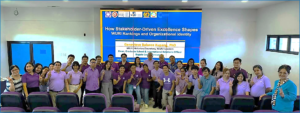
Dr. Genevieve Kupang shares her experiences during her session, “The Power of Institutional Storytelling: Sharing Narratives through International Press Agencies and Digital Platforms.
The Philippine College of Science and Technology (PhilCST) concluded its week-long In-Service Professional Development Training on July 3, 2026, with the theme “Innovating for Impact: Future-Forward SDG-Responsive Higher Education.” Genevieve Balance Kupang, the World University Rankings for Innovation (WURI) Historian, Secretary of the WUNI-Leaders, Dean of the Graduate School, and International Relations Officer of Baguio Central University, served as a resource speaker for two interlinked sessions. The first, “How Stakeholder-Driven Excellence Shapes WURI Rankings and Organizational Identity,” traced the evolution of global rankings and the Philippine HEI’s place within that story. The second part, “The Power of Institutional Storytelling: Sharing Narratives through International Press and Digital Platforms,” turned the lens inward, asking a different question: once an institution has a story worth telling, how does it reach the world?
The second session turned from WURI ranking mechanics to the deeper practice underneath it: institutional storytelling. Kupang, a regular contributor to the Baguio Central University website and the international press agency Pressenza, walked participants through how personal narratives and collective institutional achievements reach international publication and why that process matters beyond prestige. A story submitted to WURI or shared through a global press agency describes an institution. It also shares with other stakeholders local knowledge, best practices, accomplishments, and transformative programs that made an impact. In the telling, it clarifies what the institution itself values.
As a certified cultural mapper and anthropologist, Kupang offered PhilCST a direct, achievable next step: identify the significant personalities within the institution and write their stories, starting with the founder president herself, Dr. Lourdes S. Fernandez, a transformative educator, a woman visionary in Pangasinan, a religious devotee, a hotelier, an exemplary businesswoman, and coach whose life already carries the shape of a story worth telling. She is also the president of the Señor Divino Tesoro Organization since 1994. She has a doctorate in education and is very visible during calamities and Alay sa Pasko, showing her generosity and leadership outside of PhilCST. Kupang went further, suggesting that PhilCST consider nominating her for the Exceptional Woman of Peace Award, a recognition under Pathways to Peace, St. Paul, Minnesota, USA. How many lives has she touched? How many scholars has she extended a hand to and helped become the professionals they are today? These are not rhetorical questions. They are the beginning of a case worth documenting.

PhilCST College President and School Directress Dr. Lourdes S. Fernandez was celebrated by the PhilCST and MLLS Administration, Deans, faculty members, and staff on her birthday. Now 92, Dr. Fernandez continues to grace the institution she founded with her presence, a living testament to decades of visionary leadership in Philippine basic and higher education. Poster credit: PhilCST.
Kupang pointed specifically to WURI’s Category B.1, Visionary Leadership, as the natural home for such a case. The category recognizes leaders who craft and communicate a clear, inspiring vision for their institution, one that reads the evolving landscape of higher education and prepares for what comes next. Dr. Fernandez’s decades at the helm of PhilCST, building an institution from the ground up while anticipating the needs of Pangasinan’s students long before policy caught up, is precisely this kind of story. That same foresight now reaches far beyond the province: her institution draws students from as far as the Cordillera Administrative Region, where Maritime Studies is not offered, a pull that speaks to vision. It is not innovation for its own sake. It is the long, patient work of securing an institution’s relevance and survival across generations, the very definition WURI uses for visionary leadership itself.
Look next to the innovative programs and initiatives that made a real difference in Pangasinan and neighboring provinces and regions. Write an honest account of what happened and what changed. Begin building a culture of research and documentation that treats every meaningful program and every person behind it as a story worth preserving.

Innovation does not erase tradition. It builds on it. Dr. Genevieve B. Kupang offered this reflection to PhilCST faculty, a reminder that every ranking, reform, and act of institutional courage stands on ground that tradition already prepared. It is a principle she carries into every room she enters as WURI Historian, one hand honoring where an institution has been, the other pointing toward where it is going.
The Soul-Feeding Power of Appreciation in Education
She added that appreciation stories deserve the same attention. Administrators, faculty members, and personnel carry messages from students and stakeholders that reveal what made a difference in someone’s life, and those messages are worth reflecting on and sharing, not filing away. She offered her own example first. Weeks before the PhilCST training, she had served as a panelist for the dissertation defense of Mr. Jonie Wasingan Leung, a Doctor of Philosophy in Administration and Supervision candidate from Kapangan, Benguet. His study examined work-life balance and job satisfaction among Kapangan secondary teachers and closed with a framework he called the Symphony of Adaptive Equilibrium. He named it: “melody as lived experience, rhythm as the cyclical, multi-tasked nature of teaching, harmony as the tension between support and strain, dynamics as emotional intensity and resilience, and motifs as professional identity anchored in purpose.” After his defense, Dr. Kupang wrote to him:
“Sir Jonie, your Symphony of Adaptive Equilibrium is, for me, the most compelling part of your manuscript. It is a distillation of everything your research stands for. You rendered it with both intellectual precision and an artistic, spiritually grounded work… The challenge now, Sir Jonie, and I say this with full confidence in you, is to carry your recommendations beyond the pages of this manuscript and into the actual corridors of Kapangan’s secondary schools. Your participants gave you their stories. The most meaningful return you can offer them is action. Bravo, Graduand Sir Jonie. This symphony is yours. Now, go conduct and implement what needs to be implemented…”

Credit: Leung, J. W. (2026). Symphony of Adaptive Equilibrium [Figure 2]. From the dissertation Transcendental Phenomenology of Work-Life Balance and Job Satisfaction Among Kapangan Secondary Teachers. Baguio Central University. Baguio City.
Sir Jonie replied that same evening:
“Thank you very much, Ma’am Genevieve B. Kupang. I can honestly say that this is the most meaningful, humbling, and overwhelming feedback I have ever received throughout my entire academic journey. And yes, Ma’am, with God’s guidance and grace, I will do my very best to transform this research into meaningful action. I truly believe that the best way to honor the stories entrusted to me by my participants is to ensure they lead to positive change in our schools and community… Here in Kapangan, my colleagues, our community, and I would be deeply honored to welcome you anytime…”
Kupang told the PhilCST faculty that this exchange between her and Sir Jonie is the kind of message a mentor should keep in the inbox, one worth rereading again and again. It feeds the soul, and it lets the one being appreciated feel truly validated and affirmed. She pointed to the same principle at work in the opposite direction, an article in which several of her own graduate students expressed appreciation for her mentorship across instruction, research, community extension, peace advocacy, good governance, and publications (https://www.pressenza.com/2025/05/the-soul-feeding-power-of-appreciation-in-education/). Both exchanges record something a transcript cannot: that a defense, or a mentorship, is more than an evaluation. It is a moment where a scholar’s work is recognized as meaningful, and once written down, that recognition becomes evidence of what mentorship actually accomplishes.
Kupang, the speaker, then invited the participants to open their own phones and find a message worth keeping, an email, a text, a note from a student or a colleague that had stayed with them longer than the moment it arrived. Several read theirs aloud. Faculty who had spent decades in the classroom sat alongside colleagues only weeks into their appointments, and both groups leaned in with the same attention. The exercise made a simple point. Behind every diploma and every research defense is a relationship, and that relationship, once written down, becomes something others can learn from too.
Faculty members from PhilCST shared touching testimonials of appreciation from their students, proof that their mentorship had an impact on those students’ successes. One, from the College of Criminal Justice Education, was recognized by a student who passed the board examination with an impressive 89.35% rating. Another, from the College of Education, received a similar note of gratitude from her own students.

Mr. Sean Caasi Carillo, who passed the Criminologist Licensure Examination administered by the Professional Regulation Commission (exam held February 4–6, 2026, with results released March 13, 2026), takes a selfie with Ms. Laila De Guzman, a former PAMMA and now PhilCST faculty member he credited for the mentorship that carried him through his board revi
Ms. Laila De Guzman read a message from Sean Carillo, a board passer who credited her, alongside two colleagues he called Sir Jacob and Sir Bejay, for building the foundation that carried him through his review. He recalled being the only student who received one-on-one lectures from her after repeatedly asking questions back in school, and described her as being like an older sister or a mother figure to him. He wrote that the discussions they had across Forensic Science, Criminology, and Correctional Administration stayed with him well into his board review, so much so that he topped the diagnostic exam at his review center before regular review even began. He credited his parents and his girlfriend as his motivation, alongside the foundation his professors gave him.
Dr. Clarita A. Aban read a message from a student who wrote, “We really appreciate everything po kahit hindi namin laging napapakita. Thank you for being part of our journey this year. Sana makita pa rin namin kayo around the school or hopefully maging instructor namin ulit someday. Thank you so much po, Ma’am. God bless you always!” Another student echoed the same gratitude in a separate note, thanking her for the patience, support, and understanding she extended throughout the school year.

Dr. Clarita A. Aban, College of Education faculty, shares with participants a message of appreciation from her students, a quiet reminder that mentorship leaves marks long after the semester ends.
Dr. Marilyn M. Catungal, College of Education faculty


What distinguished the day was the content, the manner of delivery, kinesthetic engagements, open exchanges, inviting questions mid-session, asking participants to share their own experiences, and at one point asking everyone to bring out their phones and read aloud a line of appreciation that had stayed with them. Participants who had spent decades in the classroom sat alongside colleagues only weeks into their appointments, and both groups leaned in with the same attention. The atmosphere in the room carried something closer to admiration than mere interest, the recognition of someone speaking from lived experience rather than borrowed slides.

Dr. Ma. Ditas Fernandez, who extended the invitation to Kupang on behalf of PhilCST, expressed particular satisfaction with how the session unfolded. She observed that Kupang’s engagement with internationalization was unmistakably experience-based, interactive, and inspiring, qualities that transformed a professional development requirement into a day participants described as memorable.
The satisfaction of a resource speaker who came prepared and watched it land. After the training, three PhilCST faculty members told Genevieve Kupang, “I want to be a WURI writer too.” For a resource speaker, that is the compliment that matters most.
Photo credit: Dr. Ma. Ditas Fernandez, at Yo Kiiing Frozen Yogurt Shop, Calasiao, one of the businesses owned by Engr. Oscar F. Gironella III, grandchild of PhilCST’s founder.